

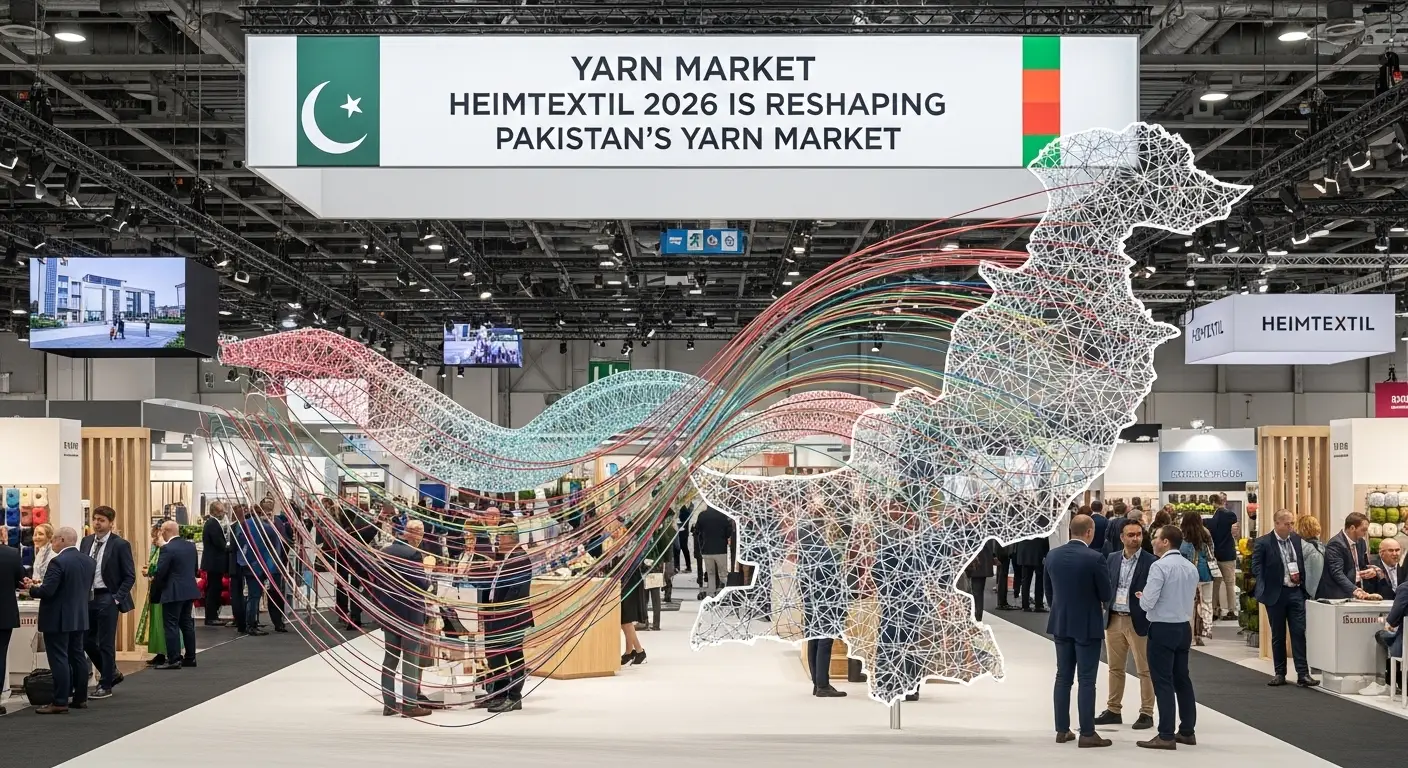
Introduction: When a Trade Fair Changes Market Dynamics
Every January, the global home textile industry descends on Frankfurt, Germany, for Heimtextil, the world’s largest trade fair for home and contract textiles. It’s where buyers meet suppliers, trends get set, and billions of dollars in orders get negotiated.
But Heimtextil 2026 is proving to be more than just another trade show. The signals emerging from Frankfurt are fundamentally reshaping how Pakistani yarn manufacturers price products, approach quality, and position themselves in global markets.
For Pakistani spinning mills, textile exporters, and yarn traders, what happened at Heimtextil 2026 represents a market inflection point. Buyer priorities have shifted. Price negotiations have intensified. Quality expectations have risen. And the entire competitive landscape is being redrawn.
This article explains exactly why Heimtextil 2026 matters so much, how it’s changing buyer behavior, what impact it’s having on Pakistan yarn market, and what Pakistani manufacturers and exporters need to do to capitalize on these shifts rather than get left behind.
Why Heimtextil 2026 Matters for the Global Textile Industry
To understand Heimtextil’s impact on Pakistan’s yarn market, you first need to grasp the event’s significance in the global textile ecosystem.
The Scale and Influence of Heimtextil
Heimtextil brings together over 2,800 exhibitors from 60+ countries and attracts 60,000+ trade visitors from around the world. This isn’t a consumer show, it’s strictly business-to-business, where:
- Hotel chains place orders for thousands of room textile sets
- Major retailers source bedding and towel collections for the year
- Interior designers discover new materials and suppliers
- Institutional buyers (hospitals, cruise lines, senior living) negotiate contracts
- Fashion brands explore home textile line extensions
The orders placed and relationships formed at Heimtextil ripple through global supply chains for months. When buyers shift preferences in Frankfurt, manufacturers worldwide feel the effects.
Why 2026 Is Different
Several factors made Heimtextil 2026 particularly impactful:
Post-pandemic market recalibration: After years of disrupted supply chains and inventory volatility, buyers are finally establishing new normal sourcing patterns rather than crisis management.
Regulatory pressure intensifying: EU sustainability regulations (ESPR, CSDDD) are now active or imminent. Buyers need suppliers who can prove compliance, not just promise it.
Economic uncertainty: Inflation concerns and cautious consumer spending make buyers more price-sensitive while simultaneously demanding better quality and sustainability, a challenging combination.
Oversupply correction: Global textile overcapacity from pandemic-era expansion is forcing price competition while buyers consolidate supplier bases.
Technology enabling transparency: Digital tools make supply chain verification easier, raising buyer expectations for traceability and data.
These converging forces created a Heimtextil 2026 where buyers arrived with very specific, non-negotiable requirements, and Pakistani yarn suppliers had to meet them or lose business.
Pakistan’s Position at Heimtextil
Pakistan typically exhibits strongly at Heimtextil, showcasing bed linens, towels, table linens, and institutional textiles. Pakistani manufacturers are known for:
- Competitive pricing on cotton-based products
- Reliable volume capacity
- Established quality in home textile categories
- Improving sustainability credentials
But Heimtextil 2026 tested whether “competitive” and “improving” were still good enough when buyer standards had fundamentally risen.
Soft CTA: Want to understand how Heimtextil buyer trends affect your sourcing strategy? Download our free Heimtextil 2026 Buyer Insights Report, analyzing key trends and their supply chain implications.
Shift in Buyer Preferences at Heimtextil 2026
The most significant outcome of Heimtextil 2026 wasn’t what buyers ordered; it was how their priorities changed what they were willing to order and from whom.
From Price-First to Value-First Thinking
Historically, many buyers approached Heimtextil with a simple question: “Who can give me the lowest price?” Pakistani suppliers often won on this basis, particularly for cotton yarn and home textiles.
Heimtextil 2026 showed a clear shift. Buyers now ask:
- “What’s your total value proposition?” (not just price)
- “Can you prove sustainability claims?” (not just make them)
- “What’s your supply chain visibility?” (not just your factory)
- “How do you ensure quality consistency?” (not just pass one audit)
- “What’s your innovation capability?” (not just current offerings)
This doesn’t mean price doesn’t matter; it absolutely does. But it means Pakistani yarn suppliers competing purely on the lowest price found themselves excluded from conversations with premium buyers who needed verified credentials alongside competitive rates.
Sustainability Moving from Nice-to-Have to Must-Have

At Heimtextil 2026, conversations about sustainability weren’t happening in dedicated “green” sections; they were everywhere. Buyers across all categories asked about:
Certifications: GOTS, OEKO-TEX, BCI, Fair Trade, not as differentiators but as baseline expectations. Suppliers without certifications faced immediate disqualification from many tenders.
Carbon footprint: Specific questions about emissions measurement, reduction targets, and renewable energy use. Vague “we’re working on it” answers didn’t satisfy buyers needing concrete data for their own ESG reporting.
Water management: Detailed inquiries about water consumption, recycling systems, and wastewater treatment. European buyers particularly scrutinized this, given water scarcity concerns.
Chemical compliance: ZDHC roadmap implementation, restricted substance lists, and testing protocols. Buyers wanted documentation, not just verbal assurances.
Pakistani suppliers with verified sustainability programs found strong interest. Those without faced skepticism and exclusion from premium segments.
Quality Consistency Trumping Spot Quality
Buyers expressed frustration with suppliers who deliver excellent samples but inconsistent bulk production. Heimtextil 2026 buyers emphasized:
Systematic quality management: ISO 9001 or equivalent systems proving quality isn’t accidental but engineered into processes.
Statistical process control: Data showing variation management and defect prevention, not just final inspection.
Third-party verification: Independent audits confirming quality claims rather than self-reporting.
Long-term track records: References from existing customers about reliability over time, not just one successful order.
Pakistani yarn manufacturers with documented quality systems and long-term buyer relationships commanded premium positioning. Those relying on spot pricing and sample quality found tougher negotiations.
Transparency as Competitive Advantage
The shift toward supply chain transparency at Heimtextil 2026 was dramatic. Buyers increasingly asked:
- “Can you trace yarn to the specific cotton farms?”
- “How do you verify no forced labor in your supply chain?”
- “What technology do you use for traceability?” (blockchain, QR codes, digital platforms)
- “Can I access real-time production updates?”
Suppliers offering genuine transparency, not just claims, differentiated themselves significantly. Pakistani mills investing in traceability systems found this investment paying off in buyer confidence and order placement.
Rising Focus on Quality, Traceability, and Compliance
These weren’t just conversation topics at Heimtextil 2026, they translated into specific requirements affecting Pakistani yarn market dynamics.
Quality Standards Becoming Non-Negotiable
Buyers at Heimtextil 2026 made clear that certain quality baselines are now mandatory, not optional:
Yarn count accuracy: ±2% tolerance maximum, verified through regular testing
Strength consistency: Minimum strength standards with statistical verification
Evenness metrics: Specific CV% requirements for professional applications. Contamination limits: Zero tolerance for certain contaminants, strict limits for others
Color consistency: Delta E measurements for dyed yarns with batch-to-batch tracking
Pakistani spinning mills meeting these standards found ready buyers. Those with inconsistent quality faced price penalties or order cancellations.
Traceability Requirements Expanding
Heimtextil 2026 demonstrated that “I don’t know” is no longer an acceptable answer to supply chain questions. Buyers need:
Cotton origin verification: Not just “Pakistan cotton” but specific regions, farms, or farmer cooperatives
Processing facility identification: Which ginning mill, spinning factory, and finishing facility touched the yarn
Certification chain of custody: Maintaining GOTS or similar certification through each processing stage
Digital documentation: Moving beyond paper certificates to blockchain, QR codes, or digital platforms providing instant verification
Pakistani yarn exporters with robust traceability could command 8-12% price premiums from transparency-focused buyers. Those unable to provide detailed origin information competed in price-commoditized segments with thinner margins.
Compliance Verification Intensity
Buyers at Heimtextil 2026 weren’t just asking about compliance, they were verifying it:
Certification validity checks: Calling certification bodies to confirm current status, not accepting expired or unverifiable certificates
Facility audits: Requiring third-party social and environmental audits, sometimes surprise inspections
Chemical testing: Independent laboratory testing for restricted substances before accepting orders
Reference checks: Speaking with current and former customers about actual compliance track records
This verification intensity means Pakistani suppliers can’t just claim compliance; they must prove it continuously through third-party validation.
Mid CTA: Preparing for Heimtextil 2027 or need to meet current buyer requirements? Vigour Impex offers GOTS-certified, traceable yarn with complete supply chain documentation. Request our compliance package or schedule a facility tour to see our quality and traceability systems.
Impact on Pakistan’s Yarn Prices and Export Demand
The shifts at Heimtextil 2026 aren’t just philosophical; they’re creating concrete market effects on Pakistani yarn pricing and demand patterns.
Price Bifurcation in the Market
Heimtextil 2026 accelerated a trend toward two-tier pricing in Pakistan’s yarn market:
Premium segment (certified, traceable, high-quality):
- Prices holding firm or even increasing 3-5%
- Strong demand from European and North American buyers
- Longer-term contracts with volume commitments
- Less price negotiation volatility
- Focus on value proposition beyond just cost
Commodity segment (uncertified, basic quality, price-focused):
- Intense price competition driving margins down
- Oversupply creating buyer leverage
- Spot transactions dominating over contracts
- High price sensitivity and negotiation pressure
- Buyers treating suppliers as interchangeable
Pakistani spinning mills with certifications, quality systems, and traceability found themselves in the premium segment with better pricing power. Those competing purely on price faced margin compression.
Volume Demand Patterns Shifting
Post-Heimtextil 2026, Pakistani yarn exporters report:
Order sizes changing: Buyers placing smaller, more frequent orders rather than massive one-time purchases. This reflects inventory caution but creates cash flow benefits through more regular payments.
Lead time pressure: Buyers want faster turnarounds, 4-6 weeks instead of 8-12 weeks, rewarding mills with efficient operations and responsive communication.
Flexibility requirements: Buyers value suppliers who can adjust quantities, specifications, or delivery schedules as their own demand fluctuates rather than rigid minimum order quantities.
Geographic diversification: Some buyers consciously spread orders across multiple countries (Pakistan, India, Turkey, Bangladesh) to reduce single-source risk, meaning Pakistani suppliers can’t take relationships for granted.
Export Destination Mix Evolving
Heimtextil 2026 revealed changing geographic demand:
European buyers: Increasing orders but with stricter sustainability and compliance requirements. Only certified Pakistani suppliers are seeing growth.
North American buyers: Cautiously returning after reducing exposure during pandemic. Price-sensitive but quality-conscious, valuing reliability.
Chinese buyers: Maintaining steady demand for specific yarn types where Pakistan offers competitive advantages, less concerned about sustainability certifications than Western buyers.
Emerging markets: Growing interest from Middle East, Africa, and Southeast Asia. Often more price-focused but representing growth opportunities.
Pakistani yarn exporters recognizing these different buyer profiles and adjusting approaches accordingly capture more opportunities than those using one-size-fits-all strategies.
Currency and Competitiveness Factors
While Heimtextil 2026 shifts focus toward quality and sustainability, currency dynamics still matter:
Pakistani rupee fluctuations create pricing uncertainty for long-term contracts. Mills managing currency risk through hedging or flexible pricing mechanisms maintain buyer confidence. Those unable to guarantee stable pricing lose orders to competitors offering more predictable costs.
Spinning Mills Adjusting Strategies Post-Heimtextil
Smart Pakistani spinning mills aren’t just reacting to Heimtextil 2026 signals; they’re proactively adjusting strategies to capitalize on the new market reality.
Investment in Certifications Accelerating
Mills are pursuing:
GOTS certification: For organic cotton yarn, opening premium markets and commanding 15-20% price premiums
OEKO-TEX Standard 100: Baseline requirement for European buyers, relatively affordable to obtain
BCI membership: Demonstrating sustainable conventional cotton sourcing
ISO certifications: Quality (9001), environmental (14001), and energy (50001) management systems
GRS (Global Recycled Standard): For mills incorporating recycled fibers into offerings
The investment pays off not just in market access but in operational improvements these certifications drive.
Technology Adoption for Transparency
Progressive Pakistani mills are implementing:
Digital tracking systems: Software recording yarn production from specific cotton bales through processing stages
Blockchain pilots: Testing immutable supply chain records for maximum buyer confidence QR code integration: Enabling buyers to scan and access yarn origin, processing, and certification information
Real-time portals: Customer dashboards showing order status, quality metrics, and delivery tracking
Automated testing: Inline quality monitoring, reducing human error and providing continuous data
These technologies create competitive differentiation while improving operational efficiency.
Quality Systems Enhancement
Mills are moving beyond basic quality control to:
Statistical process control: Using data to prevent defects rather than just catch them
Six Sigma programs: Systematic variation reduction, improving consistency
Automated testing: Modern testing equipment provides objective, continuous quality measurement
Worker training: Investing in skill development ensuring workforce can maintain quality standards
Supplier audits: Extending quality requirements upstream to cotton suppliers
Product Mix Optimization
Based on Heimtextil 2026 feedback, mills are adjusting:
Increasing organic yarn capacity: Growing demand justifies investment in organic cotton processing
Developing specialty yarns: Moving beyond commodity counts to differentiated products (slub yarns, fancy yarns, specific blends)
Sustainable blends: Combining organic cotton with recycled polyester or Tencel
Technical yarns: Performance characteristics (moisture-wicking, antimicrobial) for functional textiles
Customization capability: Flexibility for small-batch specialty orders rather than only mass production
Strategic Positioning Choices
Mills are making deliberate choices:
Premium positioning: Competing on quality, sustainability, and service rather than on the lowest price
Niche specialization: Dominating specific yarn types rather than trying to serve all markets Partnership approach: Building long-term relationships with key buyers instead of transactional spot sales
Geographic focus: Targeting specific buyer markets (premium European vs. price-focused Asian) with tailored approaches
What This Means for Yarn Buyers and Exporters
The Heimtextil 2026 market shifts create both challenges and opportunities for different players in Pakistan’s yarn ecosystem.
For Yarn Buyers (International Brands and Manufacturers)
Opportunities:
Better value propositions: Pakistani mills investing in quality and sustainability offer improved total value, not just a low price
Enhanced transparency: Technology adoption enables better supply chain visibility and risk management
Differentiation options: Access to certified, traceable yarn supports brands’ own sustainability marketing
Flexible partnerships: Mills are willing to accommodate smaller orders and faster turnarounds
What to look for:
- Valid, current certifications from recognized bodies
- Demonstrated traceability systems with documentation
- Statistical quality data, not just sample approval
- Long-term customer references verifying reliability
- Clear communication and responsiveness
- Willingness to collaborate on continuous improvement
Red flags:
- Reluctance to provide facility access or documentation
- Expired or unverifiable certifications
- No quality data beyond generic claims
- Heavy price emphasis without quality or service discussion
- Inability to explain supply chain beyond their own facility
For Pakistani Yarn Exporters
Strategic imperatives:
Invest in verification: Obtain credible third-party certifications that buyers recognize and trust
Embrace transparency: Implement traceability systems as a competitive advantage, not a burden ‘
Communicate value: Present total value proposition (quality + sustainability + service) rather than price alone
Build relationships: Transition from transactional sales to partnership approaches with key accounts
Stay informed: Understand evolving buyer requirements through events like Heimtextil and customer dialogue
Immediate actions:
- Assess current certification status and gaps
- Implement basic traceability for cotton sourcing
- Document quality systems and metrics
- Develop sustainability story with verifiable data
- Train sales teams on value selling, not just price negotiation
- Establish customer feedback systems
For Spinning Mills
Investment priorities:
Technology: Quality testing equipment, tracking systems, and transparency tools Certifications: GOTS, OEKO-TEX, BCI at minimum; ISO systems for operational excellence
Training: Worker skills, quality awareness, and sustainability understanding
Efficiency: Renewable energy, process optimization, waste reduction
Innovation: New yarn types, sustainable materials, technical capabilities
Competitive positioning:
Choose your lane: premium certified segment or efficiency-driven commodity segment. Trying to be everything to everyone typically results in succeeding at neither. Focus resources on excelling in chosen segment.
For Industry Stakeholders
Government and associations: Support certification acquisition, facilitate buyer connections, promote Pakistan’s textile capabilities internationally
Financial institutions: Recognize investments in sustainability and quality as risk-reducing, provide favorable terms for mills pursuing certifications and technology
Educational institutions: Align textile education with industry needs, quality management, sustainability principles, and technology adoption
Hard CTA: Position your business to capitalize on post-Heimtextil market shifts. Vigour Impex offers GOTS-certified organic yarn, BCI conventional yarn, complete traceability, and flexible order quantities for brands ready to work with forward-thinking Pakistani suppliers. Contact our export team, request yarn samples, or schedule a virtual facility tour to discuss your specific requirements.
Looking Ahead: Heimtextil’s Lasting Impact
The shifts emerging from Heimtextil 2026 aren’t temporary trade show trends; they represent fundamental market evolution likely to accelerate.
What to Expect
Regulatory intensity increasing: EU regulations will expand and other markets will adopt similar requirements. Compliance baselines will rise continuously.
Technology enabling transparency: Blockchain, digital platforms, and automated verification will make supply chain opacity increasingly difficult and suspicious.
Sustainability premiums persisting: As more buyers need certified sustainable products for their own compliance and marketing, premium pricing for verified suppliers will continue.
Consolidation pressures: Buyers will narrow supplier bases to partners meeting rising standards, rewarding leaders and marginalizing laggards.
Pakistan’s opportunity: The country’s cotton production, manufacturing infrastructure, and improving sustainability credentials position it well, if manufacturers invest proactively rather than react slowly.
The Competitive Landscape
Bangladesh: 202 LEED-certified green factories vs. Pakistan’s 36 creates sustainability perception advantage. Pakistani mills must close this gap through certification and transparency.
India: Larger scale and government support schemes challenge Pakistan’s competitiveness, but Pakistan’s cotton access and quality reputation in home textiles remain strengths.
Turkey: Premium positioning and geographic proximity to Europe threaten Pakistan’s market share in high-end segments. Pakistan must emphasize value proposition combining quality with competitive pricing.
Vietnam: Growing textile capabilities and trade agreements attract buyers. Pakistan needs to maintain differentiation through cotton-based products and home textile specialization.
Success requires Pakistani yarn manufacturers to recognize these competitive realities and position accordingly rather than assuming historical advantages persist automatically.
Conclusion: Adapting to the New Normal
Heimtextil 2026 isn’t just reshaping Pakistan’s yarn market temporarily; it’s revealing the permanent new normal for global textile sourcing. Quality, traceability, compliance, and sustainability aren’t trends that will fade. They’re baseline expectations that will only intensify.
For Pakistani yarn manufacturers and exporters, this creates a clear choice: invest in meeting these rising standards and compete successfully in premium segments, or remain in commodity markets with margin compression and limited growth.
The good news? Pakistan has fundamental strengths, including cotton production, manufacturing infrastructure, skilled workforce, and improving sustainability credentials. Mills making strategic investments today position themselves as preferred suppliers tomorrow.
The market rewards those who adapt quickly and penalizes those who wait. Heimtextil 2026 made the new rules clear. Success belongs to Pakistani suppliers who play by the rules.
Partner With a Heimtextil-Ready Pakistani Yarn Supplier
At Vigour Impex, we didn’t wait for Heimtextil 2026 to tell us where the market was heading we’ve been building the certifications, quality systems, and transparency capabilities buyers now demand.
Don’t compete on price alone. Partner with a supplier that offers the complete value proposition buyers at Heimtextil 2026 demand.
Contact us today to discuss how Vigour Impex can support your yarn sourcing strategy in the post-Heimtextil market reality.
Vigour Impex Meeting Tomorrow’s Standards Today
Where Quality, Sustainability, and Transparency Create Competitive Advantage
Frequently Asked Questions
Q1: What is Heimtextil and why does it matter for Pakistan’s yarn market?
Heimtextil is the world’s largest home textile trade fair held annually in Frankfurt, Germany, attracting 60,000+ buyers and 2,800+ exhibitors. It matters for Pakistan’s yarn market because major international buyers place billions in orders and set sourcing priorities there, directly influencing demand, pricing, and requirement standards for Pakistani yarn exports.
Q2: How is Heimtextil 2026 different from previous years?
Heimtextil 2026 showed dramatic shifts toward mandatory sustainability certifications (GOTS, OEKO-TEX, BCI), supply chain traceability requirements, quality consistency verification, and value-first thinking over pure price competition. Buyers arrived with non-negotiable compliance requirements rather than just price shopping, fundamentally changing supplier selection criteria.
Q3: What impact is Heimtextil 2026 having on Pakistani yarn prices?
Heimtextil 2026 is creating price bifurcation, certified, traceable, high-quality Pakistani yarn commands 8-12% premiums and firm pricing from premium buyers, while commodity yarn faces intense price competition and margin compression. Overall, quality and compliance matter more than pure cost competitiveness for premium segments.
Q4: What do Pakistani spinning mills need to do post-Heimtextil 2026?
Mills need to obtain recognized certifications (GOTS, OEKO-TEX, BCI), implement traceability systems for supply chain transparency, invest in quality management systems with statistical process control, adopt technology enabling buyer visibility, and shift from price-focused selling to value proposition communication emphasizing quality, sustainability, and service.
Q5: Should yarn buyers increase sourcing from Pakistan after Heimtextil 2026?
Buyers should evaluate Pakistani suppliers individually based on certifications, traceability capabilities, quality systems, and compliance verification. Leading Pakistani mills investing in sustainability and transparency offer excellent value propositions competitive with any origin. Those without verifiable credentials struggle to meet premium buyer requirements regardless of price competitiveness.