

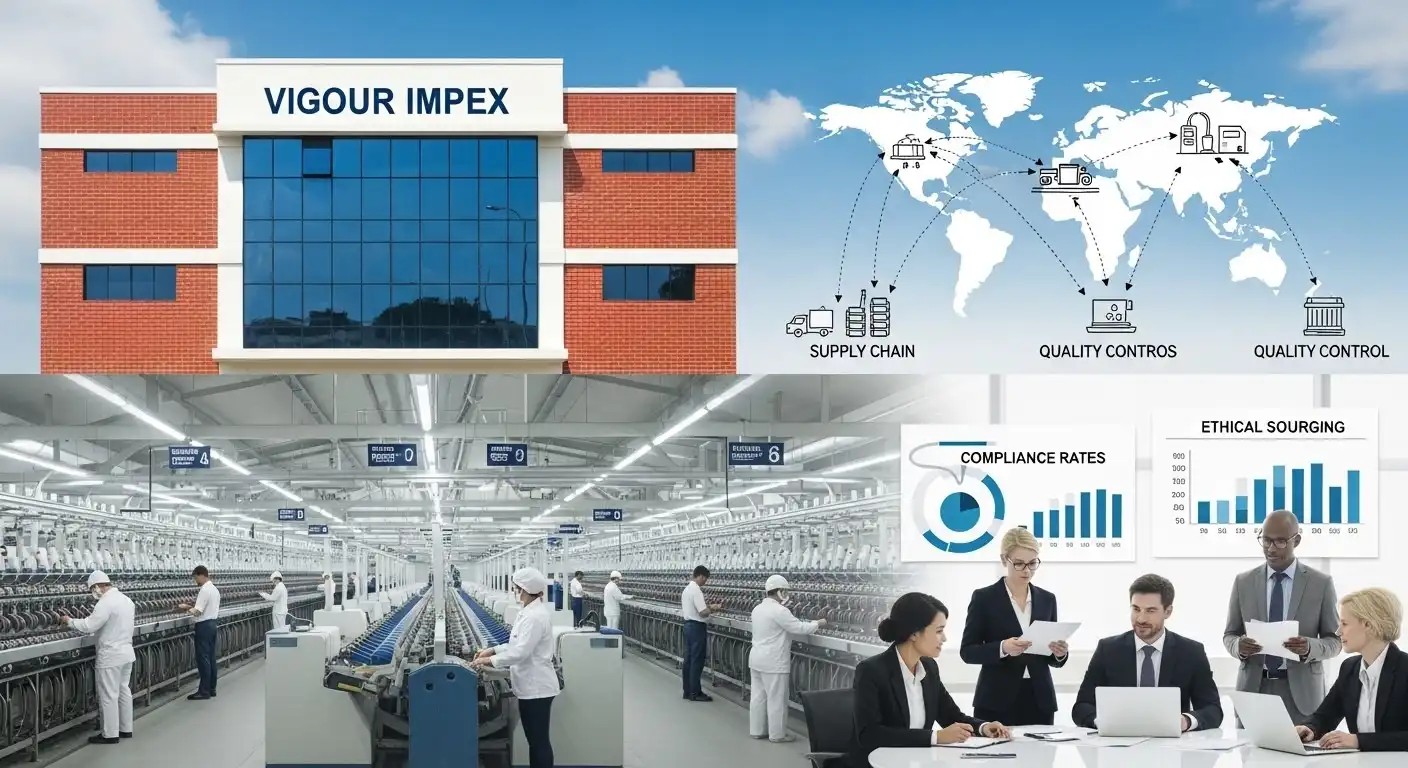
Introduction: Building the Future of Textile Manufacturing
The textile industry stands at a crossroads. Brands worldwide face mounting pressure, from regulators demanding compliance, investors requiring ESG accountability, and consumers choosing sustainable products over cheaper alternatives.
At Vigour Impex, we recognized this shift years ago and made a strategic decision: build a textile supply chain that doesn’t just meet minimum standards but sets new benchmarks for compliance and sustainability in Pakistan’s textile sector.
This isn’t marketing rhetoric. It’s our operational reality, verified through third-party audits, international certifications, and the trust of global brands that depend on our supply chain to meet their own sustainability commitments.
This article takes you inside our approach, how we source materials ethically, achieve compliance with international standards, implement transparent quality control, and embed sustainability into our long-term business strategy. Whether you’re a corporate buyer evaluating suppliers, a sustainability manager conducting due diligence, or a procurement professional seeking compliant partners, you’ll see exactly how we operate differently.
Why Compliance and Sustainability Matter in Textile Exports
Before explaining what we do, let’s establish why it matters, both for the industry and your business.
Regulatory Requirements Are Tightening
The European Union’s Corporate Sustainability Due Diligence Directive (CSDDD) and Corporate Sustainability Reporting Directive (CSRD) now require companies to verify ESG compliance throughout supply chains. The United States enforces the Uyghur Forced Labor Prevention Act, affecting cotton sourcing. These aren’t suggestions, they’re legal requirements with real penalties.
Brands sourcing from non-compliant suppliers face:
- Border rejections and customs holds
- Legal liability for supply chain violations
- Mandatory disclosures damaging reputation
- Loss of market access in regulated regions
Investor and Financial Pressure
ESG-focused investment funds manage over $35 trillion globally. Companies with weak sustainability credentials face higher capital costs, investor skepticism, and valuation discounts. Strong ESG performance attracts institutional investors and improves access to financing.
Consumer Expectations Have Shifted
73% of global consumers say they would change consumption habits to reduce environmental impact. 66% are willing to pay more for sustainable brands. This isn’t niche, it’s mainstream market behavior influencing purchasing decisions across demographics.
Competitive Differentiation
As sustainability becomes table stakes, genuine compliance and verifiable practices differentiate leaders from laggards. Brands need suppliers who help them stand out, not just keep up.
Wondering how to verify supplier sustainability claims? Download our free Supply Chain Transparency Checklist to evaluate your current partners against industry best practices.
Ethical Sourcing and Responsible Raw Materials

Sustainability starts at the source. Our supply chain begins with careful selection of raw materials that meet both quality and ethical standards.
Organic Cotton Cultivation Partnerships
We work directly with certified organic cotton farmers in Punjab and Sindh provinces, Pakistan’s primary cotton-growing regions. These partnerships ensure:
Verified organic practices: Farmers use no synthetic pesticides, chemical fertilizers, or GMO seeds. Soil health improves through crop rotation, composting, and biological pest control.
Fair pricing for farmers: We pay premium prices (15-20% above conventional rates) that make organic farming economically viable, incentivizing continued organic cultivation.
Long-term contracts: Multi-year agreements provide farmers with income stability and justify their investment in organic certification and practices.
Technical support: Our agricultural specialists provide training on organic methods, connect farmers with certification bodies, and help navigate the transition period.
Better Cotton Initiative (BCI) Membership
For our non-organic cotton sourcing, we exclusively purchase from Better Cotton Initiative-licensed farmers. BCI promotes:
- Reduced pesticide and water use
- Improved soil health through sustainable practices
- Prohibition of hazardous chemicals
- Decent work conditions for farm laborers
- Women’s empowerment in farming communities
BCI cotton represents responsible conventional farming, better environmental impact, and social conditions than standard cotton production.
Traceable Supply Chain from Farm to Factory
We maintain complete visibility of our cotton supply chain:
- Direct relationships with farmer cooperatives and ginning facilities
- Digital tracking systems are recording cotton from specific farms through the processing stages
- Regular farm audits verifying conditions and practices
- Blockchain pilot programs testing immutable supply chain records
- Geographic Information Systems (GIS) mapping of exact farm locations
This traceability means that when you source from Vigour Impex, you know exactly where the materials originated and under what conditions they were produced.
Recycled and Sustainable Fiber Integration
Beyond cotton, we source:
Recycled polyester: From post-consumer plastic bottles and textile waste, reducing virgin material demand and plastic pollution.
Tencel and Modal: Sustainably produced cellulosic fibers from certified wood sources, biodegradable, and manufactured with closed-loop processes, minimizing environmental impact.
Organic hemp: Small-volume specialty fiber requiring minimal water and no pesticides, ideal for eco-conscious brands seeking alternative natural fibers.
Prohibited Materials and Transparency
We explicitly exclude:
- Cotton from regions with forced labor concerns
- Materials from deforestation-linked sources
- Any fibers produced with child labor
- Suppliers refusing third-party verification
Every raw material purchase includes documentation proving compliance with our ethical sourcing standards.
Compliance With International Textile Standards
Claims without verification mean nothing. We back our commitments with internationally recognized certifications and regular third-party audits.
GOTS (Global Organic Textile Standard) Certification
Our GOTS certification covers the complete production chain from raw material through manufacturing. This globally recognized standard verifies:
Organic content: Minimum 70% organic fibers (we often achieve 95%+ for premium lines)
Chemical restrictions: Prohibited use of toxic dyes, heavy metals, formaldehyde, and other harmful substances
Environmental criteria: Wastewater treatment requirements, energy use tracking, waste management protocols
Social accountability: Fair wages, safe working conditions, no forced or child labor, freedom of association
Annual audits: Independent certification bodies inspect our facilities, review documentation, and verify continued compliance
GOTS isn’t just a logo on our website; it’s an operational commitment affecting daily decisions from chemical purchasing to worker welfare.
OEKO-TEX Standard 100 Certification
Our OEKO-TEX certification tests finished products for harmful substances, ensuring:
- No carcinogenic dyes or chemicals
- Compliance with restricted substances lists (EU REACH, California Prop 65)
- Safe skin contact for sensitive populations (babies, allergy-prone individuals)
- Regular testing at independent laboratories
- Product-specific certification labels for transparency
This certification matters particularly for brands serving European and North American markets with strict chemical safety regulations.
SA8000 Social Accountability Certification
Our SA8000 certification demonstrates a commitment to fair labor practices:
- Living wage payment (verified through worker interviews and payroll audits)
- Maximum working hour limits with proper overtime compensation
- Health and safety programs, including PPE, emergency procedures, and regular training
- Grievance mechanisms enabling confidential worker feedback
- Freedom of association and collective bargaining rights
- Regular social audits by accredited certification bodies
ISO 9001 Quality Management
Our ISO 9001 certification establishes systematic quality management:
- Documented processes for every production stage
- Regular internal audits identify improvement opportunities
- Corrective action protocols when issues arise
- Continuous improvement culture embedded throughout the organization
- Customer satisfaction measurement and response systems
Additional Compliance Frameworks
We align with:
WRAP (Worldwide Responsible Accredited Production): Twelve principles covering labor practices, factory conditions, and environmental compliance
Higg Index: Standardized tools measuring environmental (Higg FEM) and social (Higg FSLM) facility performance, enabling benchmarking and improvement tracking
ZDHC (Zero Discharge of Hazardous Chemicals): Roadmap commitment to eliminating priority chemical groups from manufacturing processes
Need verified ESG-compliant textile suppliers? Schedule a facility tour to see our certifications in action and meet the teams maintaining our compliance standards. Book your visit or request our complete Certification Package.
Transparent Manufacturing and Quality Control
Compliance certifications establish frameworks, but operational excellence delivers results. Our manufacturing practices emphasize transparency and quality at every stage.
Vertical Integration Advantage
We control the complete production chain:
Spinning: Converting raw cotton into yarn with modern ring-spinning and compact spinning technology
Weaving and Knitting: Advanced looms and knitting machines producing fabric to exact specifications
Dyeing and Finishing: State-of-the-art wet processing with water recycling and chemical management systems
Cut and Sew: Garment manufacturing with skilled operators and quality checkpoints
Final Inspection and Packaging: Comprehensive quality verification before shipment
This vertical integration provides:
- Quality consistency across production stages
- Faster turnaround times without dependency on third-party processors
- Cost efficiency, eliminating middleman markups
- Complete traceability, knowing exactly what happens at each step
- Accountability – one partneris responsible for the entire process
Multi-Stage Quality Control
Quality assurance happens continuously, not just at final inspection:
Raw material inspection: Every cotton bale is tested for fiber length, strength, moisture content, and contamination before processing
In-process monitoring: Real-time checks during spinning (yarn count, strength, evenness), weaving (defects, density), dyeing (color matching, fastness), and assembly (measurements, stitching quality)
Pre-production sampling: Client-approved samples before full production begins, ensuring specifications match expectations
Inline quality audits: Random inspections during production, catching issues immediately rather than after completion
Final inspection: 100% inspection for critical specifications and AQL sampling for comprehensive quality verification
Third-party testing: Independent laboratories verify compliance with customer specifications and certification requirements
Technology-Enabled Transparency
We invest in systems providing real-time visibility:
ERP integration: Complete production tracking from raw material receipt through finished goods shipment
Digital quality management: Tablet-based inspection systems recording defects, generating analytics, and triggering corrective actions
Real-time reporting: Customer portals showing order status, quality metrics, and expected delivery dates
Traceability systems: QR codes or RFID tags linking finished products to specific production batches, raw material sources, and quality records
Photo documentation: Visual records of production progress shared with customers for remote verification
Worker Training and Skill Development
Quality comes from skilled people. Our human resource investments include:
- Comprehensive onboarding for new workers covering processes, quality standards, and safety protocols
- Ongoing skill development through regular training programs on techniques and equipment
- Quality awareness programs emphasizing each worker’s role in delivering excellence
- Certification support helps workers gain recognized qualifications, advancing careers
- Cross-training, building a versatile workforce capable of multiple production roles
Continuous Improvement Culture
We systematically pursue improvement through:
Root cause analysis: When defects occur, we identify underlying causes rather than just fixing symptoms
Kaizen programs: Employee suggestions for process improvements, with recognition and implementation of best ideas
Benchmarking: Comparing our performance against industry leaders and adopting best practices
Technology upgrades: Regular investment in modern equipment improves efficiency, quality, and environmental performance
Customer feedback integration: Using client input to refine processes and prevent recurring issues
Sustainability as a Long-Term Business Strategy
We view sustainability not as a compliance burden but as a strategic competitive advantage. Our environmental and social initiatives generate business value while reducing impact.
Environmental Initiatives Delivering Results
Renewable Energy Investment
Our facilities now generate 40% of electricity needs through rooftop solar installations. This provides:
- Reduced carbon emissions (equivalent to removing 450 cars annually)
- Lower and more predictable energy costs
- Grid independence during power shortages
- Positive environmental messaging for conscious buyers
We’re targeting 70% renewable energy by 2028 through additional solar capacity and exploring wind energy options.
Water Management Systems
The textile industry faces criticism for water consumption. Our approach:
Water recycling: Advanced treatment systems enabling reuse of up to 60% of process water. Wastewater undergoes biological treatment, filtration, and quality testing before discharge or reuse.
Waterless technologies: Digital printing and air dyeing equipment reduce water consumption by 90% compared to conventional methods for applicable product lines.
Rainwater harvesting: Collection systems capturing monsoon rainfall for non-production uses (landscaping, cooling towers, initial washing stages).
Continuous monitoring: Real-time tracking of water consumption, quality, and discharge, ensuring compliance and identifying improvement opportunities.
Chemical Management Excellence
We implement ZDHC (Zero Discharge of Hazardous Chemicals) principles:
- Maintaining approved chemical lists, excluding harmful substances
- Proper chemical storage with spill containment and handling protocols
- Training workers on safe chemical use and emergency procedures
- Regular testing of wastewater and finished products for restricted substances
- Continuous substitution of problematic chemicals with safer alternatives
Waste Reduction and Circular Economy
Our waste management strategy encompasses:
Fabric waste recycling: Cutting room scraps and production waste sent to recycling facilities, converting textiles back to fiber or repurposing for lower-grade applications
Packaging optimization: Reduced packaging materials, recycled content packaging, and reusable transport containers
Energy recovery: Exploring waste-to-energy options for non-recyclable material
Design for sustainability: Product development considering end-of-life recyclability and disassembly
Social Responsibility Beyond Compliance
While certifications verify baseline standards, we invest beyond minimums:
Living Wage Commitment
We conduct annual living wage assessments using international methodologies accounting for local cost of living, family size, and essential needs. Our wages exceed the calculated living wage by 10-15%, verified through third-party audits.
Worker Welfare Programs
Healthcare access: On-site medical facilities with full-time nurses and regular doctor visits. Health insurance coverage for workers and families.
Transportation: Company-provided transport ensures safe commutes, particularly important for women workers concerned about safety.
Childcare support: Subsidized daycare enabling working parents (predominantly mothers) to maintain employment without childcare barriers.
Education programs: Literacy classes, skill development, and support for workers pursuing further education.
Financial literacy: Training on budgeting, saving, and financial planning, helping workers maximize earnings and build stability.
Gender Equality Initiatives
Our workforce is 45% female. We actively promote:
- Equal pay for equal work (verified through regular audits)
- Women in leadership positions (currently 30% of supervisory roles)
- Anti-harassment policies with confidential reporting mechanisms
- Maternity leave and support exceeding legal requirements
- Flexible scheduling accommodating family responsibilities
Community Engagement
Our operations impact surrounding communities. We engage through:
- Local employment priority providing jobs near facilities
- Educational support for community schools and scholarship programs
- Infrastructure development, improving roads, water access, and sanitation
- Health initiatives supporting community clinics and health awareness programs
Governance and Accountability
Strong governance ensures sustainability commitments translate to action:
Board-Level Oversight
Our Chief Sustainability Officer reports directly to the Board of Directors, ensuring ESG receives executive attention and resources.
Transparent Reporting
We publish annual sustainability reports following the GRI (Global Reporting Initiative) frameworks. These reports disclose:
- Environmental performance metrics (emissions, water use, waste, energy)
- Social indicators (wages, safety incidents, training hours, diversity)
- Governance practices (audit results, policy updates, stakeholder engagement)
- Progress against targets with honest assessment of achievements and shortfalls
Stakeholder Engagement
We regularly consult:
- Workers through committee meetings, surveys, and suggestion systems
- Local communities regarding facility impacts and development initiatives
- Customers are aware of evolving sustainability requirements and collaboration opportunities
- Suppliers on joint improvement programs and expectation alignment
- NGOs and civil society providing external perspective and expertise
Third-Party Verification
We submit to regular independent audits:
- Annual certification renewals for GOTS, OEKO-TEX, SA8000, and ISO standards
- Customer-commissioned audits when buyers conduct supplier assessments
- Surprise inspections verifying ongoing compliance rather than preparation for scheduled audits
- Participation in industry benchmarking (Higgs Index), enabling performance comparison
Continuous Target Setting
We establish ambitious, time-bound goals:
- 2026: 70% renewable energy, 65% water recycling, 100% living wage verified across Tier 1 suppliers
- 2028: Carbon-neutral Scope 1 and 2 emissions, zero waste to landfill
- 2030: 50% recycled content across product portfolio, complete supply chain traceability to raw material origin
These targets drive continuous improvement and provide accountability benchmarks.
Ready to partner with a textile manufacturer that takes sustainability seriously? Request our complete ESG Performance Report with third-party audit results, visit our facilities to see our practices firsthand, or discuss how we can support your brand’s sustainability goals. Contact our sustainability team or Download our ESG Report.
Why Global Brands Choose Vigour Impex
Our compliance and sustainability investments translate to tangible benefits for partners:
Risk Mitigation
Sourcing from verified compliant suppliers reduces your:
- Regulatory risk (meeting EU, US, and other market requirements)
- Reputational risk (avoiding supply chain scandals)
- Operational risk (reliable partner less prone to shutdowns or quality failures)
- Financial risk (ESG leaders demonstrate better long-term performance)
Brand Differentiation
Our certifications and transparency enable your marketing:
- Credible sustainability claims backed by third-party verification
- Detailed supply chain stories connecting products to ethical sources
- Differentiation from competitors making vague “eco-friendly” claims
- Appeal to conscious consumers willing to pay premiums
Investor Confidence
When investors evaluate your ESG performance, our partnership provides evidence of:
- Sustainable supply chain practices
- Due diligence on human rights and environmental impacts
- Continuous improvement trajectory
- Alignment with international frameworks (GRI, SASB, TCFD)
Operational Excellence
Our quality systems and vertical integration deliver:
- Consistent product quality meeting specifications reliably
- Faster lead times from integrated production
- Flexibility for customization and small-batch production
- Responsive communication and problem-solving
- Competitive pricing despite sustainability investments
Partnership Approach
We collaborate with customers on:
Co-development: Working together on sustainable product innovations, materials, and processes
Transparency: Sharing performance data, audit results, and improvement plans openly
Continuous improvement: Joint goal-setting and progress monitoring
Market insights: Providing intelligence on regulatory changes, certification developments, and industry trends
Long-term commitment: Building relationships that survive market cycles and support mutual growth
Our Journey and Future Roadmap
Vigour Impex didn’t achieve its current sustainability performance overnight. It’s been a deliberate journey with continued ambitions.
Where We’ve Been
1999-2010: Founded as a traditional textile manufacturer focused on quality and customer service
2010-2015: Initial sustainability investments, ISO 9001 certification, beginning organic cotton sourcing, basic environmental management
2015-2020: Major commitments, GOTS certification, solar installation, OEKO-TEX compliance, SA8000 social accountability
2020-2025: Leadership positioning, comprehensive ESG strategy, blockchain traceability pilots, circular economy initiatives, renewable energy expansion
Where We’re Going
2025-2027: Deepening impact, Tier 2 supplier engagement, science-based carbon targets, increased recycled content, digital product passports
2027-2030: Industry leadership, Carbon neutrality achievement, zero waste operations, supply chain transparency to raw material origin, regenerative agriculture pilots
We share this roadmap not as an achievement boast but as an accountability commitment. These targets guide our investment decisions and operational priorities.
Frequently Asked Questions
Q1: What certifications does Vigour Impex hold for sustainable textiles?
Vigour Impex holds GOTS (Global Organic Textile Standard) for organic products, OEKO-TEX Standard 100 for chemical safety, SA8000 for social accountability, ISO 9001 for quality management, and is a Better Cotton Initiative member. We also align with WRAP principles and participate in Higg Index assessment, verified through annual third-party audits.
Q2: How does Vigour Impex ensure ethical sourcing of raw materials?
We source organic cotton directly from certified farmers through long-term contracts with fair pricing. BCI cotton comes from licensed sustainable sources. Complete traceability systems track materials from farm to factory using digital platforms and blockchain pilots. Regular farm audits verify conditions, and we exclude materials from forced labor regions or deforestation-linked sources.
Q3: What makes Vigour Impex’s supply chain transparent?
Our vertical integration controls the complete production chain from spinning through finished products. Digital tracking systems record each production stage. Customer portals provide real-time order visibility. We conduct regular third-party audits and publish annual sustainability reports. Blockchain pilot programs test immutable supply chain records for enhanced verification.
Q4: How does Vigour Impex manage environmental impact?
We generate 40% of energy from rooftop solar (targeting 70% by 2028), recycle 60% of process water through treatment systems, implement ZDHC chemical management protocols, operate waste recycling programs, and use waterless dyeing technologies where applicable. Real-time monitoring tracks emissions, water use, and waste with continuous improvement targets.
Q5: Why should brands choose Vigour Impex over other textile suppliers?
Brands choose us for verified compliance, reducing regulatory risk, third-party certified sustainability enabling credible marketing claims, vertical integration ensuring quality consistency and faster turnarounds, transparent reporting supporting their ESG disclosures, and a partnership approach, collaborating on sustainability goals rather than just transactional supplier relationships.
Conclusion: Partnership for Sustainable Success
Building a compliant and sustainable textile supply chain isn’t a destination; it’s continuous evolution requiring investment, commitment, and partnership.
At Vigour Impex, we’ve made this journey our strategic priority because we believe the future of textiles demands it, our planet requires it, and our workers deserve it. But we also know it makes business sense, attracting premium buyers, accessing better markets, and building resilient operations.
For brands seeking textile partners who share sustainability values while delivering quality and reliability, we offer verified credentials, transparent operations, and collaborative relationships supporting your success.
The question isn’t whether textile supply chains must become sustainable; market forces have decided that. The question is whether you’re partnering with suppliers genuinely committed to this transformation or those treating it as a paperwork exercise.
We invite you to see the difference for yourself.
Get Started
Contact us today to discuss your textile sourcing needs and discover how Vigour Impex’s compliant, sustainable supply chain creates value for your brand.
Vigour Impex Building Sustainable Textile Supply Chains Since 1999
Where Compliance Meets Quality, and Sustainability Drives Success