


Introduction: A Trade Agreement That Changes Everything
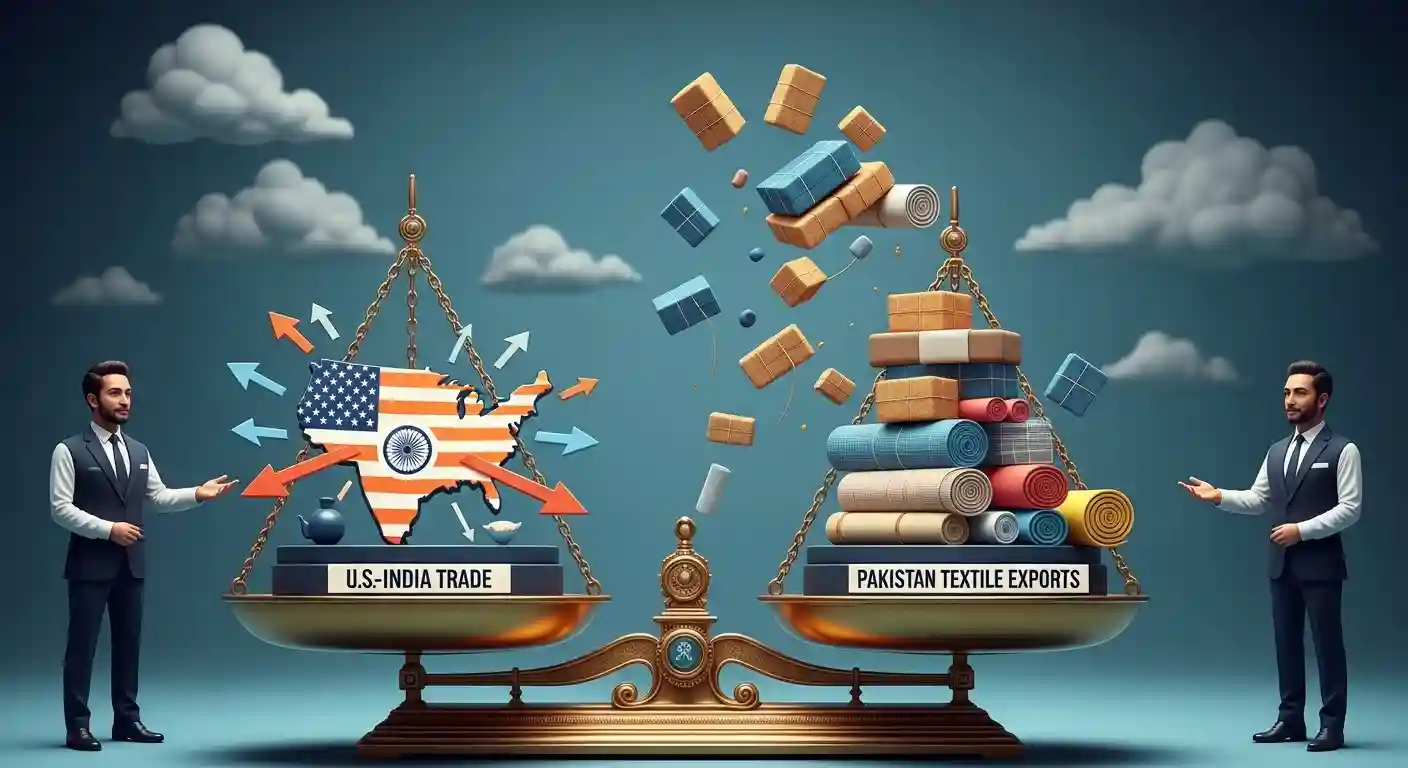
In February 2026, the United States and India announced a trade agreement that sent shockwaves through Asian textile markets. The deal slashed U.S. tariffs on Indian goods from 50% to 18%, a dramatic reduction that fundamentally alters competitive dynamics for every textile exporter targeting American buyers.
For the Pakistan textile industry, this isn’t just another trade development to monitor. It’s a direct competitive threat that could reshape market access, pricing strategies, and buyer relationships that Pakistani manufacturers have built over decades.
Pakistan currently faces 19% U.S. tariffs on textile exports, just 1 percentage point higher than India’s new 18% rate. This narrow margin might seem insignificant, but in the razor-thin profit margins of textile manufacturing, even small disadvantages compound into lost orders, reduced market share, and squeezed profitability.
This article analyzes exactly how the U.S.-India trade agreement affects Pakistan’s textile exports, what competitive pressures Pakistani manufacturers now face, and most importantly, what strategic responses can help Pakistani exporters not just survive but thrive in this new trade reality.
Overview of the U.S.–India Trade Agreement
Understanding the impact requires first grasping what this agreement actually entails and why it happened.
The Path to the Agreement
The U.S.-India trade relationship deteriorated dramatically in 2025 when President Trump initially imposed tariffs as high as 50% on Indian goods, citing trade imbalances and India’s continued Russian oil purchases. Indian textile exports to the U.S. plummeted 31.4% year-on-year through November 2025 as these punitive tariffs destroyed competitiveness.
After months of negotiations and direct leader-level engagement between President Trump and Prime Minister Modi, a framework agreement emerged in February 2026, rolling back these elevated tariffs significantly.
Key Features of the U.S.–India Trade Agreement
Tariff reduction to 18%: The U.S. reduced average tariffs on Indian exports from 50% (punitive level) down to 18%, a massive relief for Indian exporters who had been hemorrhaging orders and market share.
India’s commitments: In exchange, India committed to stop purchasing Russian oil, increase U.S. energy imports, and provide greater market access for American goods, including agricultural products, energy, and manufactured items.
Strategic partnership elevation: Beyond tariffs, the agreement positions India as a preferred trade partner in U.S. supply chains, part of America’s broader strategy to reduce dependence on China while strengthening ties with democratic allies.
What This Means in Context
The 18% tariff rate places India in a relatively competitive position compared to other Asian textile exporters:
- India: 18% (post-agreement)
- Pakistan: 19%
- Indonesia: 19%
- Bangladesh: 20%
- Vietnam: 20%
- China: 34%
While Pakistan’s 19% rate remains close to India’s 18%, the psychological and practical advantages India gains are significant, particularly when combined with India’s recent EU trade deal and UK agreement creating additional market access advantages.
Why the U.S. Market Matters for Pakistan’s Textile Industry
Before analyzing competitive impacts, let’s establish why U.S. market access is so critical for Pakistani textile manufacturers.
The Numbers Tell the Story
The United States represents Pakistan’s largest single export market for textiles, accounting for approximately $4-5 billion annually in textile and apparel exports. This represents roughly 25-28% of Pakistan’s total textile exports.
Key Pakistani textile categories in the U.S. market include:
- Home textiles (bed linens, towels, table linens): Pakistan’s strength category
- Cotton yarn: Sold to U.S. textile manufacturers and re-exporters
- Garments: Particularly cotton-based apparel and knitwear
- Made-ups: Institutional textiles for hotels, hospitals, and commercial use
Why U.S. Buyers Matter
Beyond volume, American buyers provide:
Premium pricing: The U.S. market generally pays better than some other regions, improving margins for quality-focused suppliers
Long-term relationships: Established partnerships with major U.S. retailers and brands provide stability and predictable order flows
Quality standards: Meeting rigorous U.S. buyer requirements builds capabilities that serve other markets
Dollar revenues: Exports priced in USD provide currency stability and predictability
Market credibility: Success in the demanding U.S. market enhances reputation globally
Pakistan’s Competitive Position
Pakistani textile manufacturers have built strong positions in specific niches:
Home textiles expertise: Decades of specialization in bedding and towels create a quality reputation
Cotton access: As the world’s 4th largest cotton producer, Pakistan offers raw material proximity
Vertical integration: Many Pakistani mills control complete supply chains from spinning through finishing
Established relationships: Long-standing partnerships with U.S. buyers based on trust and performance
This foundation is now being tested by India’s improved tariff advantage.
Concerned about maintaining your U.S. market position? Download our free analysis: “5 Strategies for Pakistani Textile Exporters in the Post-Agreement Market” to understand how competitive positioning is shifting.
Potential Competitive Pressure on Pakistan’s Textile Exports
The U.S.-India trade agreement creates several specific competitive challenges for Pakistani manufacturers.
Direct Price Competition Intensifies
The 1 percentage point tariff difference (India 18% vs. Pakistan 19%) might seem minor, but consider the math:
For a $100 wholesale product:
- Pakistani supplier faces $19 in tariffs
- Indian supplier faces $18 in tariffs
- Difference: $1 per $100, or 1%
In textile manufacturing, where net profit margins often run 5-8%, this 1% difference represents 12-20% of total profit margin. Indian suppliers can now:
- Undercut Pakistani pricing while maintaining margins
- Match Pakistani pricing and enjoy higher profitability
- Invest margin gains into quality improvements, certifications, or customer service
Buyer Perception and Momentum
Beyond pure mathematics, India’s tariff reduction creates psychological advantages:
Positive momentum: Buyers see India moving in the right direction (tariffs decreasing) versus Pakistan’s static position
Government engagement: India’s high-level negotiations demonstrate commitment to trade partnership, creating confidence
Market buzz: Industry media coverage positions India as a competitive destination, attracting buyer attention
Risk perception: Lower tariffs reduce landed cost uncertainty, making Indian sourcing feel safer
India’s Additional Trade Advantages
The U.S. agreement didn’t happen in isolation. India recently secured:
EU trade deal (December 2025): Zero-duty access to the $95 billion European market, where India currently holds only 6% share
UK trade agreement (July 2025): Preferential access to British markets post-Brexit
Oman and New Zealand agreements: Expanding market diversification
This portfolio of trade deals compounds India’s competitive advantage, allowing it to offer buyers a global footprint and diversified production that Pakistan struggles to match.
Sector-Specific Vulnerabilities
Certain Pakistani textile categories face particularly acute pressure:
Cotton apparel and knitwear: India’s massive garment sector competes directly with Pakistani manufacturers. U.S. buyers sourcing basic cotton t-shirts, knitwear, or casual apparel can easily shift orders from Pakistan to India with minimal adjustment.
Home textiles overlap: While Pakistan has a strong reputation in bedding and towels, India also produces these categories. Buyers may test Indian suppliers at the new lower tariff rate, potentially diverting orders.
Yarn exports: Pakistani cotton yarn competes with Indian spinning mills. Price-sensitive buyers may favor Indian yarn when tariff advantages tip the scales.
The “China+1” Strategy Impact
Many U.S. buyers have been pursuing “China+1” diversification, reducing China dependence by sourcing from alternative Asian countries. Pakistan has been a beneficiary of this strategy.
But India’s tariff advantage, combined with its massive manufacturing scale, makes it an increasingly attractive China alternative, potentially capturing diversification orders that might have gone to Pakistan, Bangladesh, or Vietnam.
Strategic Opportunities for Pakistan’s Textile Manufacturers

While competitive pressures are real, they’re not insurmountable. Pakistani textile manufacturers have multiple strategic responses that can maintain and even strengthen their U.S. market position.
Double Down on Quality and Differentiation
When you can’t compete on tariff rates, compete on value proposition:
Specialization in premium segments: Focus on higher-quality home textiles, organic cotton products, and specialty items where quality matters more than marginal price differences.
Certification advantages: Obtain GOTS, OEKO-TEX, and other certifications that Indian competitors may lack, creating differentiated positioning.
Customization capabilities: Offer flexibility for small-batch custom orders, rapid turnarounds, and personalized service that large Indian mills can’t match.
Vertical integration benefits: Highlight complete supply chain control, enabling quality consistency and faster production cycles.
Leverage Niche Strengths
Pakistan excels in specific categories where India doesn’t dominate:
Hotel and institutional linens: Pakistani manufacturers have deep expertise in contract textiles for hospitality, healthcare, and commercial sectors, markets requiring consistent quality and reliability.
Premium towels: Pakistan’s towel manufacturing, particularly in Faisalabad, rivals Turkish quality at more competitive pricing.
Sustainable cotton products: Pakistan’s growing organic cotton sector and Better Cotton Initiative membership create sustainability credentials appealing to conscious buyers.
Strengthen Buyer Relationships
Established partnerships matter more than ever:
Proactive communication: Contact existing U.S. buyers directly, acknowledge competitive landscape changes, and reinforce your commitment and value proposition.
Collaborative problem-solving: Work with buyers on cost optimization, quality improvements, and service enhancements that deepen relationships beyond just price.
Long-term contracts: Negotiate multi-season commitments providing buyers predictability while securing your order flow.
Joint product development: Partner with brands on exclusive product lines or innovations, creating switching costs.
Cost Optimization Without Quality Compromise
Find efficiencies that improve competitiveness:
Renewable energy investments: Solar installations and other renewable sources reduce energy costs, Pakistan’s biggest operational expense.
Process improvements: Lean manufacturing, waste reduction, and efficiency gains cut costs without affecting quality.
Supply chain optimization: Streamline logistics, negotiate better raw material pricing, and reduce unnecessary overhead.
Technology adoption: Automated testing, digital tracking, and modern equipment improve productivity and consistency.
Market Diversification Strategy
Reduce U.S. market dependence by expanding elsewhere:
EU expansion: Pursue European buyers where Pakistan doesn’t face the same disadvantage as India
Middle East growth: GCC countries represent growing markets for home textiles with fewer tariff complications
Asian markets: Japan, South Korea, and ASEAN countries offer opportunities
Domestic market: Pakistan’s own growing middle class creates domestic demand for quality textiles
Need help navigating the new competitive landscape? Vigour Impex combines quality manufacturing with strategic market positioning to maintain competitiveness despite trade agreement shifts. Schedule a consultation to discuss your U.S. market strategy.
How Exporters Can Prepare for Shifting Trade Dynamics
Beyond strategy, Pakistani textile exporters need concrete action plans to address the changed market reality.
Immediate Actions (Next 30-60 Days)
Assess current exposure: Calculate what percentage of your revenue depends on U.S. exports and which product categories are most vulnerable to Indian competition.
Contact key buyers: Proactively reach out to major U.S. customers. Don’t wait for them to question your competitiveness; initiate the conversation.
Benchmark pricing: Understand exactly where your pricing stands versus comparable Indian suppliers. Identify whether you’re competitive, need cost improvements, or can justify premium positioning.
Review certifications: Ensure all sustainability and quality certifications are current and prominently communicated to buyers.
Evaluate product mix: Determine which products face the most Indian competition versus those where Pakistan maintains clear advantages.
Medium-Term Positioning (3-12 Months)
Invest in differentiation: Obtain additional certifications (GOTS, OEKO-TEX, Fair Trade) that create competitive moats.
Enhance capabilities: Add specialized production capabilities or finishing techniques that Indian competitors can’t easily replicate.
Strengthen quality systems: Implement or upgrade statistical process control, automated testing, and documentation that proves consistent quality.
Improve supply chain transparency: Invest in traceability systems (blockchain pilots, QR codes, digital platforms) that buyers increasingly demand.
Develop new products: Create innovative textile products or sustainable alternatives that open new market segments.
Long-Term Strategic Investments (1-3 Years)
Renewable energy transition: Major solar installations or other renewable sources providing long-term cost advantages and sustainability credentials.
Technology modernization: Advanced machinery, automation, and digital systems are improving productivity and quality.
Vertical integration expansion: Acquiring or developing additional supply chain stages for greater control and efficiency.
Market diversification: Establishing presence in the EU, the Middle East, or other markets, reducing U.S. dependence.
Brand development: Moving from an anonymous supplier to a recognized brand with direct market relationships.
What NOT to Do
Don’t panic and slash prices: Racing to the bottom on price destroys profitability and brand positioning. Compete on value, not desperation.
Don’t ignore the challenge: Hoping the situation resolves itself or buyers remain loyal without reinforcement is dangerous complacency.
Don’t badmouth competitors: Criticizing Indian manufacturers to buyers looks unprofessional. Focus on your strengths, not competitor weaknesses.
Don’t sacrifice quality for cost: Cutting corners to match Indian pricing damages long-term reputation and buyer relationships.
Collaboration Opportunities
Industry association engagement: Work with APTMA (All Pakistan Textile Mills Association) on collective responses, government advocacy, and market intelligence sharing.
Government dialogue: Advocate for the Pakistani government to pursue similar trade negotiations with the U.S., addressing tariff parity.
Supplier partnerships: Collaborate with raw material suppliers, logistics providers, and service companies on cost optimization, benefiting the entire value chain.
Vigour Impex: Positioned to Compete in the New Trade Reality
At Vigour Impex, we’ve been preparing for intensifying global competition long before this trade agreement. Our strategic investments position us to maintain and grow U.S. market share despite India’s tariff advantage.
Why We Remain Competitive
GOTS Certified Organic Products: Our certified organic cotton textiles command a premium positioning that price-sensitive Indian competition can’t challenge. U.S. buyers seeking verified sustainable products find the 1% tariff difference negligible compared to the quality assurance and sustainability credentials we provide.
Specialized Home Textile Excellence: We focus on categories where Pakistan genuinely excels, such as premium bed linens, hotel-quality towels, and institutional textiles. Our decades of specialization create quality, consistency, and innovation that Indian mass-producers struggle to match.
Vertical Integration Advantage: Controlling our complete supply chain from cotton sourcing through spinning, weaving, dyeing, and finishing enables:
- Quality consistency across production stages
- Faster turnaround times than multi-vendor Indian supply chains
- Complete traceability for buyers requiring supply chain transparency
- Cost efficiencies, eliminating middleman markups
Technology and Transparency: Our investments in traceability systems, digital tracking, and blockchain pilots provide the supply chain visibility that U.S. buyers increasingly demand, particularly as regulations like EU CSDDD require documented supply chain verification.
Established U.S. Buyer Relationships: We’ve served major American brands and retailers for years. These aren’t transactional spot purchases; they’re partnerships built on trust, quality delivery, and collaborative problem-solving that don’t evaporate over 1% tariff differences.
Renewable Energy Infrastructure: Our 40% solar-powered operations reduce energy costs (Pakistan’s biggest expense) while providing sustainability credentials. This operational efficiency helps us maintain competitive pricing despite tariff disadvantages.
Responsive Partnership Approach: Unlike large Indian mills processing thousands of orders, we maintain flexibility for custom requirements, small-batch production, and rapid adjustments, service levels that price alone can’t replace.
Our Commitment to U.S. Market Partners
We’re not conceding market share to Indian competition. Instead, we’re:
Investing aggressively in quality systems, certifications, and capabilities that deepen our competitive moat
Maintaining pricing competitiveness through operational excellence and efficiency gains, not quality compromise
Expanding product innovation in sustainable materials, technical textiles, and specialized offerings, where we add unique value
Strengthening customer service and responsiveness that larger Indian competitors can’t match
Building long-term partnerships rather than chasing every transaction
Don’t let tariff changes disrupt your textile sourcing strategy. Partner with a Pakistani manufacturer positioned to compete successfully in the new trade landscape. Contact Vigour Impex to discuss how our quality, certifications, and specialized capabilities serve your needs despite competitive pressures. Request product samples, schedule a facility tour, or download our capability presentation.
Frequently Asked Questions
Q1: How does the U.S.-India trade agreement affect Pakistan’s textile exports?
The agreement reduces U.S. tariffs on Indian goods to 18% while Pakistan faces 19%, creating a 1% cost disadvantage. This narrows Pakistan’s price competitiveness, particularly in commodity textiles, though quality-focused and certified products maintain advantages where price differences matter less than sustainability credentials and reliability.
Q2: Can Pakistani textile exporters still compete in the U.S. market?
Yes. Pakistani manufacturers with quality certifications (GOTS, OEKO-TEX), specialized capabilities (premium home textiles, organic cotton), established buyer relationships, and differentiated value propositions remain competitive. The 1% tariff difference impacts commodity products most; premium segments prioritize quality, service, and sustainability over marginal pricing.
Q3: What should Pakistani textile manufacturers do in response?
Focus on differentiation through certifications, quality excellence, and specialized capabilities. Invest in renewable energy and efficiency to offset tariff disadvantages. Strengthen existing U.S. buyer relationships proactively. Diversify markets to reduce U.S. dependence. Avoid panic pricing that destroys margins and brand positioning.
Q4: Will India take all of Pakistan’s U.S. textile business?
Unlikely. India’s strength lies in mass production and scale. Pakistan excels in specialized categories (premium home textiles, organic cotton, institutional linens) where quality and service matter more than marginal price differences. Different manufacturers serve different buyer segments and needs.
Q5: How can buyers identify Pakistani suppliers who remain competitive?
Look for GOTS or OEKO-TEX certifications, vertical integration (spinning through finishing), renewable energy investments, traceability systems (blockchain, digital tracking), established track records with U.S. brands, and willingness to demonstrate quality through samples and facility tours. Competitive suppliers emphasize value proposition beyond just price.
Conclusion: Competition Drives Excellence
The U.S.-India trade agreement undeniably creates competitive pressure for Pakistan’s textile exporters. Pretending otherwise or minimizing the challenge would be dishonest and dangerous.
But competitive pressure isn’t necessarily destructiven it can be catalyzing. It forces Pakistani manufacturers to excel in areas where they genuinely add value rather than coasting on previous advantages. It accelerates necessary investments in quality, sustainability, and efficiency that would have been needed eventually anyway.
Pakistani textile manufacturers who respond strategically, investing in differentiation, strengthening buyer relationships, improving operations, and competing on value rather than pure price, will emerge from this challenge stronger and more competitive globally.
Those who panic, slash prices desperately, or ignore the changing landscape will struggle regardless of tariff rates.
The choice belongs to each manufacturer: view this as an existential threat leading to retreat, or as competitive pressure demanding excellence that drives growth.
At Vigour Impex, we’ve chosen the latter. We’re confident our quality, certifications, specialized capabilities, and partnership approach create value that transcends 1% tariff differences.
The U.S.-India trade agreement changes the game, but it doesn’t end it. Pakistani textile manufacturers who play the new game strategically will continue succeeding in American markets and beyond.
Partner With a Strategically Positioned Pakistani Textile Manufacturer
Vigour Impex offers U.S. buyers the quality, sustainability, and reliability they need, with competitive positioning that transcends tariff rate differences.
✓ Detailed capability presentation
✓ Product samples for evaluation
✓ Certification documentation
✓ Competitive pricing analysis
✓ Facility tour (virtual or in-person)
✓ Custom solution development
Don’t let trade agreement shifts disrupt your sourcing. Partner with a Pakistani manufacturer built to compete successfully in the new global trade landscape.