


Introduction: A New Era for Home Textile Sourcing
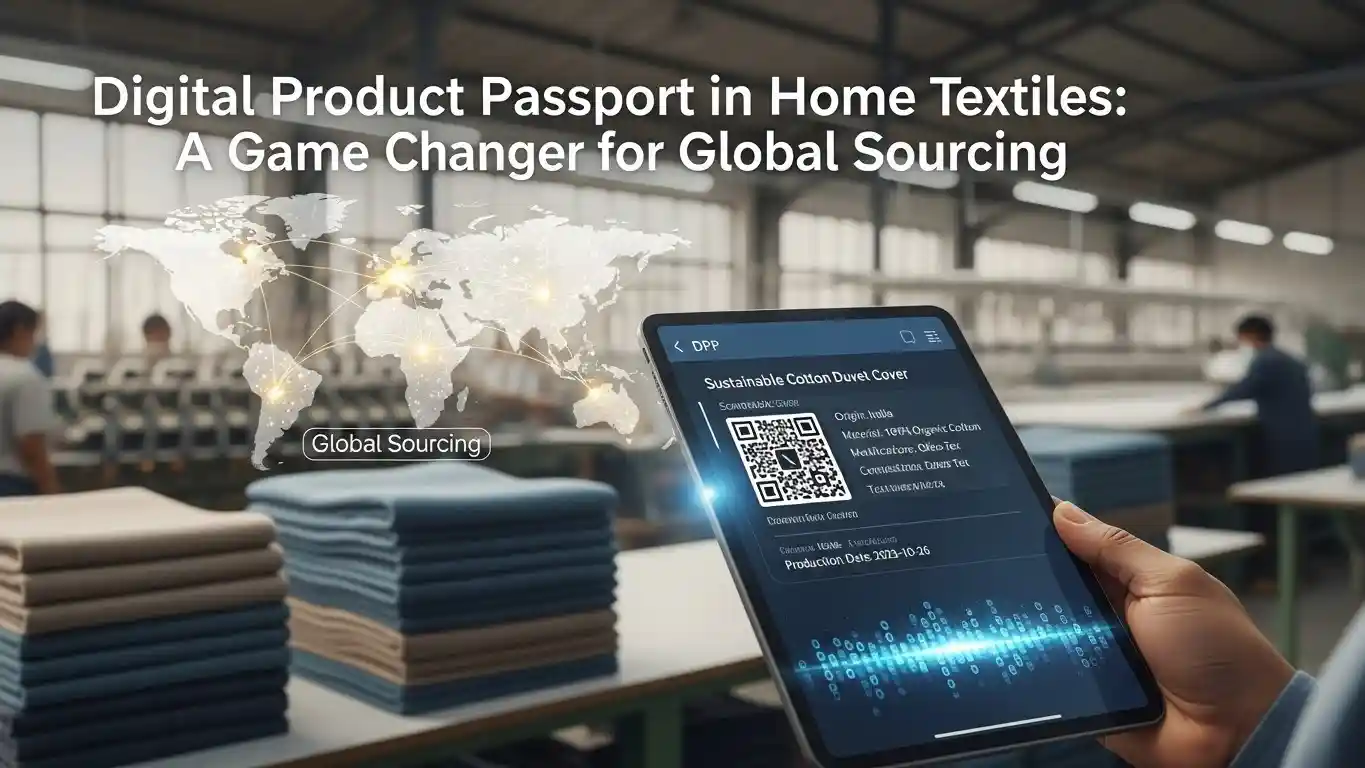
Imagine scanning a QR code on your hotel bedding and instantly knowing where the cotton was grown, how much water was used in production, whether workers received fair wages, and exactly how to recycle it when it wears out. This isn’t science fiction; it’s the reality being created by Digital Product Passports (DPP) in the home textiles industry.
Starting in 2027, every bedding set, towel, curtain, and tablecloth sold in the European Union will need this digital identity card. For businesses sourcing home textiles globally, whether you’re a hotel chain, retailer, or interior design firm, this changes everything about how you select suppliers and manage your supply chain.
This comprehensive guide explains what Digital Product Passports mean for home textiles, why they’re becoming mandatory, and most importantly, how your business can turn this compliance requirement into a competitive advantage.
What is a Digital Product Passport (DPP)?
A Digital Product Passport is like a detailed resume for your products, but instead of past jobs and education, it contains comprehensive information about the complete lifecycle of a product, from raw material extraction to final disposal.
Think of it as a digital twin of your physical product. When you scan a QR code, NFC chip, or similar identifier attached to home textiles like:
- Bedding (sheets, duvet covers, pillowcases, comforters)
- Bath textiles (towels, bathrobes, bath mats)
- Window treatments (curtains, drapes, blinds)
- Table linens (tablecloths, napkins, placemats)
- Decorative textiles (cushion covers, throws, upholstery)
You gain immediate access to verified information that was previously impossible to obtain or buried in complex supply chain documentation.
What Information Does a DPP Contain?
The specific data requirements for home textile DPP include:
Material Composition
- Exact fiber content percentages (cotton, polyester, linen, etc.)
- Origin of raw materials (country, region, specific farms for organic cotton)
- Certifications (GOTS, OEKO-TEX Standard 100, Better Cotton Initiative)
Manufacturing Details
- Factory locations and names
- Production processes used (dyeing methods, weaving techniques)
- Water consumption during manufacturing
- Energy sources (renewable vs. conventional)
- Chemical substances used and wastewater treatment
Environmental Impact
- Carbon footprint (CO₂ emissions throughout lifecycle)
- Water footprint (liters used per kilogram)
- Waste generated during production
- Packaging materials and recyclability
Social Compliance
- Labor practices and working conditions
- Fair wage verification
- Worker safety standards
- Certifications (WRAP, Fair Trade)
Product Care & Longevity
- Washing instructions for maximum durability
- Repair and maintenance guidelines
- Expected lifespan under normal use
- Warranty information
End-of-Life Options
- Recycling instructions and facilities
- Take-back programs
- Biodegradability information
- Donation or resale guidance
Why Are Digital Product Passports Becoming Mandatory?
The European Union didn’t create this requirement on a whim. The numbers tell a stark story:
- 5 million tons of textiles are discarded annually in the EU (12kg per person)
- Only 22% of textile waste is currently collected for reuse or recycling
- The textile industry contributes 8-10% of global carbon emissions
- 20% of global wastewater comes from textile dyeing and treatment
The EU Plan for Sustainable and Circular Textiles, A component of the wider European Green Deal, seeks to transform how textiles are produced, used, and disposed of. DPPs are a cornerstone of this transformation.
Timeline: When Does Your Business Need to Comply?
July 18, 2024: Ecodesign for Sustainable Products Regulation (ESPR) entered into force
January 2026: Specific DPP requirements for textiles to be published
Mid-2027: DPP becomes mandatory for all textile products sold in the EU, including home textiles
2030: Full implementation across all product categories
This means if you’re sourcing bedding from Pakistan, towels from Turkey, curtains from India, or table linens from China and selling them in European markets, you have approximately two years to ensure full compliance.
How DPP Changes Home Textile Global Sourcing
For decades, home textile sourcing has operated on a relatively simple model: find suppliers offering the best combination of quality, price, and delivery time. Transparency was nice to have, but rarely a dealbreaker.
Digital Product Passports fundamentally disrupt this model.
The New Sourcing Reality
Transparency Becomes Non-Negotiable
Previously, when sourcing hotel bedding or retail towels, buyers might ask general questions about cotton origin or certifications. With DPPs, vague answers like “our cotton comes from certified suppliers” won’t cut it.
Suppliers must provide:
- Specific farm or region names
- Exact certification numbers (verifiable GOTS certificates, not just logos)
- Documented water and energy consumption
- Traced the supply chain from fiber to finished product
Supply Chain Traceability is Essential
Home textiles often involve complex supply chains:
- Cotton farmers (potentially multiple farms)
- Ginning facilities (separating cotton from seeds)
- Spinning mills (creating yarn)
- Weaving or knitting facilities
- Dyeing and finishing plants
- Cut-and-sew operations for bedding sets
For DPP compliance, every step must be documented and verified. This eliminates suppliers who operate with fragmented, untraceable supply chains.
Price Considerations Shift
The cheapest supplier is unlikely to be DPP-compliant. Implementing tracking systems, obtaining certifications, and ensuring ethical labor practices require investment. Smart buyers will recognize that slightly higher prices from compliant suppliers represent better long-term value than cheap products that can’t enter EU markets.
Regional Sourcing Implications

Different home textile manufacturing regions face varying DPP challenges:
China (Dominant in curtains, cushions, bedding)
- Strengths: Established digital infrastructure, experience with regulatory compliance, scale
- Challenges: Supply chain fragmentation, environmental data collection across provinces
- DPP Readiness: Medium to High (larger manufacturers preparing actively)
India (Strong in handcrafted linens, organic cotton textiles)
- Strengths: Growing organic cotton sector, artisanal transparency in smaller operations
- Challenges: Informal supply chains in some regions, technology adoption in smaller units
- DPP Readiness: Medium (rapid improvement as major buyers demand compliance)
Pakistan (Major cotton producer, bedding, towels)
- Strengths: Vertically integrated mills, organic cotton programs, established certification culture
- Challenges: Energy data tracking, water consumption documentation
- DPP Readiness: Medium to High (proactive manufacturers investing in systems)
Turkey (Premium towels, bathrobes, luxury linens)
- Strengths: Geographic proximity to EU, modern facilities, quality focus
- Challenges: Competing with lower-cost regions while maintaining DPP compliance costs
- DPP Readiness: High (many suppliers already exporting to sustainability-focused EU retailers)
Benefits of Digital Product Passports for Home Textile Businesses
While compliance is mandatory, viewing DPPs purely as a regulatory burden misses their strategic value. Forward-thinking businesses are discovering multiple advantages:
1. Enhanced Brand Reputation and Consumer Trust
Today’s consumers, especially younger generations, increasingly make purchasing decisions based on sustainability and ethics. A home textile brand that can prove, not just claim, sustainable practices wins customer loyalty.
Hotels showcasing QR codes on room linens that reveal ethical sourcing build guest trust. Retailers offering transparent product information differentiate themselves from competitors.
2. Improved Supply Chain Management
Creating a DPP requires deep visibility into your supply chain. This visibility brings operational benefits beyond compliance:
- Quality control: Identify which suppliers/processes create defects
- Risk management: Know alternative sources if a supplier faces issues
- Cost optimization: Understand true costs at each production stage
- Negotiation power: Data-driven discussions with suppliers about pricing and quality
3. Access to Premium Markets
Some retailers and hotel chains are moving beyond basic DPP compliance to require enhanced sustainability credentials. Being DPP-ready positions suppliers to win these higher-value contracts.
Brands like those targeting high-end hotels, luxury residential markets, or eco-conscious consumers will pay premium prices for verified sustainable home textiles.
4. Circular Economy Opportunities
DPPs enable new business models:
- Take-back programs: Hotels can return worn linens to manufacturers for recycling, documented through DPP systems
- Certified second-hand markets: DPPs enable verified resale of used hotel bedding or curtains to budget accommodations
- Material recycling: Knowing the exact fiber composition makes textile recycling more efficient and valuable
5. Regulatory Future-Proofing
The EU is just the beginning. Similar requirements are being discussed in:
- United States (American Apparel and Footwear Association pushing for digital labels)
- United Kingdom (post-Brexit sustainability regulations)
- Australia (extended producer responsibility schemes)
- Canada (transparency legislation proposals)
Investing in DPP infrastructure now prepares your business for global market access.
Challenges in Implementing DPP for Home Textiles
Honesty matters: implementing Digital Product Passports isn’t simple. Understanding the challenges helps you prepare effectively.
Challenge 1: Data Collection Across Complex Supply Chains
Home textiles supply chains span continents and dozens of facilities. Collecting accurate data from every step requires:
- Supplier cooperation: Every factory and farm must share detailed information
- Standardization: Data formats must be consistent across different suppliers and countries
- Verification: Someone must validate that the reported data is accurate
Solution Approach: Start with your primary suppliers (those handling final production) and work backward through the chain. Use existing certifications as foundations; suppliers with GOTS or OEKO-TEX already collect much of the required data.
Challenge 2: Technology Investment
Implementing DPP-compliant systems requires:
- Software platforms: Product Information Management (PIM) systems, blockchain solutions, or specialized DPP platforms
- Physical identifiers: QR codes, NFC tags, or RFID chips that survive washing and wear
- Staff training: Teams must learn to collect, input, and manage DPP data
Cost Reality: Initial investment ranges from $10,000-$100,000+, depending on business size and complexity. However, this is a one-time infrastructure build, and costs are decreasing as technology matures.
Challenge 3: Supplier Readiness Varies Dramatically
Your current supplier of budget hotel towels may have zero DPP awareness, while your premium bedding supplier might already be piloting digital passports.
This creates difficult decisions: Do you invest in helping current suppliers become compliant, or do you switch to DPP-ready alternatives?
Strategic Consideration: Long-term supplier relationships have value. For key partners, consider collaborative investment in DPP readiness. For commodity products with multiple sourcing options, competitive pressure will drive supplier adaptation.
Challenge 4: Maintaining DPP Data Accuracy Over Time
Creating an initial DPP is step one. Maintaining accuracy as products change, suppliers evolve, and regulations update is an ongoing process requiring:
- Regular audits and updates
- Version control systems
- Clear responsibility assignments
Challenge 5: Smaller Businesses Face Resource Constraints
Large hotel chains or major retailers can absorb DPP implementation costs. Boutique hotels, independent interior designers, or small retailers face tougher economics.
Leveling the Playing Field: Industry associations, technology providers, and even some forward-thinking suppliers are creating shared infrastructure and affordable solutions specifically for smaller businesses.
How to Prepare Your Business for DPP in Home Textiles
Whether you’re a manufacturer, importer, retailer, or end-user of home textiles, here’s your action plan:
For Manufacturers and Suppliers
Step 1: Assess Current State (Now – Q1 2025)
- Audit what data you currently collect about materials, production, and environmental impact
- Identify gaps between current capabilities and DPP requirements
- Evaluate your supply chain traceability. Can you trace raw materials to their origin?
Step 2: Invest in Foundational Certifications (Q1-Q2 2025). If you don’t already have them, prioritize:
- GOTS (Global Organic Textile Standard) for organic products
- OEKO-TEX Standard 100 for chemical safety
- ISO 14001 for environmental management
- WRAP or equivalent for social compliance
These certifications provide much of the data framework DPPs require.
Step 3: Implement Technology Solutions (Q2-Q4 2025)
- Research DPP software platforms (options include specialized textile solutions and broader PLM/PIM systems)
- Test QR code or NFC tag integration on product samples
- Train staff on data collection and management
- Run pilot programs with willing customers
Step 4: Collaborate with Supply Chain Partners (Ongoing)
- Share DPP requirements with raw material suppliers
- Establish data sharing agreements
- Consider vertical integration for critical supply chain steps
- Join industry consortia working on DPP standardization
Step 5: Market Your DPP Readiness (2025-2026) Don’t wait until 2027 to tell buyers you’re DPP-compliant. Early adopters win customer loyalty and premium contracts.
For Buyers, Importers, and Retailers
Step 1: Educate Your Team (Now). Ensure procurement, compliance, and marketing teams understand:
- What DPP is and why it matters
- Timeline for mandatory compliance
- How it affects current and future sourcing decisions
Step 2: Survey Your Current Supplier Base (Q1 2025) Send formal inquiries asking:
- Are they aware of DPP requirements?
- What steps have they taken toward compliance?
- What timeline do they project for full DPP capability?
- Do they need support or collaboration from you?
Step 3: Develop DPP-Compliant Sourcing Criteria (Q1-Q2 2025). Update your supplier evaluation and RFP processes to include:
- Mandatory DPP readiness for new supplier relationships
- Transition timelines for existing suppliers
- Pricing adjustments that account for compliance costs
Step 4: Pilot DPP with Select Products (Q2-Q4 2025). Don’t try to convert your entire catalog overnight. Choose:
- High-volume product lines for maximum learning
- Premium products where customers value transparency most
- Simple products with short supply chains as testing grounds
Step 5: Plan for Consumer Communication (2026-2027) How will you educate customers about DPPs?
- In-store signage explaining what the QR codes mean
- Website content showcasing your commitment to transparency
- Staff training so they can answer customer questions
For Hotels, Restaurants, and Institutional Users
Special Considerations for Bulk Purchases
Hotels replacing linens every 2-3 years and restaurants with regular table linen turnover face unique DPP scenarios:
Inventory Transition: When replacing bedding stock in summer 2027, ensure new purchases are DPP-compliant. Keep documentation showing when non-compliant items were purchased (before mandatory dates).
Guest Communication: Consider DPPs a marketing opportunity. Sustainability-conscious guests appreciate hotels that can prove their green claims.
Lifecycle Planning: Use DPP data to optimize linen lifecycles, knowing exact durability specifications helps you plan replacement schedules and budget accurately.
Technology Behind Digital Product Passports

Understanding the tech stack helps demystify implementation:
QR Codes vs. NFC vs. RFID
QR Codes
- Pros: Inexpensive, easily printed on labels, and any smartphone can scan them
- Cons: Can wear off, requires line-of-sight scanning
- Best for: Bedding sets, packaged towels, curtains with permanent tags
NFC (Near Field Communication)
- Pros: More durable, scannable through fabric layers, enables “tap” interactions
- Cons: Slightly more expensive, requires NFC-enabled phones (increasingly standard)
- Best for: Hotel linens requiring frequent inventory checks, premium products
RFID (Radio Frequency Identification)
- Pros: Can be scanned in bulk, extremely durable, and works through packaging
- Cons: Most expensive, typically used for inventory management rather than consumer access
- Best for: Hotel linen inventory management, large-scale textile rental operations
Data Storage: Cloud vs. Blockchain
Cloud-based systems are most practical for businesses starting DPP implementation:
- Central database storing all product information
- Unique identifiers (QR codes) link to specific database entries
- Easy to update and manage
- Cost-effective
Blockchain Solutions’ more sophisticated offering:
- Immutable records (can’t be altered retroactively)
- Distributed trust (no single controlling party)
- Enhanced security against fraud
- Higher initial costs but valuable for premium products or brands requiring maximum credibility
Hybrid Approaches Many businesses combine blockchain for critical supply chain verification, cloud storage for detailed product information, and regular updates.
Integration with Existing Systems
DPPs don’t exist in isolation. They should integrate with:
- ERP systems: For inventory and order management
- PLM/PIM software: For product data management
- E-commerce platforms: To display DPP information on product pages
- Compliance tracking tools: For certification management
Real-World Examples: Early DPP Adopters in Home Textiles
While full mandatory implementation arrives in 2027, forward-thinking companies are already testing and deploying Digital Product Passports:
Example 1: Premium Hotel Chain Pilot
A European luxury hotel group piloted DPPs on all bedding in five properties. Each duvet cover, sheet, and pillowcase received a washable QR code tag. Results:
- Guest engagement increased: 23% of guests scanned codes, with an average dwell time of 2.5 minutes reading sustainability information
- Social media buzz: Guests shared experiences online, generating organic marketing
- Supply chain insights: Discovered one supplier’s water consumption was 40% higher than claimed, leading to productive improvement discussions
- Operational efficiency: Integrated DPP data with inventory management, reducing reordering time by 15%
Example 2: Eco-Conscious Retail Brand
A home goods retailer focusing on sustainability made DPPs standard for their organic cotton towel line:
- Sales lift: 18% increase in towel category sales attributed to transparency initiative
- Customer loyalty: Repeat purchase rate improved 12%
- Wholesale opportunities: Landed contracts with two major hotel brands specifically because of DPP capability
- Return reduction: Better product information led to 8% fewer returns (customers understood care requirements better)
Example 3: Manufacturer Competitive Advantage
A Pakistani bedding manufacturer invested early in DPP infrastructure:
- Won 4 major European contracts specifically because competitors couldn’t demonstrate DPP readiness
- Streamlined certifications: Data collected for DPPs helped accelerate additional sustainability certifications
- Improved profit margins: Premium pricing for DPP-compliant products offset implementation costs within 18 months
- Export diversification: DPP system became a selling point in new markets beyond the EU
Regional Focus: Pakistan’s Position in DPP-Compliant Home Textiles
Pakistan represents one of the world’s major home textile manufacturing centers, particularly for cotton-based products like bedding and towels. How is the industry preparing for DPPs?
Current State and Opportunities
Strengths Pakistan Can Leverage:
- Vertical integration: Many Pakistani mills control the entire process from cotton ginning to finished products, simplifying traceability
- Organic cotton growth: Expanding organic cotton cultivation provides a raw material foundation for premium, DPP-compliant products
- Certification culture: Pakistani manufacturers already pursue GOTS, OEKO-TEX, and BCI certifications for European export
- Technology adoption: Leading mills are investing in modern ERP and PLM systems that can integrate DPP functionality
Challenges to Address:
- SME readiness: Smaller manufacturers lack resources for DPP infrastructure investment
- Energy data: Documentation of energy sources and consumption needs improvement
- Worker welfare documentation: While conditions are improving, formal documentation systems need strengthening
- Industry coordination: Shared standards and cooperative platforms would benefit the entire sector
Vigour Impex’s DPP Journey
At Vigour Impex, we recognize that Digital Product Passports represent both a compliance requirement and an unprecedented opportunity to demonstrate our commitment to transparency, sustainability, and quality.
Our Preparation Roadmap:
Phase 1 (Completed): Foundation building
- Conducted comprehensive supply chain mapping from cotton farms to finished products
- Achieved GOTS and OEKO-TEX certifications across our core product lines
- Implemented preliminary data collection systems for environmental metrics
Phase 2 (Current): Technology integration
- Partnering with leading DPP platform providers to implement robust data management
- Testing QR code and NFC tag integration on sample product lines
- Training staff across departments on DPP requirements and systems
Phase 3 (2025-2026): Customer piloting
- Working with early-adopter customers to refine DPP implementation
- Gathering feedback on data presentation and accessibility
- Expanding DPP coverage across our complete product range
Phase 4 (2026-2027): Full deployment
- All products destined for EU markets will be DPP-compliant by Q2 2026
- Offering DPP consulting and support to customers navigating their own compliance journeys
- Marketing our DPP capability as a key differentiator in global sourcing
We invite businesses sourcing home textiles from Pakistan, whether bedding, towels, table linens, or institutional textiles, to partner with us in this transformation. Our commitment to DPP excellence ensures your supply chain is future-ready.
Frequently Asked Questions
Q1: Is the Digital Product Passport mandatory for all home textiles? Yes, starting mid-2027, all textile products sold in the EU, including home textiles like bedding, towels, curtains, and table linens, must have a compliant DPP. This applies regardless of where the products are manufactured.
Q2: Who is responsible for creating the DPP, the manufacturer or the retailer? The company placing products on the EU market (typically the importer or retailer) is legally responsible. However, they rely entirely on manufacturers and suppliers to provide the underlying data. Practically, this requires close collaboration throughout the supply chain.
Q3: How much does implementing DPP cost? The expenses differ significantly depending on the size of the business and existing infrastructure. Small manufacturers might spend $10,000-30,000 for basic systems, while large operations could invest $100,000+ for comprehensive integration. However, technology costs are decreasing rapidly, and shared industry platforms offer more affordable options.
Q4: Can small businesses afford to implement DPP? Yes, though it requires planning. Industry associations and technology providers are developing affordable solutions specifically for smaller companies. Additionally, many suppliers are sharing DPP infrastructure costs with their customers. The key is starting early rather than waiting until the last minute when emergency solutions are more expensive.
Q5: What happens if my products aren’t DPP-compliant by 2027? Non-compliant products cannot legally be sold in the EU market. This means retailers can’t stock them, and customs authorities may block entry. The financial consequences include lost sales, rejected shipments, and potential contract penalties.
Q6: Will DPP increase home textile prices for consumers? Implementation costs will likely result in modest price increases, estimated at 2-5% for most products. However, DPPs also enable more informed purchasing decisions, potentially extending product lifecycles through better care and recycling, which can offset initial costs.
Q7: How do I scan and access a Digital Product Passport? Most DPPs will be accessible by scanning a QR code with any smartphone camera or by tapping an NFC tag with NFC-enabled phones. This opens a web page or app displaying the product information. No special software or accounts are required for basic access.
Q8: What information will consumers see versus business users? DPP systems can present different information levels. Consumers typically see material composition, care instructions, sustainability highlights, and recycling information. Business users (buyers, customs, regulators) can access detailed supply chain data, certifications, and compliance documentation through authenticated access.
Q9: Can Digital Product Passports be updated after products are sold? Yes, one advantage of digital systems is updateability. If certification status changes, new recycling facilities become available, or product care recommendations are refined, the DPP can be updated. The physical identifier (QR code) remains the same, but the linked information evolves.
Q10: What about products made before DPP became mandatory? There’s typically a sell-through period. Products manufactured and imported before the enforcement date can usually be sold until the existing stock depletes. However, retailers should minimize non-compliant inventory as the deadline approaches. Check specific regulatory guidance for exact transition rules.
Q11: How does DPP affect second-hand or vintage home textiles? DPP requirements apply to new products placed on the EU market after the enforcement date. Second-hand, vintage, or antique textiles are generally exempt. However, DPPs actually benefit second-hand markets by enabling verification of product authenticity, quality, and care history.
Q12: Will my current certifications, like GOTS or OEKO-TEX, be enough for DPP? Certifications are an essential component, but not sufficient alone. GOTS and OEKO-TEX provide much of the required data, but DPPs need additional specific information (exact material percentages, factory locations, environmental metrics) and require digital accessibility through QR codes or similar systems.
Q13: Can I use the same DPP for multiple identical products? DPPs can work at different levels. For mass-produced items like basic white towels, a single DPP covering the entire production batch is acceptable. For custom or premium products, individual item-level passports provide more value. The regulations are flexible to accommodate different business models.
Q14: How do hotels handle DPP for linens that get replaced frequently? Hotels should maintain DPP documentation showing compliance at the time of purchase. When linens are replaced, new stock should be DPP-compliant. Many hotels are finding that DPP data helps optimize replacement schedules by providing accurate durability information, actually saving money long-term.
Q15: Where can I find approved DPP technology providers and platforms? The EU is establishing lists of compliant systems and standards. Industry associations like the European Apparel and Textile Confederation (EURATEX) maintain updated resources. Additionally, major PLM/PIM software providers (like Inriver, Centric Software) and specialized DPP platforms (like Circularise, Provenance) offer solutions. Consult with industry associations or sourcing consultants for recommendations specific to home textiles.
Conclusion: Turning Compliance into Competitive Advantage
Digital Product Passports represent the most significant change in home textile sourcing since the emergence of global supply chains. Starting in 2027, every bedding set, towel, curtain, and tablecloth sold in Europe will carry a complete digital record of its journey from field to finished product.
For businesses unprepared, DPPs represent a daunting compliance burden, complex data requirements, technology investments, and supply chain transparency that exposes inefficiencies and ethical gaps.
For forward-thinking companies, DPPs offer unprecedented opportunity:
- Build an unassailable brand reputation through verified sustainability credentials
- Command premium pricing for transparently produced products
- Strengthen supplier relationships through collaborative data sharing
- Gain operational insights that reduce costs and improve quality
- Future-proof your business as transparency requirements spread globally
The choice isn’t whether to implement Digital Product Passports; that’s decided by regulation. The choice is whether to approach it reactively, scrambling for last-minute compliance, or strategically, building DPP capabilities that become a cornerstone of your competitive positioning.
The home textile industry stands at an inflection point. Those who embrace transparency, invest in traceability, and make DPP excellence a priority won’t just survive; they’ll thrive as consumers, retailers, and markets worldwide demand the accountability that Digital Product Passports enable.
The future of home textile sourcing is transparent. Is your supply chain ready?
Ready to partner with a DPP-prepared home textile manufacturer?
At Vigour Impex, we’re actively implementing Digital Product Passport capabilities across our bedding, towels, and institutional textile lines. With GOTS certification, comprehensive supply chain traceability, and cutting-edge data management systems, we’re positioned to help your business navigate the DPP transition smoothly. Contact us to discuss how our DPP-ready products can secure your supply chain for the future.