

Introduction: An Unexpected Partnership Driving Pakistan’s Textile Future
When you think about China and Pakistan’s textile relationship, what comes to mind? For most people, it’s competition, two manufacturing giants fighting for the same global buyers. But something more interesting is happening beneath the surface.
China isn’t just competing with Pakistan. They’re buying from Pakistan, a lot.
Specifically, Chinese textile manufacturers are importing Pakistani yarn at volumes that have become crucial for Pakistan’s textile industry stability. At a time when global demand feels uncertain, domestic Pakistani consumption remains weak, and cost pressures squeeze margins everywhere, China’s yarn demand provides a lifeline that’s reshaping how Pakistan’s textile sector operates and plans for the future.
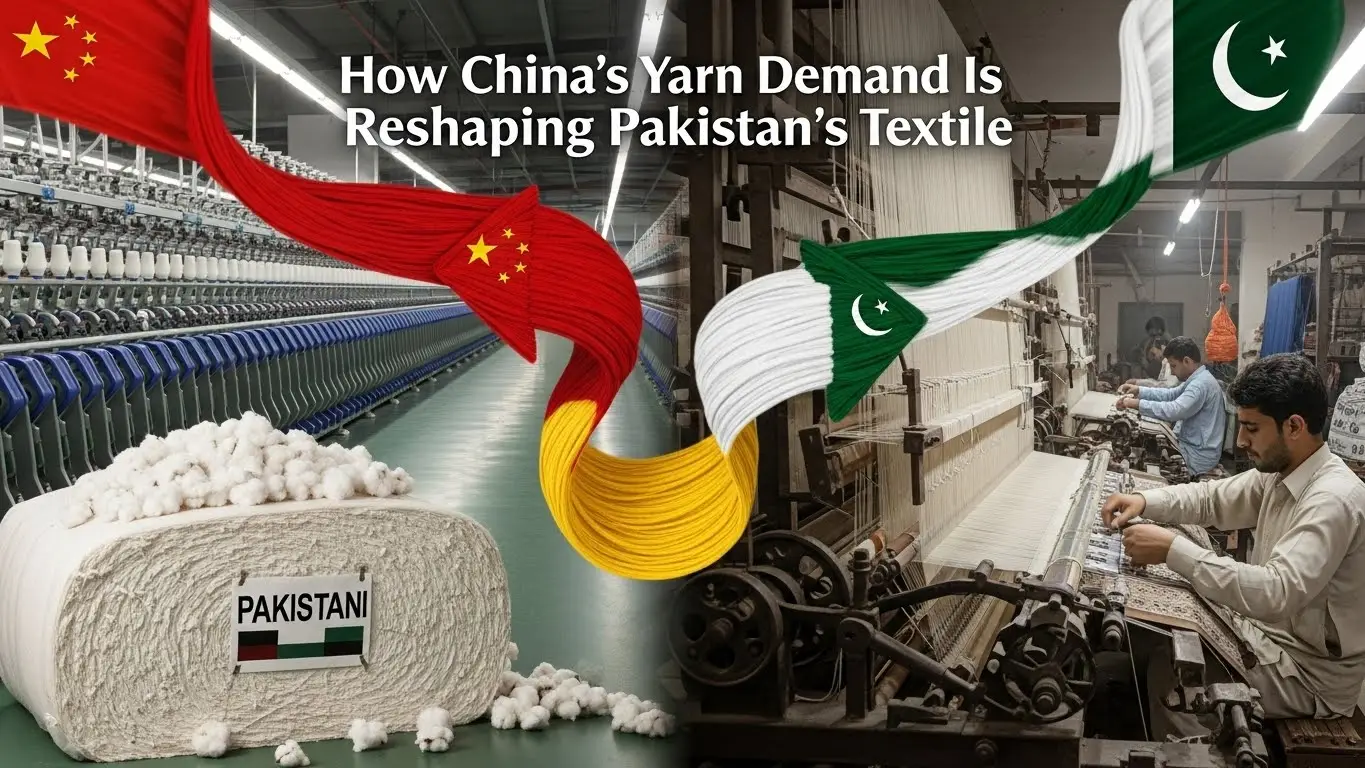
This isn’t a small side story. China has become Pakistan’s largest yarn export market, and that relationship is influencing everything from which mills stay operational to how manufacturers invest, what products they prioritize, and even how optimistic they feel about tomorrow.
This article explores exactly how China’s yarn imports are changing Pakistan’s textile landscape, why this relationship developed, what it means for different players in the industry, and what might happen next.
Understanding the Numbers: How Big Is China’s Yarn Demand from Pakistan?
Let’s start with scale, because understanding how much yarn Pakistan exports to China helps explain why this matters so much.
Pakistan’s Yarn Export Profile
Pakistan’s textile exports reach approximately $17-18 billion annually, with yarn representing a significant portion of this total. While exact real-time figures fluctuate monthly, China consistently ranks as the top destination for Pakistani cotton yarn exports.
Recent trade data shows Pakistani yarn exports to China maintaining strong volumes even as other textile categories face challenges. When fabric markets slow and garment orders remain cautious, yarn exports to China provide steady demand that keeps spinning mills operational.
Why These Numbers Matter
Think about what the yarn export volume means practically:
- Dozens of spinning mills depend primarily on Chinese orders for capacity utilization
- Thousands of workers keep their jobs because Chinese manufacturers need Pakistani yarn
- Cotton farmers have consistent buyers because mills purchasing for Chinese exports need raw material
- Foreign exchange earnings from China help Pakistan’s balance of payments
This isn’t abstract trade theory; it’s the operational foundation keeping a large segment of Pakistan’s textile industry functioning during challenging times.
The Growth Trend
What makes this relationship particularly significant is the trajectory. China’s yarn imports from Pakistan haven’t just held steady, they’ve shown growth even as overall global textile trade faced headwinds.
Several factors drive this:
Rising Chinese labor costs make certain yarn production less competitive domestically, increasing import demand for specific counts and qualities that Pakistan produces well.
Environmental regulations in China have closed or restricted some textile facilities, creating gaps in domestic supply that imports fill.
Garment export production from China continues at a massive scale, requiring more yarn inputs than domestic production can efficiently supply.
Quality improvements from Pakistani mills have made their yarn more attractive to Chinese manufacturers who previously might have sourced domestically or from other countries.
Why China Needs Pakistani Yarn: The Industrial Logic
Understanding why the world’s largest textile manufacturer imports yarn from Pakistan requires looking at both countries’ industrial structures.
China’s Textile Industry Scale Creates Structural Import Need
China operates the world’s largest textile manufacturing complex. Their garment, fabric, and home textile production dwarfs every other country. But this massive scale creates a challenge: even as the world’s largest cotton producer, China’s textile manufacturing capacity exceeds what domestic fiber and yarn production can efficiently supply.
Think of it this way: if you’re producing millions of garments daily for global markets, you need enormous yarn quantities. While Chinese spinning mills produce substantial volumes, concentrating all that capacity domestically faces limitations:
- Water scarcity in key cotton-growing regions limits expansion
- Labor costs continue rising, making some yarn production less competitive
- Environmental compliance requires expensive equipment and processes
- Land costs make building new spinning capacity expensive
Meanwhile, Pakistani mills offer:
- Competitive pricing for quality yarn due to lower operational costs
- Cotton access as the world’s 4th largest producer
- Modern equipment in many facilities produces an internationally acceptable quality
- Established trade infrastructure, making imports efficient
Specific Yarn Types China Sources from Pakistan
Not all yarn is created equal. China doesn’t just randomly buy any Pakistani yarn; they specifically target:
Medium to coarse counts (10s to 40s): These workhorse yarns go into everyday garments, workwear, and basic textiles. Pakistani mills excel at producing these at competitive prices with acceptable quality.
Cotton-polyester blends: Increasingly popular for garment manufacturing, these blends require the good processing capabilities that Pakistani manufacturers have developed.
Organic and sustainable yarns: As Chinese manufacturers supply brands with sustainability requirements, demand for GOTS-certified and Better Cotton Initiative yarn from Pakistan has grown.
Specific fiber compositions: Chinese buyers sometimes need particular cotton varieties or blend ratios where Pakistan’s cotton base and processing capabilities align well.
This selectivity means Pakistani mills that position themselves in these categories benefit most from Chinese demand.
How China’s Demand Creates Stability for Pakistan’s Textile Market
Now let’s get to the core question: How exactly does Chinese yarn buying reshape Pakistan’s textile outlook?
1. Operational Continuity During Weak Domestic Cycles
Pakistan’s domestic textile market faces real challenges. Consumer spending remains pressured by inflation. Local garment sales are soft. Fabric buyers are cautious.
In this environment, mills that focused solely on domestic markets struggle. But mills with strong Chinese export relationships maintain steady production schedules.
When your largest customer needs regular yarn deliveries to keep their own manufacturing running, you have predictable orders that allow:
- Production planning weeks or months ahead
- Raw material procurement based on actual needs rather than speculation
- Workforce stability without layoffs and rehiring cycles
- Cash flow is sufficient to meet obligations
This operational continuity sounds boring, but it’s actually transformative. The difference between a mill running at 85% capacity year-round versus swinging between 50% and 95% dramatically affects profitability and survival.
2. Investment Confidence and Long-Term Planning
Mills with established Chinese customers make different investment decisions than those chasing uncertain domestic or Western markets.
If you know Chinese buyers will likely need your yarn capacity for the next 2-3 years, you can justify:
- Upgrading machinery to improve quality and efficiency
- Obtaining certifications (GOTS, OEKO-TEX), Chinese customers value
- Installing solar panels to reduce energy costs on operations you’re confident will continue
- Training workers in specialized skills for yarn types that Chinese manufacturers prefer
Without demand visibility, these investments feel risky. With it, they become strategically positioned.
This confidence ripples through the supply chain. Cotton farmers supplying mills with Chinese contracts feel more secure planting cotton. Equipment suppliers can forecast spare parts demand. Banks become slightly less nervous about financing textile operations.
3. Market Diversification and Risk Reduction
Depending entirely on any single market, domestic Pakistani, European buyers, and American brands creates vulnerability. When that market faces problems, you face problems.
China’s yarn demand provides Pakistani mills with crucial market diversification:
- When Western brands reduce orders, Chinese manufacturers maintain theirs
- When Pakistani domestic consumption weakens, export demand continues
- When European buyers face slow seasons, Chinese production cycles may differ
- When American tariff situations create uncertainty, Chinese relationships provide alternatives
This diversification doesn’t eliminate risk, it spreads it across multiple markets with different economic cycles, policy environments, and demand patterns. That spreading dramatically improves business stability.
4. Price Floor Support
Here’s something subtle but important: Chinese demand helps prevent yarn price collapses.
In purely domestic markets with weak demand, prices can crash as desperate sellers cut rates, trying to move inventory. This destroys everyone’s margins and creates unsustainable conditions.
Export demand from China creates a price floor. When domestic buyers offer very low prices, mills can choose to export instead. This optionality prevents the race-to-the-bottom pricing that devastates industries.
Chinese buyers pay market rates; they’re not charity. But having a large, consistent buyer who will take volume at reasonable prices keeps the market rational.
5. Technology and Quality Push
Chinese manufacturers increasingly demand better quality. They’re not just buying the cheapest yarn anymore; they want consistency, specific specifications, and reliability.
This quality focus pushes Pakistani mills to improve:
- Investing in better testing equipment
- Implementing stricter quality control processes
- Training staff on consistency maintenance
- Upgrading machinery to reduce defects
These improvements, initially made to satisfy Chinese customers, benefit the entire business. Mills producing quality yarn for China can also better serve Western buyers, domestic premium markets, and other export destinations.
In this way, China’s demand doesn’t just provide volume; it drives quality evolution across Pakistan’s textile sector.
The Challenges: It’s Not All Perfect
Honest analysis requires acknowledging the complications in this China-Pakistan yarn relationship.
Dependency Risk
Relying heavily on any single market creates vulnerability. If Chinese demand suddenly weakens, due to their domestic economic challenges, policy changes, or shifts in garment production, Pakistani mills that depend on this market would face serious disruption.
Smart manufacturers recognize this and work to maintain diversified customer bases even while benefiting from Chinese demand.
Price Pressure and Margin Squeeze
Chinese buyers are sophisticated and price-conscious. They negotiate hard, understand market dynamics, and have alternatives if pricing doesn’t work for them.
This means Pakistani mills can’t take Chinese demand for granted or price uncompetitively. The volume is there, but margins can be thin, especially when facing:
- High energy costs in Pakistan
- Expensive raw cotton (when production falls and imports are needed)
- Currency fluctuations are affecting competitiveness
- Financing costs for working capital
Mills must operate efficiently to profitably serve Chinese demand rather than just chasing volume.
Quality Expectations Keep Rising
As mentioned, Chinese buyers increasingly demand better quality. This is good long-term but creates short-term challenges:
- Mills must invest in equipment upgrades
- Quality control systems need improvement
- Staff training becomes essential
- Rejection rates for inconsistent production affect relationships
Mills that can’t meet these evolving standards risk losing Chinese business to competitors who can, whether other Pakistani mills or alternative suppliers from other countries.
Payment Terms and Working Capital
Export transactions, even with established buyers, require working capital. The time between purchasing cotton, producing yarn, shipping to China, and receiving payment can stretch 60-90 days.
In Pakistan’s current liquidity-constrained environment, where financing is expensive and bank lending is cautious, managing this working capital gap challenges many mills, even those with good Chinese orders.
Geopolitical Considerations
While China-Pakistan relations are generally strong, global geopolitics can complicate trade relationships. Western pressure on both countries, trade policy changes, or regional tensions could theoretically impact textile trade.
So far,the commercial textile trade has remained largely insulated from geopolitical issues, but prudent businesses monitor these dynamics.
What This Means for Different Stakeholders
The China yarn demand story affects various players in Pakistan textile ecosystem differently:
For Spinning Mills
Opportunity: Chinese demand provides volume, stability, and justification for quality improvements and capacity investments.
Strategy: Develop strong relationships with multiple Chinese buyers rather than over-depending on one. Invest in quality systems that meet Chinese expectations. Position in yarn counts and types that Chinese manufacturers prefer. Maintain alternative markets as backup.
For Vertically Integrated Textile Companies
Opportunity: Strong spinning division performance (fed by Chinese exports) can subsidize temporary weakness in fabric or garment divisions during market cycles.
Strategy: Use Chinese yarn demand to maintain overall company health while building capabilities in other value chain stages. Consider whether Chinese buyers might also be interested in fabric or finished products as relationships deepen.
For Cotton Farmers
Opportunity: Mills with Chinese export commitments provide reliable cotton buyers at reasonable prices, reducing farmer risk.
Strategy: Develop relationships with mills serving export markets. Consider organic certification if mills have Chinese demand for certified organic yarn. Understand the quality standards Chinese buyers expect and produce cotton meeting those specs.
For the Pakistani Textile Associations and the Government
Opportunity: The China relationship can be strengthened through trade facilitation, quality promotion, and policy support.
Strategy: Facilitate mill-to-buyer connections through trade missions and exhibitions. Support quality and certification programs that meet Chinese buyer requirements. Negotiate favorable trade terms and reduce transaction costs. Promote Pakistan’s yarn capabilities in Chinese markets.
For International Buyers (Non-Chinese)
Opportunity: Pakistani mills serving Chinese markets demonstrate the capability to handle volume, maintain quality, and deliver reliably.
Strategy: Consider that mills with strong Chinese relationships have proven capabilities. Evaluate whether these mills could apply their operational excellence to your orders. Potentially benefit from overcapacity if Chinese demand temporarily softens.
Regional Competition: How Pakistan Stacks Up
Pakistan isn’t the only supplier to Chinese yarn buyers. Understanding the competitive landscape helps explain Pakistan’s position:
India: The Largest Competitor
India produces far more cotton and yarn than Pakistan. They’re geographically close to China and have substantial manufacturing capabilities.
India’s advantages: Larger scale, more investment in technology, better infrastructure in some regions, and government support schemes.
Pakistan’s advantages: Sometimes better pricing, certain cotton qualities Chinese buyers prefer, established relationships, and potentially fewer geopolitical complications.
The competition is real, but both countries supply Chinese demand, it’s not zero-sum.
Vietnam and Indonesia
These Southeast Asian countries have growing textile sectors but remain more focused on garment assembly than yarn production. They’re more likely to be yarn importers themselves than major competitors to Pakistan in the Chinese market.
Central Asian Producers
Countries like Uzbekistan produce cotton and yarn but focus more on regional markets and Europe than China.
The Competitive Reality
Pakistan occupies a specific niche in Chinese yarn sourcing: reliable quality at competitive pricing for medium counts and cotton blends. Maintaining this position requires continuous improvement, but is achievable with focused effort.
Looking Forward: What’s Next for This Relationship?
Several trends will likely shape how China’s yarn demand influences Pakistan’s textile future:
Sustainability Requirements Increasing
Chinese manufacturers supplying global brands face growing pressure to prove sustainable sourcing. This creates an opportunity for Pakistani mills with:
- GOTS certified organic cotton yarn
- Better Cotton Initiative certification
- Traceable supply chains
- Environmental compliance documentation
Mills’ investment in these credentials positions well for future Chinese demand.
Quality Standards Continuing to Rise
As Chinese garment manufacturers move upmarket (they’re no longer just producing ultra-cheap basics), they need better quality inputs. Pakistani mills that continuously improve will benefit; those standing still risk losing business.
Potential Yarn Type Evolution
Chinese buyers might shift which yarn types they need based on their own product evolution. Pakistani mills should stay attuned to these changes and maintain flexibility to adjust production mixes.
Trade Facilitation Improvements
Both governments continue working on trade efficiency. Improvements in customs processing, payment systems, and logistics could increase trade volumes and strengthen relationships.
Alternative Markets as Backup
While benefiting from Chinese demand, smart Pakistani manufacturers will develop relationships in Bangladesh, Vietnam, Europe, and American markets as diversification against over-dependence.
The Broader Implications for Pakistan’s Textile Outlook
Step back from the details, and China’s yarn demand creates several strategic implications:
Export Orientation Over Domestic Focus
Mills’ success with Chinese exports demonstrates that international markets provide more stable demand than domestic Pakistani consumption. This encourages broader export orientation across the sector.
Quality and Certification Emphasis
Chinese buyers’ quality requirements push the entire industry toward better standards. This quality evolution benefits Pakistan’s competitiveness globally, not just in China.
Industrial Relationships Over Spot Trading
Chinese manufacturers prefer reliable supplier relationships over purely transactional spot buying. This encourages Pakistani mills to think long-term and invest in customer relationships.
Confidence Despite Challenges
Perhaps most importantly, Chinese demand provides enough stability that manufacturers, workers, and suppliers maintain confidence in the sector’s future despite current challenges. This confidence itself enables the investment and improvement needed for long-term success.
Conclusion: A Relationship Reshaping Possibilities
China’s yarn demand isn’t saving Pakistan’s textile industry; that’s too dramatic and ignores Pakistan’s own capabilities and efforts. But it is providing crucial support that allows the industry to navigate difficult times while positioning for better ones.
This relationship has transformed from transactional trade to strategic interdependence. Chinese manufacturers need Pakistan’s yarn capacity and cotton access. Pakistani mills need Chinese volume and market stability.
The outlook this creates for Pakistan’s textile sector is cautiously optimistic. Challenges remain: energy costs, working capital constraints, and regional competition. But having the world’s largest textile manufacturer as your biggest yarn customer provides a foundation other textile-producing countries would envy.
For Pakistani textile businesses, the message is clear: China’s demand is an opportunity to leverage, not take for granted. Mills that use this demand to improve quality, obtain certifications, invest in efficiency, and build strong customer relationships will thrive.
Those who view it as temporary luck or fail to continuously improve risk losing this crucial market to competitors who take the opportunity more seriously.
The textile industry emerging from this period will be different, more export-focused, more quality-conscious, more efficient, and more realistic about what creates sustainable competitiveness. And China’s yarn demand is playing a central role in shaping that transformation.
Pakistan’s textile outlook is being reshaped not by government policy or subsidy programs, but by the practical reality of commercial relationships meeting mutual needs. That might be the most sustainable foundation for growth the industry could ask for.
Frequently Asked Questions
Q1: Why does China import yarn from Pakistan when it produces its own?
China’s massive textile manufacturing scale exceeds domestic yarn supply capacity. Rising labor costs, water scarcity, environmental regulations, and land costs make importing certain yarn types more economical than producing everything domestically. Pakistan offers competitive pricing, acceptable quality, cotton access, and an established trade infrastructure, making them an attractive supplier.
Q2: How much yarn does Pakistan export to China annually?
While exact figures fluctuate monthly, China consistently represents Pakistan’s largest yarn export market, accounting for a significant portion of Pakistan’s $17-18 billion annual textile exports. Recent data shows this relationship maintaining strong volumes even as other textile categories face challenges, with Chinese orders helping keep spinning mills at 80-90% capacity utilization.
Q3: What types of yarn does China buy from Pakistan?
China primarily imports medium to coarse count cotton yarns (10s-40s) for everyday garments and basic textiles, cotton-polyester blends for apparel manufacturing, organic and sustainably certified yarns (GOTS, BCI) to meet international brand requirements, and specific fiber compositions where Pakistan’s cotton base and processing capabilities align with Chinese manufacturer needs.
Q4: How does China’s yarn demand help Pakistan’s textile stability?
Chinese demand creates stability through consistent orders, enabling production planning, providing cash flow when domestic markets weaken, supporting firm pricing that prevents market collapses, enabling investment confidence for mill upgrades and improvements, and offering market diversification, reducing dependence on any single buyer geography.
Q5: What are the risks of Pakistan depending on Chinese yarn demand?
Main risks include over-dependence on a single market, creating vulnerability if Chinese demand weakens, intense price pressure from sophisticated Chinese buyers squeezing profit margins, rising quality expectations requiring continuous investment, working capital challenges during payment cycles, and potential geopolitical complications that could theoretically impact trade relationships.
Partner With Export-Focused Pakistani Textile Manufacturers
Understanding how China’s yarn demand reshapes Pakistan’s textile landscape is one thing. Positioning your business to benefit from these dynamics is another.
At Vigour Impex, we’re not just watching this China-Pakistan yarn relationship; we’re actively participating in it and leveraging the stability it creates to serve clients globally.
Why Vigour Impex Succeeds in the China-Influenced Textile Market:
🇨🇳 Established Chinese Buyer Relationships
We maintain strong connections with Chinese textile manufacturers, providing us with the operational stability and capacity utilization that comes from consistent export demand. This Chinese market success demonstrates our capability to meet international buyer standards.
Quality-Certified Yarn Production
Our spinning facilities produce cotton yarn (10s-60s counts), blended yarns, and specialty varieties meeting the quality specifications Chinese buyers demand. GOTS-certified organic options and BCI membership position us for sustainability-conscious buyers.
Vertical Integration Advantage
From cotton procurement through spinning, weaving, dyeing, and finished textile production, we control the entire value chain. What Chinese buyers value in our yarn, you benefit from across all our products.
Operational Stability
Mills dependent solely on uncertain markets struggle. Our diversified customer base, including Chinese, European, American, and regional buyers, means we maintain consistent operations, preserve a skilled workforce, and deliver on commitments reliably.
Market Intelligence
We track Chinese textile manufacturing trends, demand patterns, and specification requirements. This intelligence informs our production planning and benefits all our customers; you gain from insights developed by serving the world’s largest textile market.
Certifications: Chinese Buyers Trust
- GOTS (Global Organic Textile Standard)
- OEKO-TEX Standard 100
- Better Cotton Initiative (BCI)
- ISO 9001 Quality Management
These credentials satisfy the most demanding international buyers, whether in China, Europe, or North America.
Beyond Yarn: Complete Textile Solutions
While yarn exports to China create our operational foundation, we offer complete textile solutions:
- Cotton and blended yarns (various counts)
- Woven and knitted fabrics
- Home textiles (bedding, towels, table linens)
- Garments and made-ups
- Custom product development
What This Means for Your Sourcing Strategy:
Reliability: Mills with strong Chinese relationships have proven they can handle volume, maintain quality, and deliver consistently, capabilities that benefit all customers.
Quality: Quality standards that satisfy Chinese manufacturers exceed many buyers’ requirements, ensuring you receive excellent products.
Stability: Our diversified customer base means we’re not desperate for orders or making short-term decisions that compromise quality.
Value: Operational efficiency from high capacity utilization allows competitive pricing without sacrificing quality or service.
Ready to Discuss Your Textile Needs?
Whether you’re:
- Sourcing yarn for textile manufacturing
- Developing home textile product lines
- Planning garment collections
- Requiring certified sustainable textiles
- Any buyer evaluating Pakistani manufacturers
We’re ready to explore partnership possibilities.
What Happens When You Contact Us:
✓ Rapid response (same-day or within 24 hours)
✓ Detailed discussion of specifications, volumes, timelines
✓ Transparent pricing with clear breakdowns
✓ Sample availability for quality evaluation
✓ Facility documentation (certifications, photos, references)
✓ Market insights relevant to your product categories
No pressure. Professional conversation about whether we’re the right fit.
Special Focus: Yarn Buyers
If you’re sourcing yarn (whether you’re a Chinese, Bangladeshi, Vietnamese, or Western textile manufacturer):
Our yarn capabilities include:
- Cotton counts: 10s to 60s (carded and combed)
- Blended yarns: Cotton-polyester, cotton-viscose combinations
- Organic cotton: GOTS-certified sustainable production
- Speciality yarns: Technical specifications to order
- Packaging: Customer specifications (cones, hanks, cartons)
- Logistics: FOB Karachi with reliable shipping partners
Request our Yarn Export Catalog:
Email info@vigourimpex.com with “Yarn Sourcing Inquiry” in the subject line.
The China-Pakistan yarn relationship demonstrates that commercial success comes from meeting real needs reliably. That principle guides everything we do at Vigour Impex.
Let’s discuss how we can support your textile sourcing requirements.
info@vigourimpex.com | vigourimpex.com
Vigour Impex Textile Excellence Through Global Partnerships Since 1999