


The home textile industry has entered 2026 in a state of controlled turbulence. Tariff policy is being rewritten in real time, sourcing maps are shifting between South and Southeast Asia, sustainability has moved from marketing language to a procurement requirement, and buyers are demanding more transparency, more certification, and more supply chain resilience than at any point in the last decade. For global buyers of bedding, towels, curtains, upholstery fabric, rugs, and other soft furnishings, understanding these home textile sourcing trends is no longer optional it is the difference between a stable supply chain and a costly disruption.
This article breaks down the major forces reshaping global home textile sourcing in 2026: market growth and size, tariff and trade policy shifts, sourcing diversification across manufacturing hubs, sustainability and certification requirements, material and design trends, technology-driven procurement, and practical strategies buyers can use to source smarter this year.
The State of the Global Home Textile Market in 2026
Despite economic headwinds, the global home textile market continues to expand. Industry estimates place the global home textile market at roughly $145 billion in 2026, up from around $136 billion in 2025, with projections reaching close to $200 billion by the early 2030s at a compound annual growth rate in the range of 6–7%. Growth is being driven by steady demand for performance bedding, a rebound in home renovation and furnishing spend, and rising middle-class consumption in emerging markets across Asia, the Middle East, and Latin America.
At the same time, the broader textile and apparel market which shares supply chains, raw materials, and manufacturing capacity with home textiles is estimated at over $1 trillion globally, with China still commanding the largest share of textile exports worldwide. That dual reality matters for buyers: home textile sourcing decisions are increasingly influenced by capacity constraints and pricing dynamics in the wider textile sector, not just the home furnishings category in isolation.
For sourcing and procurement teams, this growth is good news, but it comes with a caveat. Demand growth is happening at the same time as cost inflation, tariff uncertainty, and stricter compliance expectations meaning buyers who source well in 2026 will be the ones who plan for complexity rather than assume business as usual.
Tariffs and Trade Policy: The Biggest Variable in 2026 Sourcing
If there is one theme dominating home textile sourcing trends in 2026, it is tariff volatility. Trade policy shifts in the United States have rippled through every major sourcing hub China, India, Vietnam, Bangladesh, Cambodia, and Sri Lanka and buyers who built sourcing strategies around 2024 or 2025 tariff assumptions have had to rework them multiple times this year alone.
A few key developments are shaping the landscape:
A more uniform tariff environment emerged after a major U.S. Supreme Court ruling in February 2026. A broad Section 122 tariff rate began applying more uniformly across many sourcing countries, which reduced the tariff arbitrage that had previously made countries like Bangladesh, Vietnam, and Cambodia artificially cheaper relative to China. For buyers, this means country selection can no longer be based purely on last year’s tariff differential rates are being renegotiated and restructured throughout the year, with further changes anticipated as temporary tariff provisions expire and are replaced.
Bangladesh secured tariff relief that brought its rate more in line with regional competitors, while India has faced a comparatively higher rate in the U.S. market pending a finalized trade agreement. This has created uneven competitive positioning even among countries that were previously viewed as close substitutes for one another in home textile sourcing particularly for bedding, towels, and cotton-based products where India and Bangladesh compete directly.
Vietnam has strengthened its position as a resilient, higher-value sourcing hub, benefitting from more favorable tariff treatment and a continued push toward automation and higher-margin production. Vietnamese manufacturers are increasingly investing in productivity and value-added capabilities rather than competing purely on labor cost, positioning the country as a long-term strategic sourcing destination rather than just a low-cost alternative.
Polyester-heavy and synthetic home textile products are seeing the steepest landed-cost increases, while cotton and linen-based products a large share of the home textile category, including sheets, towels, and natural-fiber upholstery have more breathing room, in part because sourcing across South Asia for these fiber types was already diversified before the latest tariff changes.
The practical takeaway for buyers: landed cost, not quoted unit price, is now the only number that matters. A supplier’s per-yard or per-unit quote can look competitive on paper and still result in a higher final cost once tariffs, surcharges, and currency adjustments are factored in. Buyers who continue comparing raw quotes side by side without running full landed-cost calculations are, in effect, comparing the wrong numbers and it is an increasingly expensive mistake to make in 2026’s environment.
Sourcing Diversification: Beyond China, Beyond Single-Country Dependence
Sourcing diversification has been a talking point in textiles for years, but in 2026 it has become an operational necessity rather than a strategic preference. Several forces are accelerating this shift:
- Reduced reliance on any single country. Many apparel and home textile brands have set internal targets capping any one sourcing country at 20–25% of total production volume, spreading risk across multiple manufacturing hubs rather than concentrating it in one region.
- Growth across Vietnam, Bangladesh, India, Cambodia, Indonesia, and Sri Lanka. Buyers surveyed in recent industry reporting have increased their use of nearly every major Asian sourcing hub outside China, reflecting a broad-based diversification strategy rather than a shift toward any single alternative.
- Persistent China exposure even in “diversified” supply chains. Even when finished-goods production shifts to Vietnam or Cambodia, those countries often still rely on China for a substantial share of raw textile inputs yarns, greige fabric, and trims. True diversification increasingly means looking at the entire supply chain, not just the country where final assembly happens.
- Nearshoring interest in Mexico and Central America, particularly for buyers serving the U.S. market who want to take advantage of preferential trade terms and shorter lead times, even though home textile-specific nearshoring capacity remains more limited than in apparel.
For buyers, the practical implication is that sourcing diversification takes real time to execute often 12 to 18 months or more for a full realignment so decisions made now will shape supply chain resilience well into 2027 and beyond. Buyers should also recognize that full sourcing diversification is more achievable for large retailers with scale and sourcing teams than for smaller brands, which may need to lean more heavily on trusted trading partners or sourcing agents with multi-country factory networks already in place.
Sustainability and Certification: From Marketing to Procurement Requirement
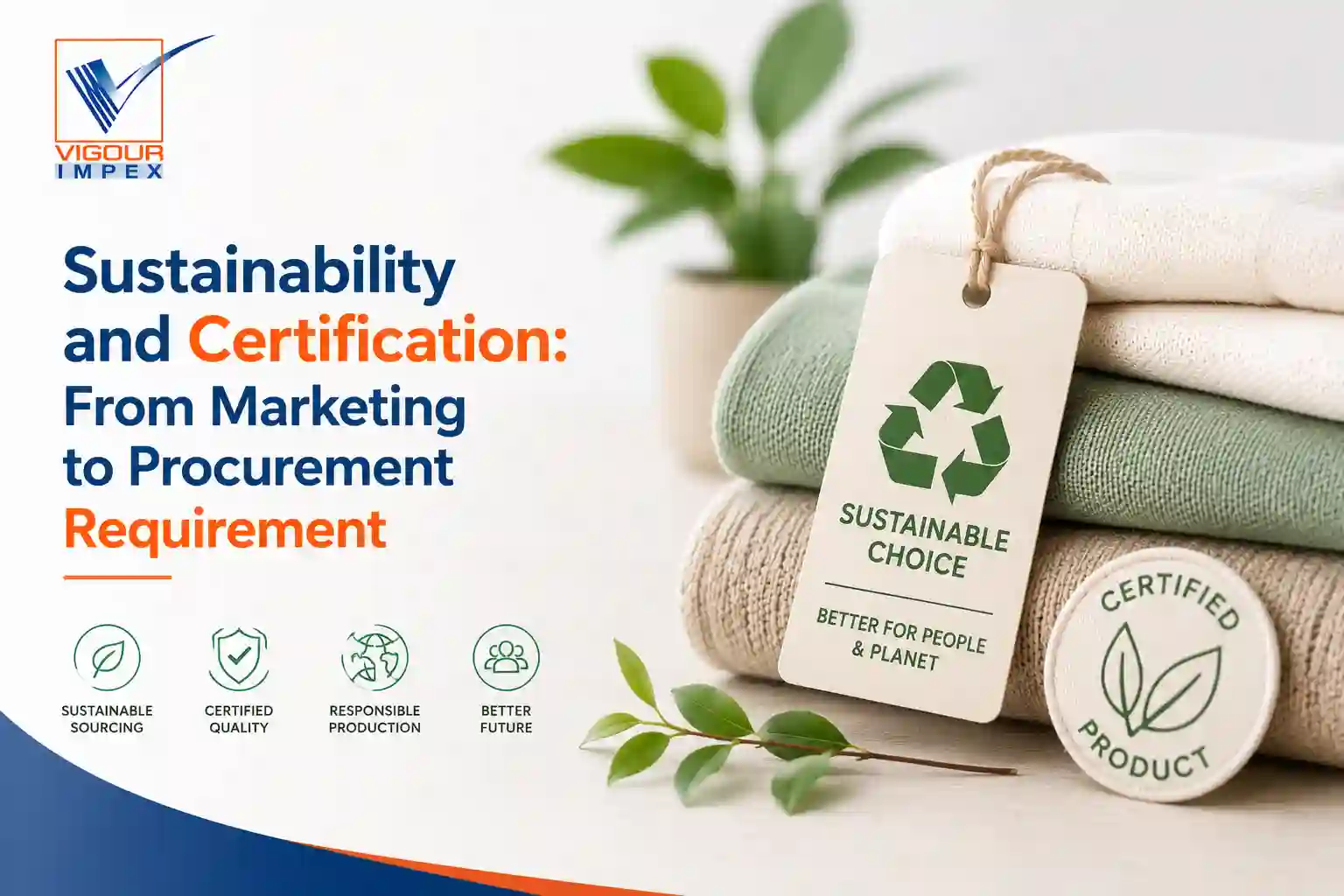
Sustainability has been a buzzword in home textiles for years, but 2026 marks a genuine shift: it is now a routine part of the procurement process rather than a differentiator. Retailers and distributors are increasingly requiring certified materials, documented traceability, and formal compliance paperwork as standard conditions of doing business not as optional add-ons.
Key sustainability-related trends buyers should track:
Certifications are becoming baseline requirements, not competitive advantages. Certifications such as OEKO-TEX and GRS (Global Recycled Standard) are increasingly expected by default for bedding, towels, and other textile categories sold through major retail channels in North America and Europe. Suppliers who cannot produce this documentation risk being excluded from RFPs altogether, regardless of price competitiveness.
Organic and natural fibers remain a major point of discussion, with organic cotton continuing to be one of the most requested materials across bedding, sheeting, and bath textiles. Buyers are also showing growing interest in other natural and biodegradable fibers as alternatives to synthetic blends, driven by both environmental positioning and consumer demand for healthier indoor environments.
Recycled and circular materials are gaining ground, particularly in European and North American markets, where retailers are favoring suppliers who can demonstrate measurable progress on waste reduction and product lifecycle responsibility even though fully circular manufacturing systems are still in early stages of development industry-wide.
Chemical-free processing and indoor air quality are emerging buyer priorities. As awareness grows around the health impact of dyes, finishes, and chemical treatments used in textile production, buyers especially in bedding and childrenswear-adjacent home categories are asking more pointed questions about production chemistry, not just fiber origin.
For buyers, the strategic point is that sustainability credentials now function as a qualifying criterion for supplier selection, similar to quality and price. Suppliers who can consistently document certified materials and traceable sourcing while holding cost stability will have a structural advantage in 2026 RFPs and vendor reviews.
Quality, Craftsmanship and the Move Toward Premiumization
Alongside sustainability, 2026 is seeing a notable shift toward premium positioning in home textiles. Buyers are increasingly sourcing products that emphasize comfort, durability, and craftsmanship rather than competing purely on the lowest unit price. This reflects broader consumer trends: shoppers are willing to pay more for home textiles that feel like an investment long-lasting sheets, well-constructed towels, and upholstery fabrics built to withstand years of use rather than treating bedding and bath linens as disposable, fast-replacement categories.
This premiumization trend creates real opportunity for manufacturers capable of producing higher-end home textiles, but it also raises the bar for what buyers expect from standard-tier suppliers. Quality consistency, not just price competitiveness, has become one of the most cited factors in supplier retention decisions, alongside reliable delivery timelines and responsive communication.
Performance features are also a growing part of the premiumization story. Cooling, moisture-wicking, antimicrobial, and hypoallergenic finishes once niche additions are increasingly embedded into mainstream bedding and bath lines as brands connect sleep quality and comfort with measurable health benefits, supporting premium price points even in categories that were historically commoditized.
Design and Material Trends Shaping 2026 Collections
On the design side, 2026 home textile collections are moving away from the symmetrical, minimalist prints that dominated recent years toward more tactile, expressive designs with narrative depth think botanical prints, abstract florals, and patterns drawing on heritage and craft traditions. For buyers curating private-label or retail collections, this shift matters because it affects everything from print licensing and design sourcing to minimum order quantities for custom patterns.
Trade platforms remain central to how these trends translate into commercial orders. Major sourcing events particularly large-scale exhibitions in China and Türkiye-focused sourcing zones continue to function as the meeting point where design trends, sustainable material innovations, and buyer relationships convert into actual production commitments. Buyers who attend or actively track these events typically gain earlier visibility into which materials and finishes will be commercially available before they become mainstream.
Digital Transformation and AI-Driven Supplier Discovery
One of the more structural shifts in 2026 home textile sourcing is how buyers find and evaluate suppliers in the first place. The traditional model relying on trade shows, personal networks, and long-standing agent relationships is being supplemented, and in some cases replaced, by digital and AI-driven sourcing tools that allow buyers to evaluate supplier capacity, compliance history, and pricing more efficiently.
This digital shift is paired with a broader change in how supplier relationships are evaluated. Buyers are moving away from transactional, price-only supplier relationships toward longer-term partnerships that reward transparency, responsiveness, and proven compliance track records. In a market where tariff policy and input costs can shift within a single quarter, buyers increasingly value suppliers who communicate proactively about cost pressures and capacity constraints rather than suppliers who simply offer the lowest quote until problems arise mid-order.
Practical Sourcing Strategies for Buyers in 2026
Given all of the above, global buyers navigating home textile sourcing in 2026 should consider the following priorities:
- Calculate landed cost, not quoted price. Factor in current tariff rates, surcharges, freight, and currency risk before comparing supplier quotes a lower unit price can easily become the more expensive option once total landed cost is calculated.
- Diversify at the raw material level, not just the country level. Verify where a supplier’s yarns, greige fabric, and trims originate, since finished-goods country of origin alone no longer tells the full exposure story, especially given continued reliance on Chinese textile inputs across Southeast Asian supply chains.
- Treat certifications as a baseline screening criterion. Request documentation for OEKO-TEX, GRS, or equivalent certifications early in supplier evaluation rather than late in the negotiation process, since retailers and end buyers increasingly require this paperwork as a condition of sale.
- Build in lead time for sourcing realignment. If shifting production between countries or suppliers, plan for a 12–18 month transition window rather than expecting an immediate switch, particularly for categories requiring specialized weaving, dyeing, or finishing capabilities.
- Balance cost competitiveness with quality and communication. Given the premiumization trend and rising buyer expectations around consistency, prioritize suppliers who demonstrate reliable delivery performance and transparent communication, not just the lowest bid.
- Monitor trade policy continuously, not annually. With tariff provisions expiring and being renegotiated throughout the year, sourcing strategies built on a single annual review are already out of date; buyers should treat trade policy monitoring as an ongoing operational function.
- Engage directly with sourcing hubs and trade events. Whether through major international exhibitions or direct supplier visits, staying close to where design and production decisions are actually made gives buyers earlier insight into material availability, pricing trends, and emerging manufacturing capabilities.
Final Thought
Home textile sourcing in 2026 is defined by a simple but demanding reality: the old playbook of chasing the lowest price from the lowest-cost country no longer produces reliable results. Tariff policy is being rewritten faster than sourcing teams can adjust to it, sustainability has become a procurement requirement rather than a marketing story, and buyers are rewarding suppliers who can deliver consistent quality, verified compliance, and honest communication over those who simply compete on cost.
For global buyers, the suppliers and partners who will matter most in 2026 and beyond are the ones capable of adapting alongside these shifts offering traceable, certified materials; absorbing and communicating tariff-driven cost pressures transparently; and supporting the higher quality and craftsmanship expectations of today’s end consumers. Buyers who build their sourcing strategy around adaptability, transparency, and long-term supplier collaboration will be far better positioned than those still sourcing home textiles the way the industry did five years ago.