



Pakistan has been a dependable source of yarn, fabric, home textiles and garments for international buyers for decades, and one of the first questions any importing textiles from pakistan asks before placing an order is simple: what will this shipment actually cost me? The answer almost always starts with FOB pricing. Understanding how FOB (Free on Board) pricing is built and what it does and doesn’t include is the difference between a smooth, profitable import program and one full of surprise costs, delayed shipments and margin erosion.
This guide breaks down exactly how FOB pricing works for textile imports from Pakistan, what goes into the number, how to calculate it step by step, and how experienced buyers protect themselves from the hidden costs that catch first-time importers off guard.
What Does FOB Pricing Actually Mean?
FOB, or Free on Board, is an Incoterm (International Commercial Term) published by the International Chamber of Commerce that defines exactly where the seller’s responsibility ends and the buyer’s responsibility begins during a shipment.
Under FOB terms, the seller (the Pakistani textile manufacturer or exporter) is responsible for all costs and risks until the goods are loaded onto the vessel at the named port of shipment, typically Port Qasim or Karachi Port in Pakistan. Once the goods pass the ship’s rail, responsibility, risk and remaining costs transfer to the buyer.
In practical terms, this means the FOB price quoted by a Pakistani supplier already includes:
- Raw material cost (cotton, yarn or fabric depending on the product)
- Manufacturing and processing costs
- Labor
- Factory overheads and supplier margin
- Local packing and labeling
- Inland transportation from the factory or mill to the port
- Port handling and export documentation
- Customs clearance in Pakistan
What FOB price does not include is anything that happens after the goods are loaded onto the ship: ocean freight, marine insurance, destination port charges, import duties and inland transportation in the buyer’s country. This distinction is where most importers underestimate their true landed cost.
Why FOB Is the Preferred Term for Textile Imports
Among the eleven Incoterms available, FOB remains the most commonly used term in the textile trade, and for good reason:
Clear division of responsibility. Both parties know exactly where their obligations start and stop, which reduces disputes over damaged or delayed cargo.
Buyer control over freight. Because the buyer arranges and pays for ocean freight from the port of loading onward, they can negotiate directly with freight forwarders, choose their preferred shipping lines, and consolidate multiple orders from different Pakistani vendors into a single container a strategy many experienced importers use to cut per-unit shipping costs.
Easier cost comparison. Since FOB strips out variable freight and insurance costs (which change depending on the buyer’s destination, shipping line, and season), it gives importers a clean, apples-to-apples basis for comparing quotes from different mills, fabric suppliers or garment manufacturers.
Standard practice among Pakistani exporters. Most textile vendor selection processes in Pakistan are built around FOB quoting, since exporters are generally not licensed freight forwarders and prefer to hand off ocean logistics to the buyer’s nominated forwarder.
Breaking Down the FOB Price: What’s Inside the Number
To calculate FOB pricing accurately whether you’re reviewing a supplier’s quote or building your own cost sheet before negotiating you need to understand each component that feeds into it.
1. Ex-Factory Cost
This is the starting point: the cost of the product as it leaves the factory floor, before any logistics costs are added. Ex-factory cost itself is built from:
- Raw material cost: Cotton, yarn, greige fabric, dyes and chemicals. Cotton prices fluctuate with global commodity markets, so this is often the most volatile line item.
- Conversion cost: Spinning, weaving, knitting, dyeing, printing, finishing, cutting, and stitching, depending on whether you’re importing yarn, fabric, home textiles, or finished garments.
- Trims and accessories: Buttons, zippers, labels, poly bags, cartons.
- Factory overhead and margin: Utilities, compliance costs, and the supplier’s profit.
2. Inland Freight to Port
The cost of moving finished goods from the factory (commonly located in textile hubs like Faisalabad, Karachi, Lahore, or Sialkot) to the port of loading. This varies depending on distance and mode of transport, and is almost always folded into the FOB quote rather than shown separately.
3. Export Documentation and Port Charges
This includes terminal handling charges (THC) at origin, customs clearance in Pakistan, export permits, certificates of origin and any inspection fees required before the container is loaded.
4. Loading Charges
The cost of physically loading the cargo onto the vessel the final step that completes the seller’s obligation under FOB terms.
Step-by-Step: How to Calculate FOB Price
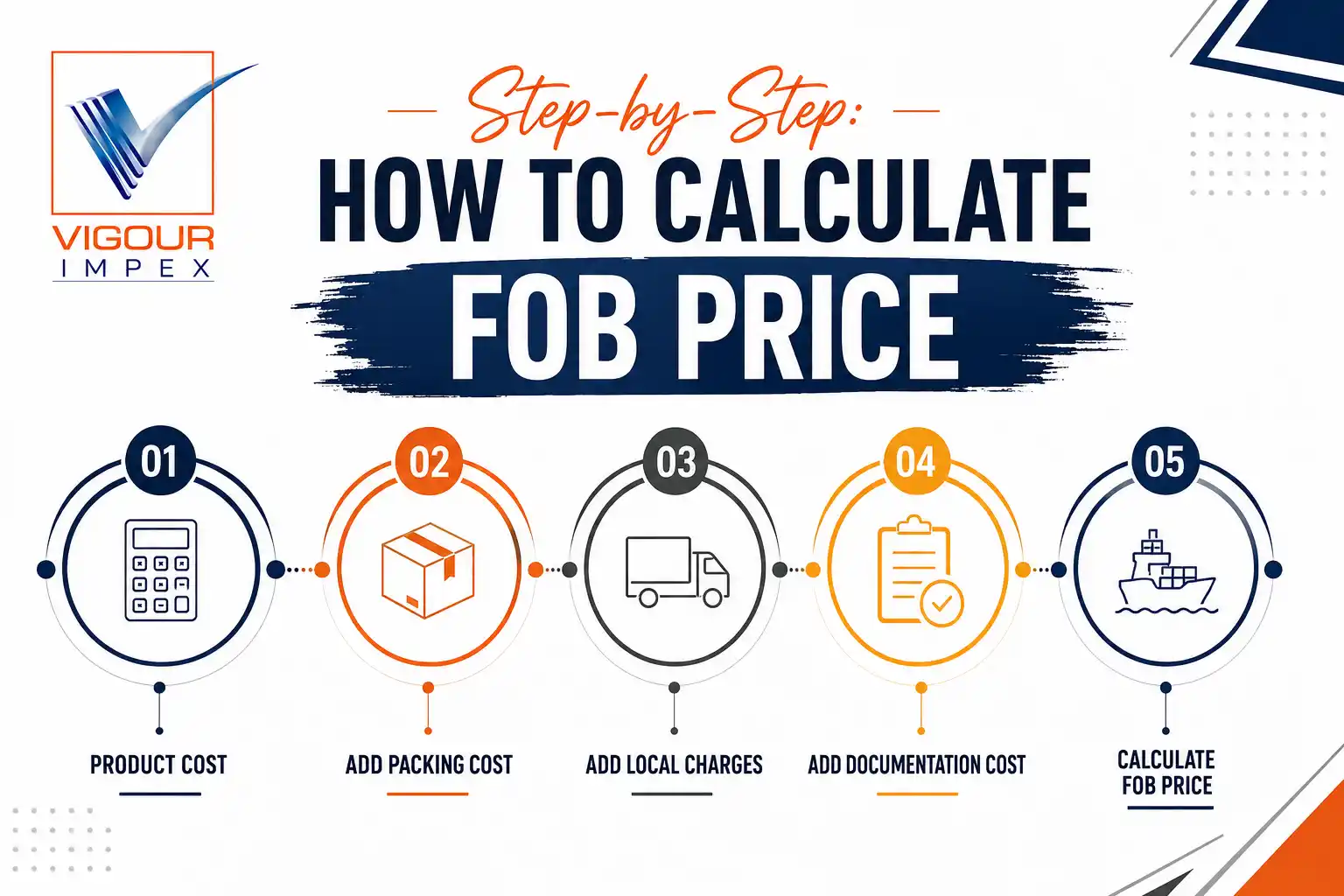
Here’s a practical framework you can apply whether you’re vetting a supplier’s quote or preparing your own cost estimate before requesting quotations from textile manufacturers in Pakistan.
Step 1: Establish the ex-factory cost per unit. Get a clear cost breakdown from your supplier cost per kg for yarn, per meter for fabric or per piece for garments and home textiles.
Step 2: Add inland transportation to the port. Confirm which port your supplier ships from (Karachi or Port Qasim are the two main options) and get the per-unit or per-container cost of moving goods from the factory to that port.
Step 3: Add export documentation and customs clearance costs in Pakistan. These are typically nominal on a per-unit basis but add up on smaller orders, so ask suppliers to itemize them rather than absorb them silently into the unit price.
Step 4: Add terminal handling and loading charges. Confirm these are included; in most cases they are bundled by default, but it’s worth verifying, especially with newer or smaller suppliers.
Step 5: Total it up.
FOB Price per Unit = Ex-Factory Cost + Inland Freight to Port + Export Documentation/Customs + Terminal Handling & Loading Charges
Worked Example
Say you’re importing 5,000 meters of cotton fabric from a mill in Faisalabad, shipping out of Port Qasim.
| Cost Component | Cost per Meter (USD) |
| Raw material (cotton yarn) | $1.20 |
| Weaving and finishing | $0.55 |
| Trims/packing | $0.10 |
| Factory overhead & margin | $0.35 |
| Inland freight to Port Qasim | $0.08 |
| Export documentation & customs | $0.04 |
| Terminal handling & loading | $0.03 |
| FOB Price per Meter | $2.35 |
For the full order: 5,000 meters × $2.35 = $11,750 FOB Port Qasim.
This is the number that appears on your commercial invoice and purchase order but it is not your landed cost. That’s the mistake many first-time buyers make.
FOB Price Is Not Your Total Landed Cost
This is the single most important thing to understand when importing textiles from Pakistan. Once you have the FOB price, you still need to calculate:
- Ocean freight from the Pakistani port to your destination port (varies by shipping line, season, container type FCL vs LCL and current freight market conditions)
- Marine insurance, typically 0.3%–0.5% of the CIF value
- Destination port charges and terminal handling
- Customs duties and import taxes in your country, which vary significantly by product category (yarn, fabric, home textiles, and garments are often classified and taxed differently under HS codes)
- Customs brokerage fees
- Inland transportation from the destination port to your warehouse
- Bank charges for letters of credit or wire transfers
- Currency exchange fluctuations, particularly relevant given PKR/USD volatility
A realistic landed cost formula looks like this:
Landed Cost = FOB Price + Ocean Freight + Marine Insurance + Destination Port Charges + Import Duties/Taxes + Customs Brokerage + Inland Delivery
Skipping this calculation and pricing your retail or wholesale products based on FOB alone is one of the most common reasons new importers see their margins evaporate.
Common Mistakes Buyers Make with FOB Pricing
Comparing FOB quotes without matching specifications. A lower FOB price often means a lighter fabric weight, a different yarn count, or reduced trims. Always compare quotes against an identical technical specification sheet, not just a number.
Assuming FOB includes inspection costs. Pre-shipment inspection is typically arranged and paid for separately by the buyer, unless explicitly negotiated into the contract. Skipping quality inspection to save cost is a false economy a rejected shipment costs far more than the inspection fee would have.
Not accounting for MOQ-driven cost swings. Ex-factory costs can shift substantially between small trial orders and full production runs. Ask for FOB pricing at your actual intended order quantity, not a sample quote.
Overlooking currency risk. If your supplier quotes in USD but sources raw materials priced in PKR, exchange rate shifts between quotation and shipment can affect final costs on longer lead-time orders. Lock in pricing terms clearly in your purchase agreement.
Treating all Pakistani ports as equal. Freight costs and transit times from Karachi Port versus Port Qasim can differ. Confirm the loading port upfront, since it affects both your FOB cost and your onward freight quote.
How Professional Sourcing Partners Streamline FOB Costing
Calculating accurate FOB pricing gets significantly easier and far less risky when you work with an established textile sourcing company in Pakistan rather than negotiating directly and independently with individual factories. This is especially true for buyers who are new to the market or scaling volume across yarn, fabric, home textiles, and garments simultaneously.
A structured sourcing process typically works like this:
- Requirement brief. The buyer’s product specifications, quality standards, target pricing, and timelines are documented clearly upfront.
- Vendor selection. Rather than relying on a single factory, a sourcing partner shortlists certified and compliant textile manufacturers in Pakistan with transparent, itemized costing which makes it far easier to benchmark FOB quotes against each other.
- Sampling and approval. Physical samples are tested and approved before bulk production begins, reducing the risk of costly rework or rejected shipments.
- Production follow-up. Structured textile production management in Pakistan ensures orders stay on schedule, with regular in-line quality checks so problems are caught early rather than at final inspection.
- Quality control. A dedicated pre-shipment inspection in Pakistan verifies that the goods loaded onto the vessel match the agreed specification, protecting the buyer’s investment before the container ever leaves port.
- Shipping and documentation. Export shipping, customs clearance, and documentation are handled professionally, reducing the chance of delays or errors that can inflate costs after the FOB stage.
Because sourcing agencies work across dozens of approved vendors and negotiate at volume, they’re often able to secure more competitive and more transparent FOB pricing than an individual buyer could negotiate directly while also absorbing much of the vendor management, quality control, and logistics coordination that would otherwise fall on the importer’s own team.
Tips for Negotiating Better FOB Pricing
Request itemized cost breakdowns, not just a single number. A supplier willing to break down raw material, labor, and overhead costs is generally more transparent and gives you room to negotiate specific line items rather than haggling blindly over a lump sum.
Time large orders around cotton price cycles. Since raw material cost is the largest component of ex-factory pricing for most textile products, understanding seasonal cotton price trends through ongoing textile market research in Pakistan can help you time larger commitments more favorably.
Consolidate orders where possible. Combining yarn, fabric, home textile or garment orders from multiple approved vendors into a single container shipment reduces the per-unit impact of inland freight and port charges.
Build long-term vendor relationships. Suppliers typically offer more consistent and competitive FOB pricing to buyers with a proven order history and reliable payment terms, rather than one-off transactional buyers.
Always confirm what’s excluded, in writing. Before finalizing a purchase order, get explicit written confirmation of what is and isn’t included in the FOB price packing specifications, inspection arrangements, documentation fees and the exact named port of loading.
FOB vs Other Common Incoterms in Textile Trade
It’s worth briefly understanding how FOB compares to other terms you may encounter when you import textile products from Pakistan, since suppliers sometimes quote alternatives:
- EXW (Ex Works): The buyer takes on responsibility from the factory gate itself, including inland transportation to the port more control, but more coordination required on the buyer’s side.
- CIF (Cost, Insurance, and Freight): The seller arranges and pays for ocean freight and insurance to the destination port, which can be convenient for buyers without established freight forwarder relationships, but often comes at a premium and less transparency over freight costs.
- CFR (Cost and Freight): Similar to CIF but without insurance, which the buyer must arrange separately.
For most experienced importers, FOB strikes the right balance: it keeps supplier accountability focused on production and export readiness, while giving the buyer control and negotiating leverage over the freight portion of the total landed cost.
Final Thoughts
FOB pricing is the foundation of every textile import transaction from Pakistan, but it’s only one piece of the total cost picture. Understanding exactly what’s built into that number and what still needs to be added for freight, insurance, duties, and inland delivery is essential for accurate budgeting, competitive vendor comparison, and protecting your margins.
For buyers sourcing yarn, fabric, home textiles or garments from Pakistan, working with an experienced sourcing partner that offers transparent costing, vetted vendor networks, structured production oversight, and reliable pre-shipment inspection can turn FOB pricing from a source of uncertainty into a predictable, negotiable part of your supply chain strategy.
Frequently Asked Questions
Does FOB price include customs duty in Pakistan?
Yes, export customs clearance and any applicable export-related fees in Pakistan are included in the FOB price. Import duties in the buyer’s own country are separate and are the buyer’s responsibility.
Who arranges the shipping line and vessel booking under FOB terms?
The buyer, or the buyer’s nominated freight forwarder, arranges vessel booking and pays for ocean freight from the Pakistani port onward.
Is pre-shipment inspection included in FOB pricing?
Generally not automatically it’s a separate service that buyers typically arrange, either independently or through their sourcing partner, and it should be budgeted for separately from the FOB unit price.
Can FOB pricing change after the purchase order is confirmed?
It shouldn’t, provided specifications, quantities, and delivery timelines remain unchanged. Significant cotton price movements or scope changes are the most common legitimate reasons a supplier might request a revision, which is why locking in clear terms in the purchase agreement matters.
Which Pakistani ports are commonly used for FOB textile shipments?
Karachi Port and Port Qasim are the two primary export gateways for Pakistan’s textile industry and the named port should always be specified clearly in the FOB quotation.