



If you buy fabric, clothing or home textiles, you will see the letters GSM on almost every spec sheet and quote. A supplier might offer you a 180 GSM t-shirt, a 500 GSM towel or a 120 GSM bed sheet. But what do these numbers really mean, and how do you know which one is right for your product?
At Vigour Impex, we have helped global brands and retailers source textiles from Pakistan since 1992, and GSM is one of the first things we discuss with every buyer. In this guide, we explain fabric GSM in simple words, share easy GSM charts for apparel and home textiles and show you how to use GSM to order the right fabric every time.
What Is GSM in Fabric?
GSM stands for grams per square meter. It tells you how much one square meter of fabric weighs. The higher the number, the heavier and usually thicker the fabric is.
For example:
- A 100 GSM fabric is light and thin, like a summer shirt or a sheer curtain.
- A 200 GSM fabric is medium weight, like a good-quality t-shirt or a polo.
- A 400 GSM fabric is heavy, like a thick hoodie or a soft bath towel.
GSM is used all over the world because it gives buyers and suppliers one clear number to compare. When you say “180 GSM cotton jersey,” everyone in the supply chain knows the weight you expect.
Why Fabric GSM Matters for Buyers
GSM is more than just a number on a sheet. It affects almost everything about your final product:
- Feel and comfort: Light fabrics feel airy and soft. Heavy fabrics feel warm and solid.
- Durability: Higher GSM fabrics often last longer and handle more washing.
- Absorbency: In towels, higher GSM means more cotton loops, which soak up more water.
- Look and drape: Light fabrics flow and move. Heavy fabrics hold their shape.
- Cost: Heavier fabric uses more yarn, so it usually costs more per meter or per piece.
- Shipping: Heavier goods weigh more, which can raise freight costs.
Picking the right GSM helps you balance quality, comfort and price for your customers.
How to Measure Fabric GSM
There are two common ways to check fabric weight in GSM.
Method 1: Use a GSM Cutter
This is the standard method in mills and quality labs.
- Use a GSM cutter to cut a round sample, usually 100 square centimeters.
- Weigh the sample on a precise digital scale.
- Multiply the weight by 100 to get grams per square meter.
So if the sample weighs 1.8 grams, the fabric is 180 GSM.
Method 2: Weigh a Measured Piece
If you do not have a GSM cutter, cut a neat square of fabric, such as 10 cm by 10 cm. Weigh it in grams, then multiply by 100. The result is close to the real GSM, but a cutter is more accurate.
Tip: Always test fabric after it is washed and finished. Washing, dyeing and finishing can change the final weight. Most buyers also accept a small tolerance, often around plus or minus 5%, so write the tolerance into your order.
GSM to Ounces Conversion
Some buyers, especially in the USA, use ounces per square yard (oz/yd²) instead of GSM. Here is a quick way to convert:
- GSM to oz/yd²: multiply GSM by 0.0295
- oz/yd² to GSM: multiply oz by 33.9
For example, 200 GSM is about 5.9 oz/yd², and 12 oz denim is about 407 GSM.
Fabric GSM Chart for Apparel
Use this GSM chart as a general guide when you plan garments. Exact numbers can change based on fiber, knit or weave and finish.
| Garment Type | Typical GSM Range | Weight Class |
| Lightweight shirts, blouses, voile | 80 – 130 | Light |
| Dress shirts (woven cotton) | 100 – 150 | Light |
| Basic t-shirts | 140 – 160 | Light to medium |
| Premium t-shirts | 180 – 220 | Medium |
| Polo shirts (pique) | 180 – 240 | Medium |
| Chinos and trousers | 200 – 300 | Medium |
| Sweatshirts and hoodies (fleece) | 280 – 400 | Heavy |
| Denim jeans | 340 – 475 | Heavy |
| Workwear and uniforms | 250 – 350 | Medium to heavy |
Choosing T-Shirt GSM
T-shirt GSM is one of the most common questions we hear. Lower GSM tees (around 140 to 160) are light and cheap, which makes them great for promotions and events. Higher GSM tees (180 to 220) feel thicker, hang better and last longer, so they suit retail and premium brands. If you are building your own clothing line, our guide to private label clothing manufacturing explains more steps to plan.
To learn more about matching fabric to your products, read our 7 tips for choosing the right fabric for clothing production, or explore our garment sourcing options.
Fabric GSM Chart for Home Textiles
GSM is just as important for home textiles. Here is a simple guide:
| Home Textile Product | Typical GSM Range | Notes |
| Bed sheets and pillowcases | 110 – 150 | Check thread count too |
| Duvet covers | 110 – 160 | Similar to sheets |
| Kitchen towels and tea towels | 200 – 400 | Higher GSM soaks up more |
| Hand and gym towels | 350 – 450 | Light and quick-drying |
| Bath towels (standard) | 400 – 600 | Good daily use |
| Bath towels (luxury and hotel) | 550 – 800 | Thick, soft and plush |
| Tablecloths and napkins | 150 – 250 | Medium weight |
| Curtains | 100 – 300+ | Sheer to blackout |
| Upholstery fabric | 300+ | Strong and long-lasting |
Bed Sheet GSM vs. Thread Count
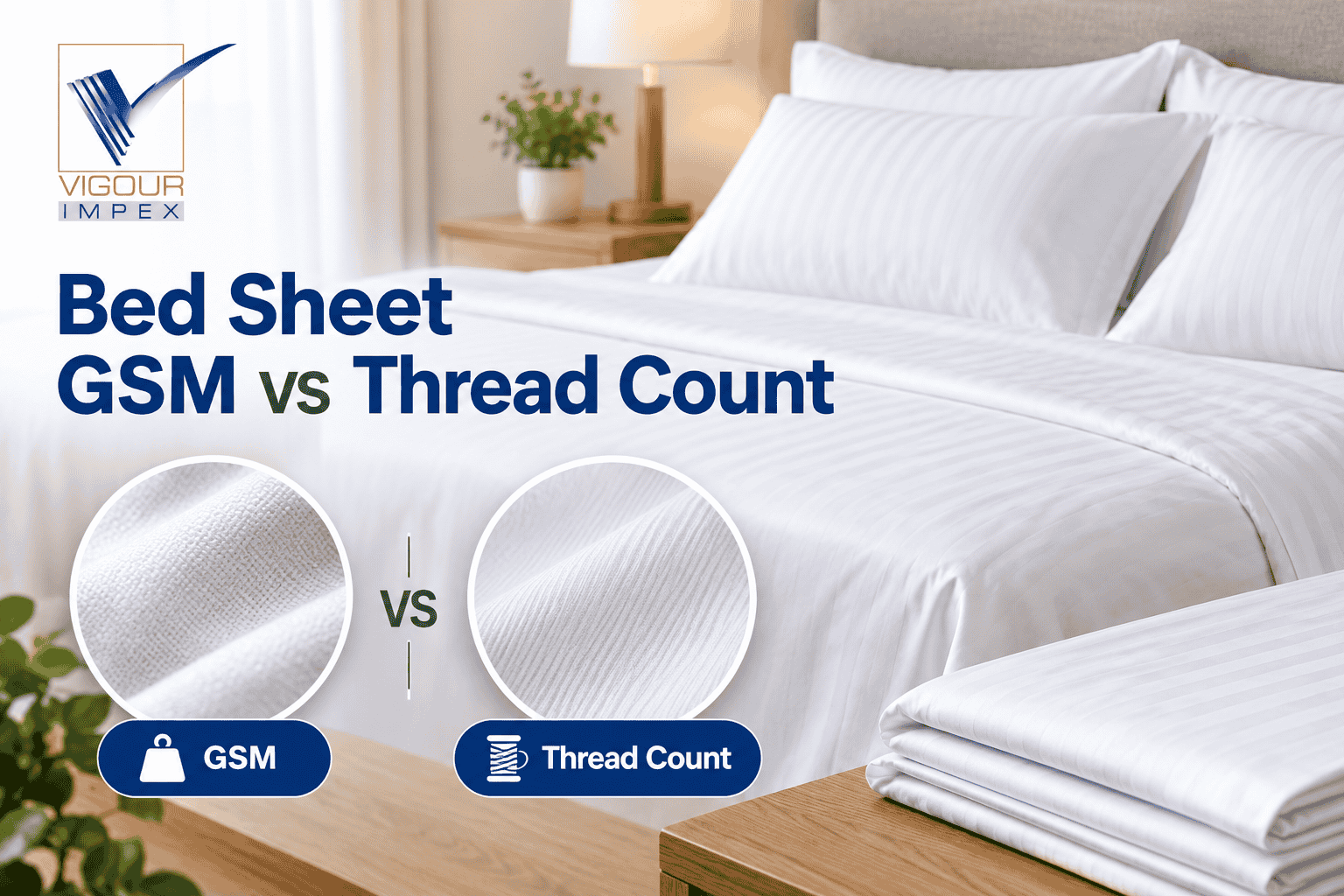
For sheets, buyers often look at thread count instead of GSM. Thread count tells you how many threads are woven into one square inch. GSM tells you the weight. A good sheet balances both. A very high thread count with a low GSM may feel thin, while a fair thread count with a solid GSM can feel smooth and strong. See our bedding and home furnishing range for more options.
Towel GSM
Towel GSM has a big effect on how a towel feels. Light towels (300 to 400 GSM) dry fast and are great for gyms, kitchens and travel. Heavy towels (600 GSM and above) feel soft and luxurious, which is why hotels and spas love them. Browse our bathroom accessories and kitchen textile accessories to see what we source.
If you buy for hotels, hospitals or other large facilities, our hotel linen buying guide and institutional textiles page can help you plan.
Is Higher GSM Always Better?
No. Higher GSM does not always mean higher quality. The best GSM depends on how the product will be used:
- A summer shirt should be light and breathable, not heavy.
- A hotel towel needs to be thick but also dry fast enough for daily laundry.
- A promo t-shirt may need a lower GSM to stay within budget.
Quality also depends on the fiber, yarn, weave or knit and finishing. A well-made 160 GSM fabric can perform better than a poorly made 200 GSM one. That is why buyers should look at GSM together with yarn count, fiber content and construction. You can learn more about our yarn and fabric sourcing on our product pages.
Tips for Ordering Fabric by GSM
Follow these simple tips to avoid surprises in bulk orders:
- Write the GSM clearly in your tech pack or purchase order.
- Add a tolerance, such as plus or minus 5%.
- Say when GSM is measured: before or after washing and finishing.
- Approve samples first and test their GSM before bulk production.
- Ask for test reports from the mill or a third-party lab.
- Check GSM during inspection, not only at the start. Our quality control and sourcing services include in-line and final inspections.
Final Thoughts
Fabric GSM is a simple number with a big impact. It shapes how your clothes, sheets and towels feel, how long they last and how much they cost. Once you understand GSM charts and how to measure fabric weight, you can write clearer specs, compare quotes fairly and get products your customers love.
Need help choosing the right GSM for your next order? Contact Vigour Impex to talk with our sourcing team, or explore our home textiles and full product range.
Frequently Asked Questions (FAQs)
What does GSM mean in fabric?
GSM means grams per square meter. It shows how much one square meter of fabric weighs. A higher GSM usually means a heavier, thicker fabric.
What is a good GSM for a t-shirt?
Most t-shirts fall between 140 and 220 GSM. Around 150 GSM is good for light, low-cost tees, while 180 to 220 GSM suits premium and retail t-shirts.
What GSM is best for bath towels?
For everyday bath towels, 400 to 600 GSM works well. For hotel or luxury towels, many buyers choose 550 to 800 GSM for a thick, soft feel.
Does higher GSM mean better quality?
Not always. Higher GSM means heavier fabric, but quality also depends on fiber, yarn, construction and finishing. The best GSM is the one that fits how the product will be used.
How do I convert GSM to ounces?
Multiply GSM by 0.0295 to get ounces per square yard. For example, 300 GSM is about 8.9 oz/yd².
