



If you’ve ever received two fabric samples that felt completely different despite sharing the same fiber content, the answer almost always comes down to two numbers most buyers overlook: yarn count and fabric density. These two specifications quietly determine everything about a fabric’s hand-feel, weight, durability, drape, and cost yet they’re often the least understood terms in an apparel sourcing conversation.
For brands and buyers working with a textile sourcing company in Pakistan, understanding yarn count and fabric density isn’t optional technical trivia. It’s the difference between approving a fabric that performs exactly as expected on the production floor and discovering after bulk production that the “same” fabric feels thinner, heavier, or completely different from the approved sample.
This guide breaks down yarn count and fabric density in plain language, explains how the two interact, and shows you exactly what to specify and verify when sourcing yarns, fabrics, and finished garments internationally.
Why Yarn Count and Fabric Density Matter in Apparel Sourcing
Every fabric whether it’s a woven poplin shirt, a knit jersey t-shirt, or a heavyweight denim is built from yarn. The thickness of that yarn (yarn count) combined with how tightly the yarns are packed together (fabric density) determines the fabric’s final weight, strength, texture, and price point.
Get these specifications wrong, and the consequences show up fast:
- A shirt fabric that feels rougher or thinner than the approved swatch
- Home textile products with inconsistent GSM between production lots
- Denim that doesn’t hold the expected weight or structure
- Knitwear that stretches out of shape or pills prematurely
- Unexpected cost overruns because finer yarns and higher densities cost more to produce
Because yarn count and fabric density directly affect cost, quality, and performance, they belong in every tech pack, purchase order, and quality control checklist not just left to “match to sample.”
What Is Yarn Count?
Yarn count is a numerical measurement that describes the thickness (or fineness) of a yarn. It essentially tells you how much length of yarn is needed to make up a specific weight, or how much a fixed length of yarn weighs depending on which counting system is used.
There are two broad categories of yarn count systems used globally in the textile industry:
1. Indirect Count Systems (Higher Number = Finer Yarn)
- English Count (Ne): The most widely used system for cotton and cotton-blend yarns, especially in Pakistan and South Asia. Ne represents the number of 840-yard hanks that weigh one pound. A higher Ne number (like 40s or 60s) means a finer, thinner yarn. A lower Ne number (like 10s or 20s) means a coarser, thicker yarn.
- Metric Count (Nm): Common in parts of Europe, this measures the number of 1,000-meter lengths per kilogram. Like Ne, a higher number means a finer yarn.
2. Direct Count Systems (Higher Number = Coarser Yarn)
- Tex: Measures the weight in grams of 1,000 meters of yarn. A higher Tex number means a thicker, heavier yarn.
- Denier: Common for synthetic and filament yarns like polyester or nylon, denier measures the weight in grams of 9,000 meters of yarn. Higher denier means a thicker yarn this is why “denier” is a familiar term in hosiery, activewear, and technical fabrics.
For apparel sourcing, cotton and cotton-blend yarns are almost always specified in Ne (English Count), so understanding this system is essential when reviewing specification sheets or negotiating with a yarn supplier.
Practical Ne guide for apparel fabrics:
- 10s–16s Ne: Coarse yarns used for heavy denim, canvas, and rugged workwear fabrics
- 20s–30s Ne: Medium yarns common in everyday t-shirts, casualwear, and mid-weight wovens
- 40s–60s Ne: Fine yarns used for dress shirts, premium t-shirts, and lightweight summer fabrics
- 80s–120s+ Ne: Very fine, luxury-grade yarns used in high-end shirting and premium apparel
Single Yarn vs. Ply Yarn
Yarn count specifications are often written with a second number, such as “30/1” or “30/2.” This indicates the ply structure:
- 30/1 means a single yarn at 30s Ne
- 30/2 means two strands of 30s Ne yarn twisted together, creating a stronger, more durable yarn (though the effective thickness becomes roughly equivalent to a 15s single yarn)
Ply yarns are generally used where strength, durability, or a more structured hand-feel is needed think heavier knitwear, structured shirting, or premium denim while single yarns are more common in lightweight, soft-handle fabrics.
Combed vs. Carded Yarn: Why It Affects Quality
Beyond count and ply, the spinning process itself affects yarn quality:
- Carded yarn goes through a simpler spinning process, retaining more short fibers and slight irregularities. It’s more economical but produces a slightly rougher, less uniform yarn.
- Combed yarn goes through an additional combing process that removes short fibers and aligns the remaining fibers more precisely, producing a smoother, stronger, and more uniform yarn commonly used for premium apparel.
When sourcing fabric, always confirm whether the yarn is carded or combed, since two fabrics with an identical Ne count and GSM can feel noticeably different in hand-feel and pilling resistance depending on this factor.
Ring Spun vs. Open-End (OE) Yarn
Spinning method is another variable that affects the final fabric:
- Ring spun yarn is spun using a traditional, slower process that produces a stronger, smoother, and more consistent yarn the standard for premium t-shirts and shirting fabrics.
- Open-end (OE) yarn is spun faster and more economically, producing a slightly coarser, bulkier yarn often used in denim, toweling, and mid-range knitwear where a softer, more uniform surface isn’t the top priority.
What Is Fabric Density?
While yarn count tells you how thick the yarn itself is, fabric density tells you how tightly those yarns are packed together during weaving or knitting. This is where fabric weight, opacity, drape, and strength really come into play.
For Woven Fabrics: EPI and PPI
Woven fabric density is measured using:
- EPI (Ends Per Inch): The number of warp yarns (running lengthwise) packed into one inch of fabric
- PPI (Picks Per Inch): The number of weft yarns (running crosswise) packed into one inch of fabric
Together, EPI and PPI form the fabric’s “thread count” or construction often written as something like “133×72,” meaning 133 ends per inch and 72 picks per inch. A higher combined EPI and PPI generally means a denser, more tightly woven fabric with better opacity and durability, while a lower combination produces a lighter, more breathable fabric.
For Knit Fabrics: Stitch Density and GSM
Knit fabrics don’t use EPI/PPI in the same way, since they’re built from interlocking loops rather than crossing yarns. Instead, knit density is typically expressed through:
- Stitch length and courses/wales per inch, which determine how tightly the loops are formed
- GSM (Grams per Square Meter), the most commonly used overall weight measurement for both knits and wovens
GSM: The Universal Weight Reference
GSM is arguably the single most important number in fabric sourcing conversations because it directly reflects the finished fabric’s weight, regardless of yarn count or construction method. It’s calculated by weighing a fixed-size fabric sample (usually a 10cm x 10cm swatch) and converting it to grams per square meter.
General GSM ranges for apparel:
- 100–150 GSM: Lightweight fabrics for summer shirts, blouses, and linings
- 150–220 GSM: Mid-weight fabrics for everyday t-shirts, casual shirts, and polos
- 220–300 GSM: Heavier fabrics for sweatshirts, premium t-shirts, and structured shirting
- 300+ GSM: Heavyweight fabrics used for denim, outerwear, and workwear
How Yarn Count and Fabric Density Work Together
Here’s where sourcing gets more nuanced: yarn count and fabric density are not interchangeable specifications they work together to determine the final fabric outcome, and the same GSM can be achieved through very different combinations.
For example, a 200 GSM fabric could be made from:
- A coarser yarn (like 20s Ne) woven at a lower density, or
- A finer yarn (like 40s Ne) woven at a much higher density
Both fabrics might hit the same GSM target on paper, but they’ll feel, drape, and perform completely differently. The finer-yarn, higher-density version will typically feel smoother and more refined, while the coarser-yarn, lower-density version will feel bulkier and more casual even though the “weight” specification matches.
This is exactly why relying on GSM alone is a common and costly sourcing mistake. A complete fabric specification should always include yarn count, weave or knit construction, and GSM together, not GSM in isolation.
Choosing the Right Yarn Count and Density for Different Apparel Categories
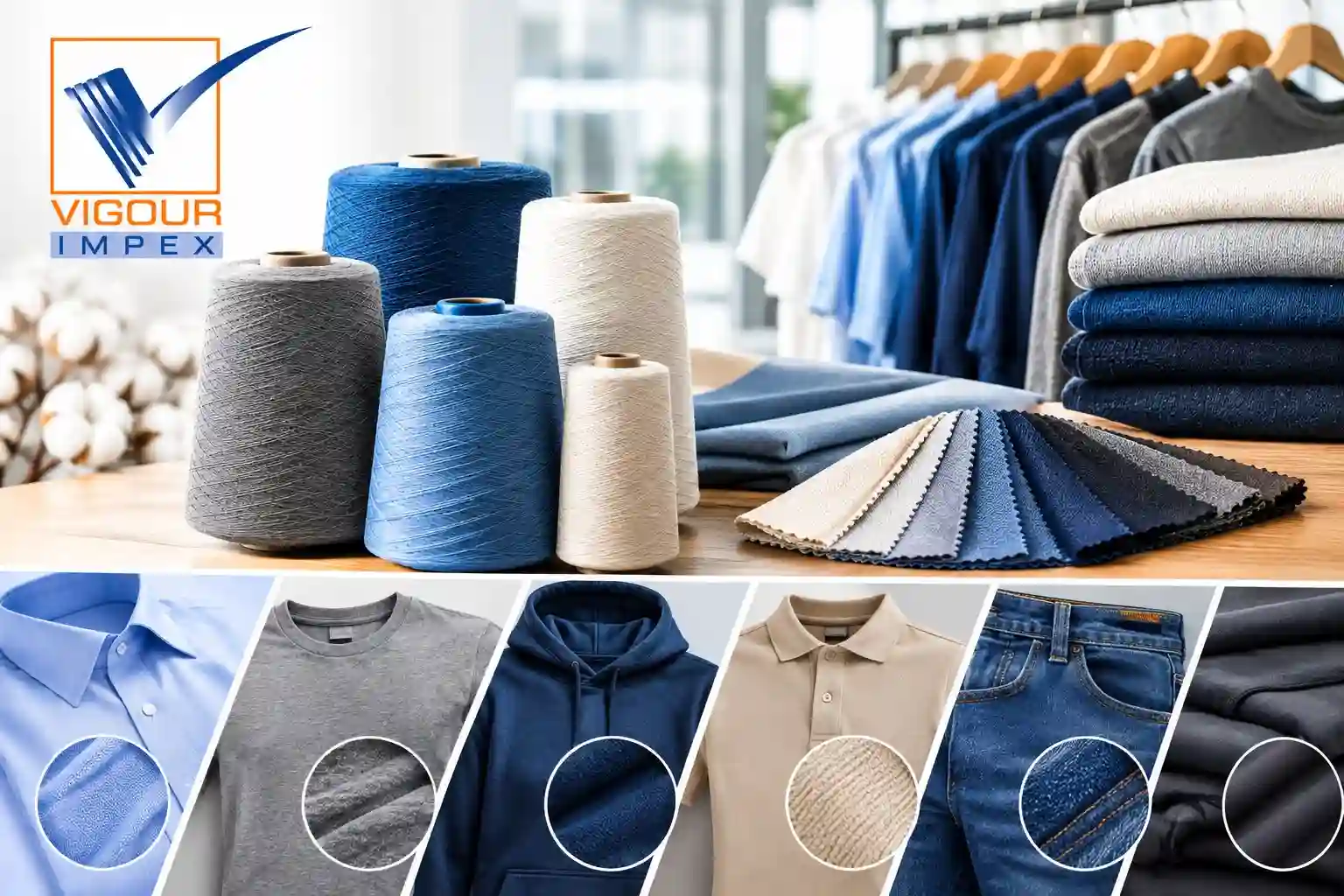
Dress shirts and premium shirting: Fine, combed, ring-spun yarns (40s–80s Ne) woven at a high EPI/PPI for a smooth, crisp hand-feel with good drape and a refined appearance.
Casual t-shirts and polos: Medium yarn counts (20s–30s Ne), often combed and ring-spun for retail-quality softness, knitted to a mid-range GSM (160–200) for everyday comfort and durability.
Denim: Coarser yarns (6s–12s Ne), frequently ring-spun or a ring/OE blend, woven at high density for structure and durability, with GSM typically ranging from 300 to 450+ depending on the desired weight and stretch.
Activewear and performance knits: Often synthetic or blended yarns, engineered for stretch recovery and moisture management, with density and GSM tuned for compression, breathability, or four-way stretch depending on the garment’s function.
Home textiles (bedding, towels): Thread count and GSM take priority higher thread counts (200+) in bedding indicate finer yarns woven densely for a smoother hand-feel, while towel GSM (400–600+) reflects loop density and absorbency.
Matching the right combination to the garment’s purpose isn’t just a quality decision it directly affects landed cost, since finer yarns and denser constructions require more raw material and production time.
Common Mistakes Buyers Make When Sourcing by Yarn Count and Density
1. Specifying GSM without yarn count or construction. As covered above, GSM alone doesn’t guarantee a consistent hand-feel or performance across different mills or lots.
2. Assuming “count” always means the same thing. Ne, Nm, Tex, and Denier are different systems. Confusing them especially when working with multiple international suppliers can lead to receiving yarn or fabric far coarser or finer than intended.
3. Not confirming carded vs. combed or ring spun vs. open-end. Two fabrics with identical count and GSM numbers can differ significantly in feel and quality depending on these production choices.
4. Skipping lab testing on bulk production. Approving a salesman’s sample isn’t enough bulk fabric should be tested against the same specifications to catch mill-to-mill or lot-to-lot variance before shipment.
5. Ignoring fabric density tolerance ranges. Reputable mills typically work within a small tolerance (for example, ±2-3% on GSM), but this should be agreed upon and documented, not assumed.
How to Verify Yarn Count and Fabric Density Before Bulk Production
A structured verification process protects buyers from costly surprises later in the supply chain:
- Request a detailed fabric specification sheet that includes yarn count, ply, spinning method (ring spun or OE, carded or combed), construction (EPI x PPI or knit structure), and target GSM with tolerance range.
- Test lab dips and swatches using standardized methods, ideally through an accredited third-party lab, to confirm the fabric matches the agreed specification before approving for bulk.
- Conduct in-line inspections during production, checking random samples against the approved GSM and construction specs rather than waiting until the final inspection.
- Run a pre-shipment inspection that includes physical GSM testing and count verification alongside the standard AQL checks for defects, color, and measurements.
- Work with a sourcing partner who understands mill capabilities, since experienced textile vendor selection in Pakistan means matching your specification to mills that can consistently produce it at scale not just at sample stage.
Why Sourcing Support Matters for Yarn Count and Fabric Density Decisions
Reading a spec sheet is one thing; sourcing the right yarn and fabric consistently, at the right price, from a compliant and reliable mill is another. This is where working with an experienced textile sourcing company in Pakistan makes a measurable difference. At Vigour Impex, we work directly with certified yarn and fabric manufacturers across Pakistan, translating buyer specifications including exact yarn count, ply, spinning method, and density requirements into production-ready sourcing briefs that mills can execute consistently, lot after lot.
Our production follow-up and quality control services include in-line and pre-shipment inspections that specifically verify GSM, construction, and yarn quality against the approved specification, not just visual defects. Whether you’re sourcing yarn for your own mill, finished fabric for a garment program, or complete garments built to a precise fabric spec, having a sourcing partner on the ground in Pakistan reduces the risk of costly mismatches between sample and bulk production.
Final Thoughts
Yarn count and fabric density aren’t just technical footnotes on a spec sheet they’re the specifications that determine whether your finished apparel matches the sample you approved, performs the way your customers expect, and hits your target cost consistently across production runs. Understanding Ne, GSM, EPI/PPI, and the production choices behind them (combed vs. carded, ring spun vs. open-end) gives buyers the vocabulary and confidence to specify exactly what they need, and to catch mismatches before they become costly production problems.
For brands sourcing yarn, fabric, home textiles, or finished garments from Pakistan, having an experienced partner who understands both the technical specifications and the mill landscape makes the difference between a smooth production run and a frustrating one. Get in touch with Vigour Impex to discuss your yarn count, fabric density, and sourcing requirements, or explore our full range of textile products to see how we support global buyers across yarn, fabric, home textiles, and garment programs.
Frequently Asked Questions
What is a good yarn count for a basic cotton t-shirt?
Most retail-quality cotton t-shirts use single or ply yarns in the 20s to 30s Ne range, combed and ring-spun for a soft, durable hand-feel, knitted to a GSM between roughly 160 and 200 depending on the desired weight.
Does a higher yarn count always mean better quality?
Not necessarily. A higher Ne number means a finer yarn, which often (but not always) correlates with a smoother, more premium fabric. Quality also depends on fiber quality, spinning method (ring spun vs. open-end), and whether the yarn is combed or carded a coarser yarn spun and finished well can outperform a poorly made finer yarn.
What’s the difference between thread count and GSM?
Thread count (EPI + PPI) measures how many yarns are packed into a woven fabric per inch, while GSM measures the fabric’s overall weight per square meter. Both matter, but they describe different things a fabric can have a high thread count and still be relatively lightweight if it’s woven with very fine yarns.
Can two fabric suppliers deliver different fabrics from the same GSM specification?
Yes, and this is one of the most common sourcing pitfalls. Since GSM alone doesn’t capture yarn count or construction, two mills can produce fabrics that hit the same GSM target but feel and perform very differently. Always request full specifications, not GSM in isolation.
How is fabric density tested and verified?
Fabric density is typically verified using a GSM cutter and precision scale to weigh a standardized fabric sample, alongside a thread-counting glass or microscope to physically count EPI and PPI on woven fabrics. These checks are usually performed during lab dip approval, in-line inspection, and pre-shipment inspection.
Why do yarn count and fabric density affect pricing?
Finer yarns require more processing and raw material efficiency to spin, and denser constructions use more yarn per square meter of fabric both of which increase raw material and production costs. Understanding this relationship helps buyers make informed trade-offs between fabric quality and target price points during sourcing negotiations.