


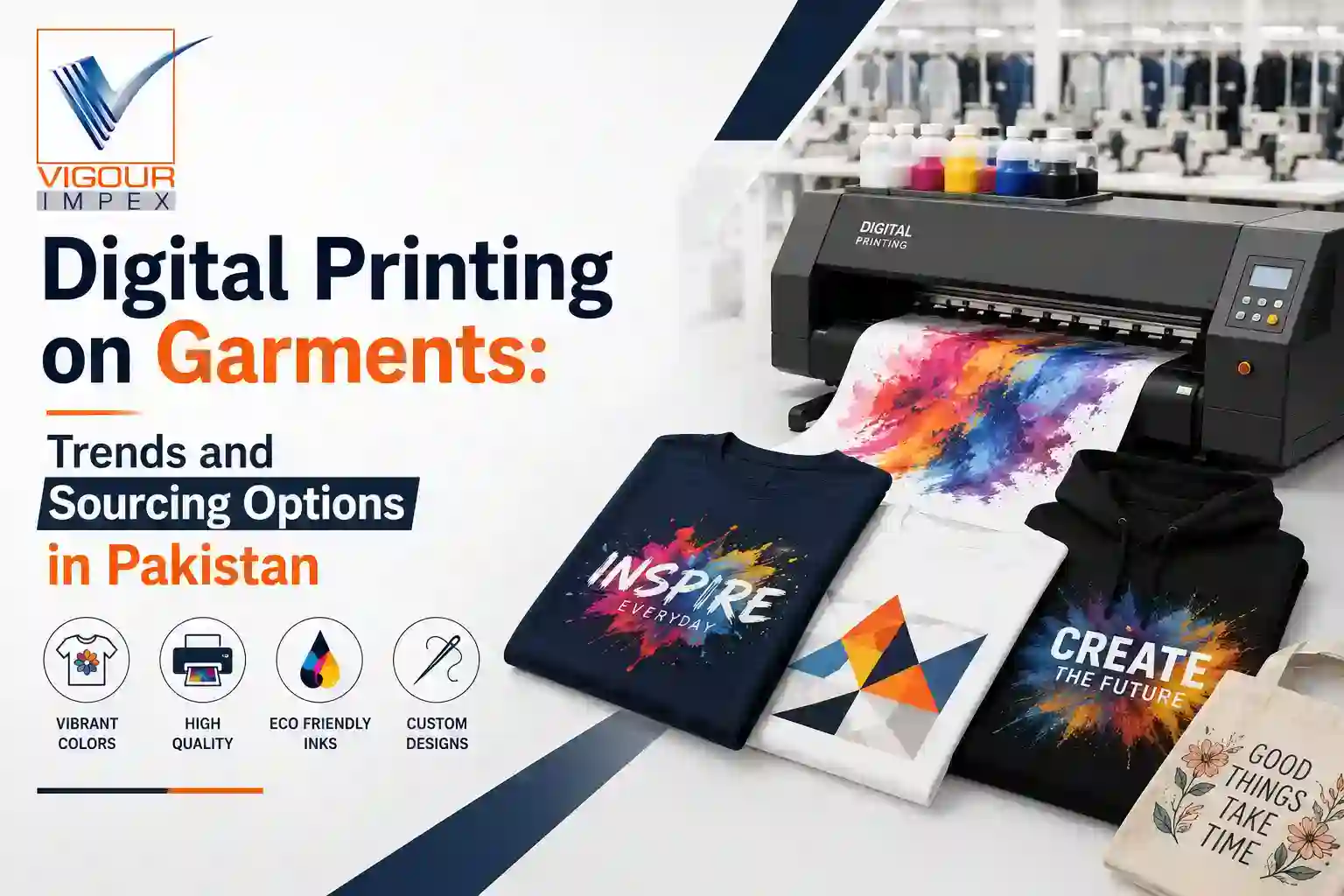
Pakistan’s textile sector has always been defined by scale cotton fields, spinning mills, and vertically integrated factories that turn raw fiber into finished apparel for global brands. But the part of the value chain that decides how a garment actually looks printing is going through the fastest transformation it has seen in decades. digital printing on garments in Pakistan, once a niche service for sample runs and small custom orders, is now reshaping how Pakistani manufacturers, exporters, and small businesses approach design, production, and sourcing.
This article looks at where digital printing on garments stands today, the technologies driving the shift and the practical sourcing options available to brands and entrepreneurs working with Pakistani manufacturers.
Why Digital Printing Is Changing the Garment Industry
Traditional garment decoration screen printing, rotary printing and hand embroidery was built around volume. Screens and dyes cost money to prepare, so profitability depended on printing thousands of identical units. That model worked well when fashion cycles were slow and retailers ordered in bulk months in advance.
That world doesn’t exist anymore. Consumers want new designs every few weeks, e-commerce brands need to test dozens of graphics before scaling one, and buyers increasingly ask for smaller, more frequent shipments instead of massive seasonal orders. Digital printing solves this by turning a fixed cost (screens, plates, setup) into a variable one (ink and substrate). A print run of 10 shirts costs roughly the same per unit as a run of 500, which makes short batches, personalization, and rapid design iteration commercially viable for the first time.
This is the core reason digital textile printing has moved from a “speciality option” to a mainstream production method across custom apparel, streetwear, sportswear, and increasingly, private-label fashion.
The Core Technologies: DTG, DTF and Sublimation
Anyone sourcing digital printing on garments in 2026 will run into three main technologies, each suited to different fabrics, order sizes and budgets.
Direct-to-Garment (DTG) Printing
DTG works like an inkjet printer for fabric a specialized machine applies water-based ink directly onto a pre-treated garment, most commonly cotton or cotton-blend T-shirts and hoodies. The advantages are a soft hand-feel (the print doesn’t sit on top of the fabric like a plastic layer) and the ability to reproduce photorealistic, full-color designs without the setup cost of screens.
DTG remains the preferred choice where quality and feel matter more than fabric versatility premium T-shirts, art prints and cotton-forward apparel are its strongest use case. Its limitations are real, though: it performs best on natural fibers, requires pre-treatment chemicals and print speed per unit is slower than transfer-based methods, which makes it less economical at higher volumes.
Direct-to-Film (DTF) Printing
DTF has become the fastest-growing digital printing method worldwide, and Pakistani print shops and export units have been quick to adopt it. Instead of printing on the garment itself, the design is printed onto a PET film using pigment inks, coated with a hot-melt adhesive powder, cured, and then heat-pressed onto the fabric.
The appeal is versatility: DTF transfers work on cotton, polyester, blends, nylon, denim, and even some synthetic leather fabrics that DTG struggles with. It also skips the pre-treatment step entirely and typically produces less ink waste than DTG. As a result, industry estimates suggest <cite index=”6-1″>DTF’s share of digital garment decoration is expected to grow from roughly a quarter of the market in 2026 to 40–50% by 2028</cite>, driven by lower setup costs, broader fabric compatibility, and steadily improving print quality. For manufacturers and small studios in Pakistan looking to serve varied product lines from polyester sportswear to cotton streetwear DTF has become the more flexible entry point.
Dye Sublimation
Sublimation printing turns dye into a gas that bonds permanently with polyester fibers, producing vivid, all-over prints that never crack or peel. It’s the standard choice for sportswear, activewear, and performance fabrics categories where Pakistan already has strong manufacturing capacity through hosiery and knitwear exporters. Its main constraint is that it only works well on polyester or polyester-coated substrates and light-colored bases, which limits it to specific product categories rather than general apparel decoration.
Trends Shaping Digital Garment Printing in 2026
1. Hybrid Production Models Are Replacing Single-Technology Shops
Few serious apparel producers now rely on just one printing method. The most competitive operations combine DTG for premium cotton pieces, DTF for mixed-fabric and bulk transfer work, and screen printing for very large single-design runs. <cite index=”4-1″>This hybrid approach pairing DTF’s broad material compatibility with DTG’s superior hand-feel on cotton-forward garments is becoming the standard rather than the exception</cite>. Pakistani manufacturers positioning themselves for export orders are increasingly investing in more than one printing line for exactly this reason: buyers want a single supplier who can handle a mixed product catalog.
2. On-Demand and Small-Batch Production Are Becoming Core, Not Niche
<cite index=”2-1″>Direct-to-garment printing is no longer treated as a fallback for short runs and custom jobs it’s becoming embedded in how apparel is produced, fulfilled, and delivered to market</cite> as brands respond to unpredictable demand and tighter supply chains. Instead of forecasting sales and committing to large inventories months ahead, brands can now print against real orders. For Pakistani exporters, this shift matters because international buyers are asking for smaller, faster shipments rather than one large seasonal order a request digital printing is uniquely equipped to satisfy.
3. Software and Workflow Integration Over Raw Machine Speed
<cite index=”2-1″>Production efficiency in 2026 is defined less by how fast a single printer runs and more by how little setup and changeover time a workflow requires</cite>. Modern DTG and DTF operations are increasingly connected directly to e-commerce storefronts and order management systems, so a customer’s order flows straight into the print queue without manual intervention. This is a meaningful shift for Pakistani sourcing agents and factories serving Western direct-to-consumer brands, many of whom expect API-level integration with their Shopify or WooCommerce backend, not just a bulk PO process.
4. Sustainability and Compliance Are Becoming Sourcing Criteria, Not Marketing Claims
Water-based and low-VOC inks have become close to standard across DTG and DTF, and buyers are paying closer attention to the environmental footprint of printing processes, not just fabric sourcing. This lines up with a broader shift in how international buyers evaluate Pakistani suppliers: <cite index=”9-1″>global buyers are increasingly prioritizing supply-chain resilience, product quality, traceability, environmental compliance, and timely delivery alongside competitive pricing</cite>, rather than choosing suppliers on cost alone. Pakistani exporters who can document their printing inputs ink types, water usage, waste handling are better positioned to win and retain EU and US accounts.
A related development worth watching closely: <cite index=”11-1″>the EU’s Digital Product Passport requires products entering the EU market to carry verifiable digital information covering their full production history and sustainability credentials</cite>, and <cite index=”11-1″>firms that cannot provide consistent, verifiable traceability data risk delays at customs, extra verification demands or gradually losing orders to better-prepared competitors</cite>. Given <cite index=”11-1″>how concentrated Pakistan’s garment and home textile exports are in the European market, even moderate compliance costs will have outsized consequences across the country’s export base</cite>. Printing suppliers that digitize their production records now will have a real advantage over the next few years.
5. AI-Assisted Design and Trend Forecasting
Design generation and print-ready artwork creation are increasingly assisted by AI tools that shorten the gap between concept and production file. <cite index=”1-1″>Several major digital textile printing trends now involve using AI for trend forecasting and automated design generation to feed rapid, on-demand production lines</cite>. For Pakistani print studios serving global streetwear and private-label clients, this means faster turnaround from concept sketch to press-ready file a genuine competitive advantage for shops that adopt these tools early.
6. Nearshoring and Micro-Factories, With Pakistan Positioned Differently
Globally, <cite index=”1-1″>some brands are establishing micro-factories closer to their key markets in North America and Europe</cite> to shorten delivery times for digitally printed goods. This trend doesn’t remove Pakistan from the picture it changes what Pakistan competes on. Rather than trying to out-compete regional micro-factories on speed for hyper-local orders, Pakistani sourcing partners are positioning around cost-efficiency, fabric-to-garment vertical integration, and mid-volume runs that micro-factories aren’t built to handle economically.
Pakistan’s Position in the Global Digital Printing and Garment Sourcing Landscape
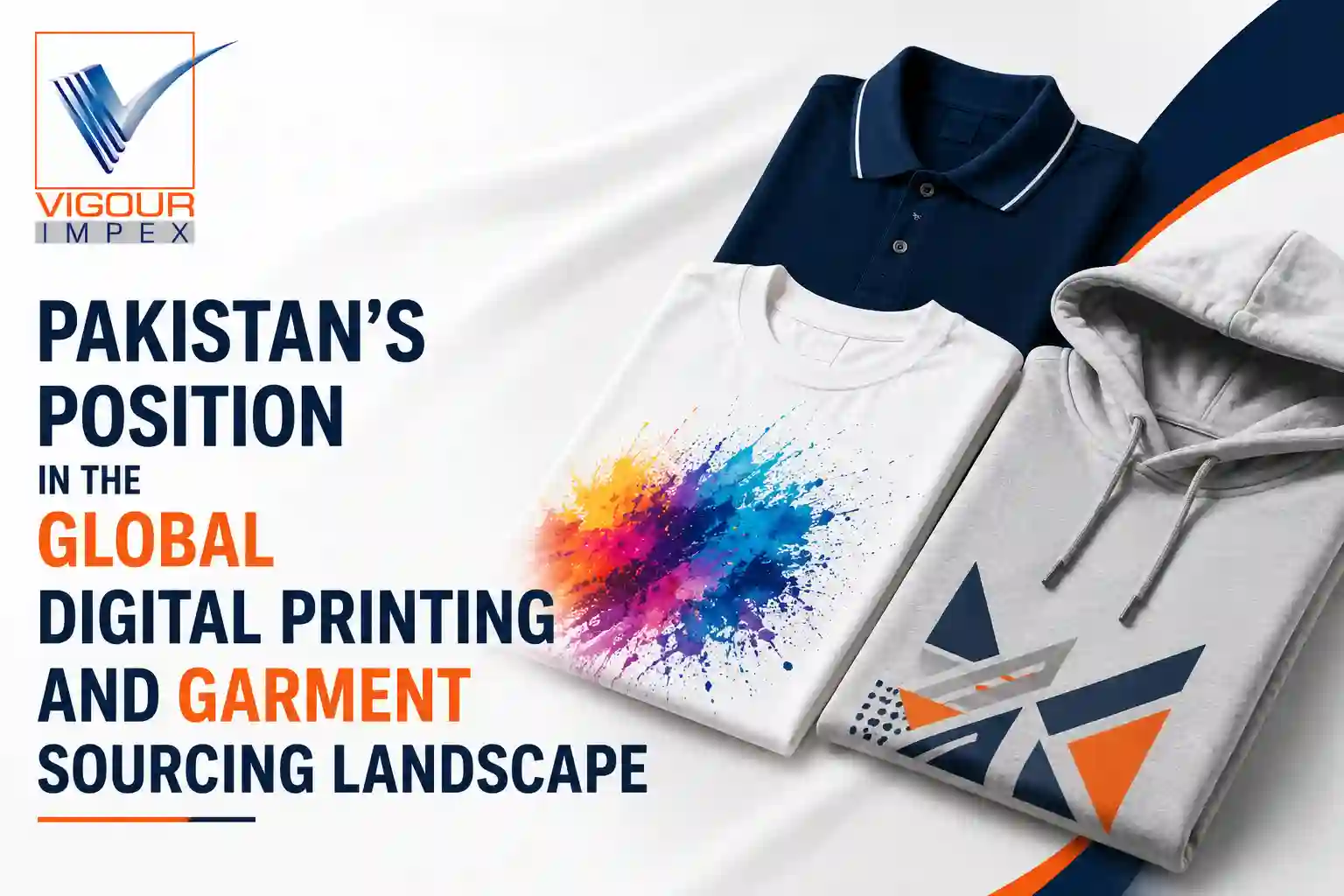
Pakistan’s advantage in garment sourcing has never been printing technology alone it’s the depth of the surrounding textile ecosystem. The country has cotton cultivation, spinning, weaving, knitting, dyeing, and garment manufacturing largely under one roof in its major industrial clusters, which is rare globally and gives buyers a level of vertical integration that’s hard to replicate elsewhere.
Key Textile and Garment Hubs
<cite index=”14-1″>Four cities handle roughly 90% of Pakistan’s apparel export volume</cite>, and each has developed its own specialization:
- Faisalabad: Pakistan’s largest textile city, strong in woven fabric, home textiles, and increasingly digital printing services for both domestic fashion brands and export-oriented sourcing offices.
- Karachi: The commercial and export hub, home to large composite textile groups and garment exporters with direct shipping access.
- Lahore: A growing center for fashion-forward apparel, streetwear, and digital print studios serving both local retail brands and small-batch export clients.
- Sialkot: Known globally for sportswear, gloves, and technical apparel, making it a natural fit for sublimation printing on polyester-based performance wear.
<cite index=”12-1″>Beyond these clusters, Pakistan’s textile industry spans spinning mills, weaving mills, knitting units, denim manufacturers, dyeing and finishing units, printing facilities, and garment factories</cite>, giving brands the option to source fabric, printing, and garment construction from a single country often within a short distance of each other.
Export Performance and Buyer Confidence
Pakistan’s textile exports remain the backbone of the national economy. <cite index=”13-1″>The sector contributes over 60% of the country’s total export earnings</cite>, and recent data shows real momentum: <cite index=”9-1″>Pakistan’s overall exports rose to roughly $2.69 billion in May 2026 from $2.47 billion in April, with knitwear, readymade garments, and bedwear all posting month-on-month growth</cite>. Over a longer window, <cite index=”9-1″>the country’s textile group exports reached approximately $16.7 billion during July–May of fiscal year 2025–26</cite>, keeping textiles firmly in place as Pakistan’s largest export earner.
Sourcing analysts tracking global placement data note that <cite index=”14-1″>Pakistan handled about 18% of denim briefs and 11% of cotton-knit briefs in recent sourcing pipelines, ranking second only to Portugal among European brands and third behind China and Bangladesh for US brands</cite>. <cite index=”14-1″>The match rate is strongest for denim, terry, and leather-adjacent categories, but tends to fall for brands needing very small minimum order quantities or four-week fast-fashion turnarounds</cite> a gap that digital printing and on-demand production models are gradually closing.
Real Investment in Digital Printing Capacity
This isn’t just policy talk Pakistani firms are actively building digital printing capacity at industrial scale. Future Fashion (Pvt) Ltd, a Faisalabad-based digital textile printer, is a clear example: <cite index=”10-1″>the company now produces between 25 and 30 million linear metres of digitally printed textile per year, primarily serving Pakistan’s fashion industry, while also providing commercial printing services to top local brands with international stores and to sourcing offices exporting to the USA and EU</cite>. Notably, <cite index=”10-1″>the company runs a fully digital operation with no analogue or rotary printing technology at all</cite> a strong signal that digital-first production is becoming commercially viable at real export scale in Pakistan, not just for small custom-print shops.
Sourcing Options: How to Work With Pakistani Digital Printers
Brands and entrepreneurs looking to source digitally printed garments from Pakistan generally have four practical routes, each suited to a different scale of business.
1. Local Print-on-Demand Studios (Small Brands, Startups, Personal Labels)
Cities like Lahore, Karachi, and Islamabad have a growing number of small DTG and DTF studios serving local streetwear labels, university merchandise, and personalized gifting businesses. These are the right fit for brands testing designs, running small drops, or fulfilling one-off custom orders. Minimum order quantities are often as low as a single piece, though per-unit costs are higher than bulk production.
2. Mid-Sized Garment Printing Factories (Growing Brands, Regional Wholesale)
Faisalabad and Karachi host factories that combine screen printing, DTF, and sublimation lines, typically requiring minimum orders in the low hundreds of units. These factories are well suited to brands that have validated a design and are scaling into wholesale, subscription boxes, or regional retail, and want a mix of print technologies under one roof without committing to a full export-scale contract.
3. Vertically Integrated Export Manufacturers (Established Brands, Bulk Orders)
For brands ordering in the thousands of units, Pakistan’s large composite textile groups offer fabric sourcing, dyeing, printing, cutting, and stitching within a single supply chain. <cite index=”12-1″>Names like Nishat Mills and Gul Ahmed are established composite textile producers, Interloop is a strong option for hosiery and activewear, and Yunus Textile Mills and Feroze1888 Mills lead in home textiles</cite> several of these groups have added digital printing lines specifically to serve fast-fashion and private-label clients who need shorter runs than traditional bulk orders. <cite index=”13-1″>Interloop, founded in 1992, has grown from a specialized hosiery manufacturer into Pakistan’s largest textile exporter and one of the world’s leading hosiery producers</cite>, making it a relevant reference point for brands sourcing printed activewear and sportswear at scale.
4. Sourcing Agencies and Consultants
For brands unfamiliar with Pakistan’s supplier landscape, independent sourcing agencies can match a product brief to the right factory cluster and printing technology, handle sampling, and manage quality control remotely. This route adds a service fee but significantly reduces the research and vetting time for first-time buyers, and is often the fastest way to identify which of Pakistan’s regional hubs denim in one city, sportswear in another, fashion apparel in a third actually fits a specific product line.
Practical Considerations When Sourcing digital printing on garments in Pakistan
Match the technology to the product. Cotton-forward premium T-shirts and art prints are better suited to DTG; mixed-fabric collections, denim, and outerwear graphics do better with DTF; and polyester sportswear or activewear should go to sublimation specialists in hubs like Sialkot.
Ask about pre-treatment and curing standards. Print durability after repeated washing is one of the most common quality issues in digital garment printing. Reputable suppliers will be transparent about their curing process, wash-test results, and ink brand.
Request digital compliance documentation early. Given the EU’s move toward mandatory digital product traceability, brands exporting to Europe should confirm a Pakistani supplier’s ability to provide production and material data upfront, rather than discovering gaps after an order is placed.
Compare minimum order quantities carefully. Digital printing dramatically lowers MOQs compared to screen printing, but factories still vary widely from single-unit local studios to factories requiring several hundred pieces. Matching order size to the right tier of supplier avoids paying premium small-batch pricing for what is really a mid-volume order.
Factor in turnaround expectations. Pakistan’s strength lies in vertically integrated, cost-efficient mid-volume production rather than the two-to-three-day turnarounds some nearshore micro-factories offer. Brands with genuinely urgent, hyper-local fulfillment needs may need a blended strategy local micro-fulfillment for speed, Pakistani sourcing for cost-efficient volume.
Digital Printing vs. Traditional Screen Printing: Cost and Quality Trade-offs
Brands new to sourcing often ask a simple question: should we still consider screen printing at all? The honest answer is that it depends entirely on order size and design complexity.
Screen printing remains the most cost-efficient method once an order crosses into the thousands of identical units with a small number of colors the per-unit cost drops sharply at volume because the screen setup cost is spread across a large run. But it loses its advantage quickly with multi-color, photographic, or gradient designs, since each color requires its own screen, and it becomes uneconomical for anything below a few hundred pieces per design.
Digital printing flips that equation. Setup cost is close to zero regardless of design complexity, so a single-piece custom order and a 500-piece order carry a similar per-unit cost curve. This is precisely why digital methods have become the default for private-label startups, personalized merchandise, and brands running frequent limited drops categories where Pakistani print studios and mid-sized factories have expanded fastest over the past two years.
For brands running a mixed catalog a handful of core, high-volume basics alongside frequently rotating limited designs the most cost-effective approach is usually a hybrid one: screen print the stable, high-volume items and use DTF or DTG for rotating or personalized designs. Several Pakistani manufacturers, particularly in Faisalabad and Karachi, now offer exactly this combination under a single production roof, which removes the need to split an order across two separate suppliers.
Final Thought
Digital printing on garments has moved well past the experimental phase it’s now a standard part of how apparel gets designed, sampled, and produced, both globally and within Pakistan. The country’s textile industry, backed by genuine vertical integration from cotton to finished garment, is adapting quickly: established mills are adding digital printing lines, dedicated digital-only printers are scaling to tens of millions of metres a year, and export data shows the value-added segments of the industry growing even as global buyers become more selective about compliance and traceability.
For brands and entrepreneurs evaluating where to source digitally printed apparel, Pakistan offers a combination that’s increasingly rare real manufacturing depth, competitive costs, and a printing sector that’s investing seriously in the technology buyers now expect. The businesses that will benefit most are the ones that match their product to the right printing technology, choose the supplier tier that fits their order volume, and start asking about sustainability and traceability documentation now, before it becomes a mandatory cost of doing business in key export markets.