


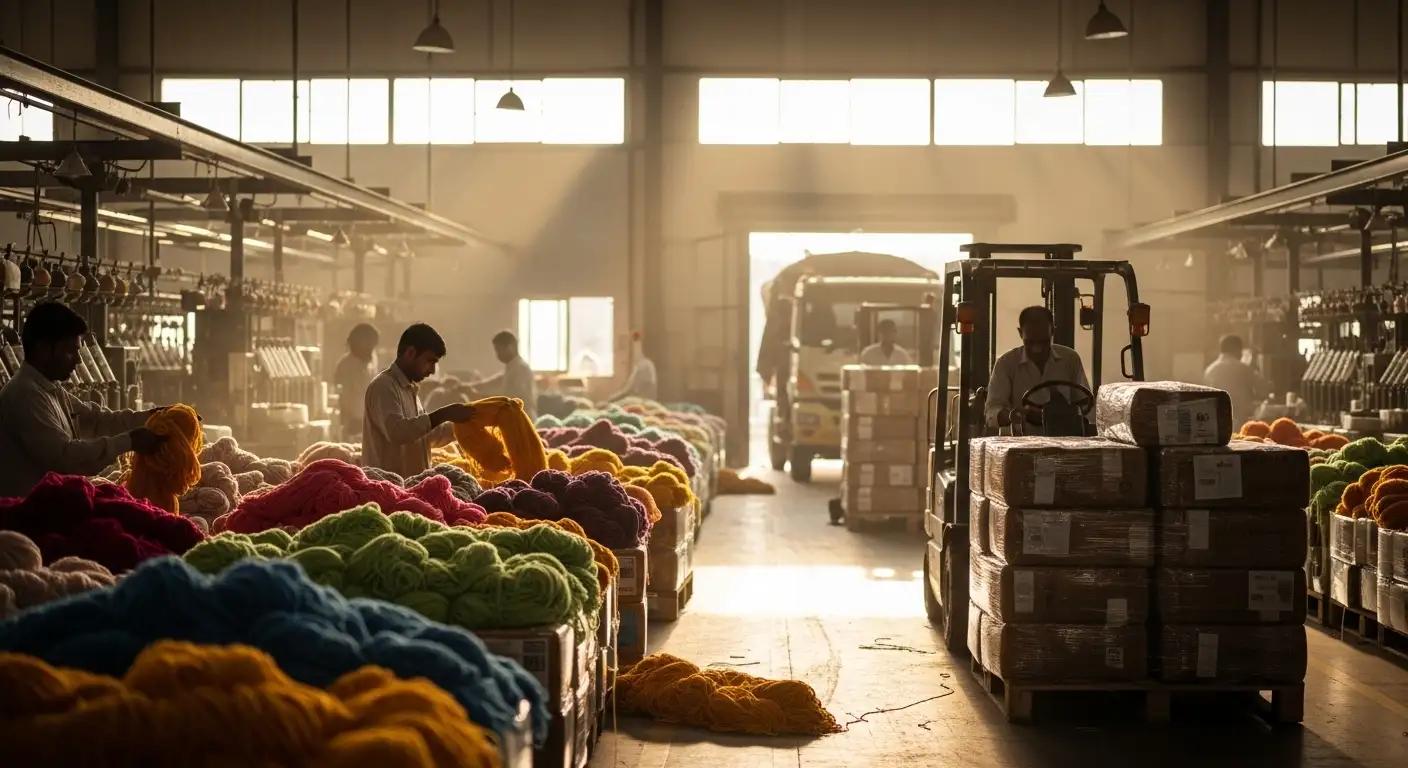
Pakistan’s textile industry is going through what economists call a “mixed signals” period. Walk into any textile hub, Faisalabad, Karachi, or Lahore, and you’ll hear contradictory stories. Some manufacturers talk about slow markets and tight budgets. Others mention steady orders and cautious optimism.
The answer lies in understanding one critical fact: export yarn demand is quietly holding Pakistan textile market together, even while other segments struggle. Particularly from China, this consistent international demand for Pakistani yarn creates a stabilizing foundation that supports the entire textile ecosystem.
This isn’t about explosive growth or dramatic turnarounds. It’s about something more valuable in uncertain times, stability. The kind that keeps mills running, workers employed, and businesses planning for tomorrow instead of just surviving today.
In this article, we’ll explore exactly how export yarn demand creates this stability through five specific ways, backed by current market realities and real-world implications for Pakistan’s textile future.
Understanding the Current Market Context
Before diving into the five ways, let’s set the scene with what’s actually happening in Pakistan’s textile market right now.
Cotton and yarn prices have stayed relatively firm, not skyrocketing, but holding steady. This stability matters because it allows manufacturers to quote consistent prices and commit to forward orders without gambling on wild price swings.
Local demand remains subdued. Pakistani consumers, facing inflation and economic uncertainty, aren’t buying textiles like they used to. This dampens the domestic market that many smaller manufacturers depend on.
Global sentiment stays cautious. International buyers aren’t placing huge bulk orders, but they’re not disappearing either. They’re ordering smaller quantities more frequently, a pattern that actually works well for agile Pakistani manufacturers.
Fabric markets move slowly, with many deals pushing deliveries into early 2026. This reflects buyer hesitation but also realistic production timelines in a market that’s being careful rather than desperate.
Garment sector capacity sits below optimal levels, and many facilities are operating at 70-80% instead of full capacity. Yet early developments for Fall-Winter 2026 (FW26) collections show a gradual recovery beginning.
Home textiles, bedding, towels, and similar products are showing real improvement. With Heimtextil 2026 (the world’s largest home textile trade fair) approaching in January, inquiries for bed linens and towels are increasing meaningfully.
This is the environment where export yarn demand, particularly from China, emerges as a crucial stabilizing force. Now let’s explore exactly how.
Way #1: Export Yarn Creates Consistent Cash Flow When Domestic Markets Weaken
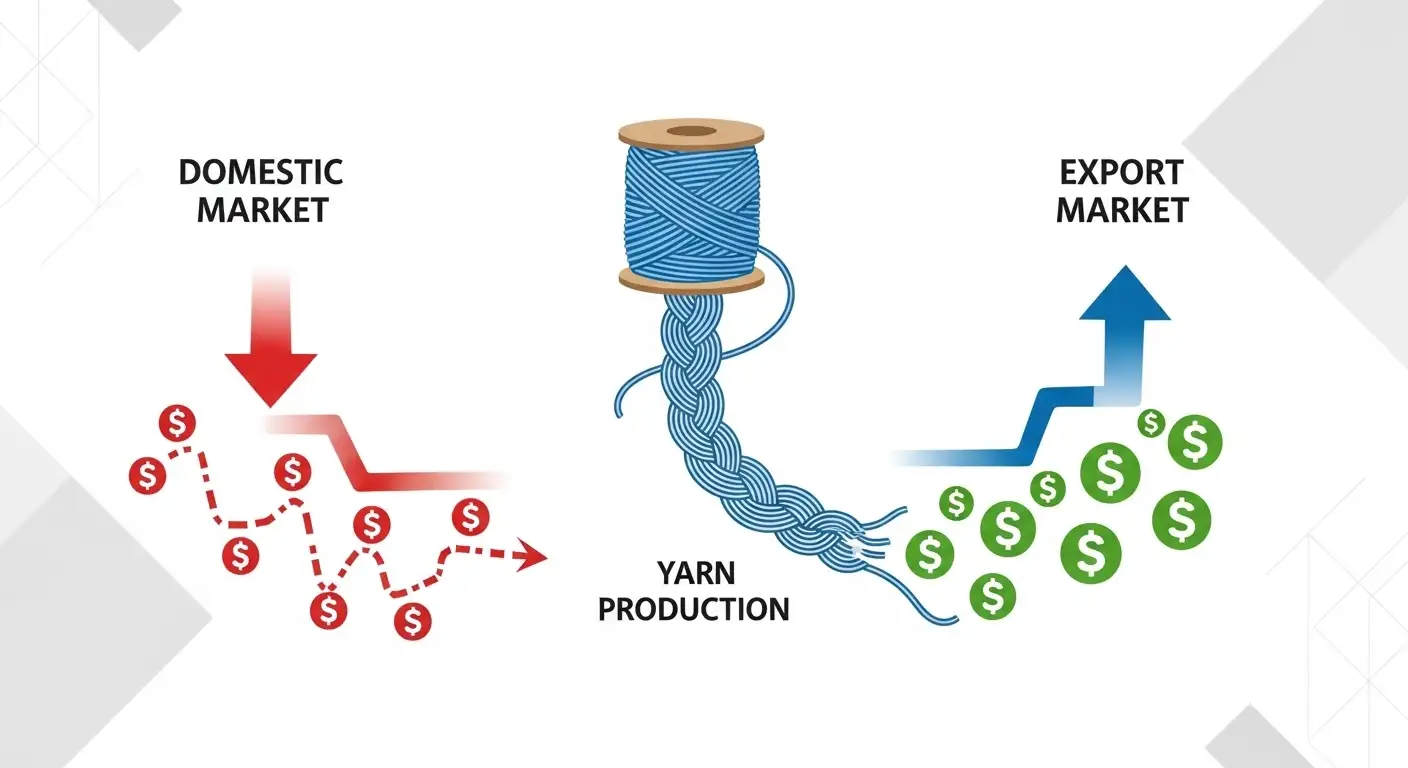
Here’s a reality many Pakistani textile businesses face: when local buyers delay payments or reduce orders, cash flow becomes tight fast. Rent still needs paying. Workers need salaries. Suppliers expect payment for cotton and materials.
Export yarn demand solves this problem in ways domestic sales often can’t.
Why Export Yarn Generates Reliable Cash Flow
Shorter production cycles: Spinning cotton into yarn takes weeks, not months. Compare this to producing finished garments, which involves design, sampling, approvals, production, finishing, and quality checks, potentially 3-4 months from order to payment.
Established payment terms: Major international yarn buyers, especially Chinese textile manufacturers, typically work with Letters of Credit or other secured payment methods. Once you ship, you get paid, no chasing invoices for months like sometimes happens with domestic buyers.
Regular order patterns: Industrial yarn buyers need consistent supply to keep their own operations running. This creates predictable order cycles rather than feast-or-famine purchasing.
The Real-World Impact
When a Pakistani spinning mill maintains steady export yarn orders, particularly to Chinese manufacturers who use that yarn for garment production, the mill generates the cash flow to:
- Purchase more raw cotton, keeping farmers paid and willing to sell
- Meet payroll consistently, retaining skilled workers
- Pay electricity bills and keep machinery running
- Service bank loans without defaulting
- Maintain relationships with suppliers who might otherwise tighten credit terms
This cash flow stability ripples through the entire value chain. Cotton farmers sell crops. Transport companies move goods. Port workers handle exports. Equipment suppliers sell spare parts. Everyone in the ecosystem benefits from that steady export yarn activity.
Way #2: Firm Yarn Prices Provide Predictability for Forward Planning
One of the most damaging things for textile businesses is price volatility. Imagine quoting a price for an order six months out, only to have your raw material costs spike 30% before production. You either lose money fulfilling the contract or damage relationships by trying to renegotiate.
Current firm cotton and yarn prices change this dynamic entirely.
What “Firm Prices” Actually Means
When we say prices are “firm,” it doesn’t mean they’re high or low, it means they’re stable. For several months now, yarn prices have held within a relatively tight range. This stability results from:
- Balanced supply and demand: Production roughly matches consumption globally
- Manageable cotton costs: Raw material prices stable enough that yarn producers can plan
- Export demand supporting price floors: Consistent international buying prevents prices from collapsing
How This Enables Business Planning
With firm yarn prices, Pakistani manufacturers can:
Quote confidently: When bidding on international contracts, you can commit to prices knowing your costs won’t suddenly spike. This competitiveness wins orders.
Commit to longer-term relationships: Buyers appreciate suppliers who can lock in pricing for multiple order cycles. Firm underlying costs make this possible.
Manage inventory strategically: Instead of panic-buying when prices might spike, manufacturers can purchase raw materials based on actual production needs.
Invest in improvements: When you’re not constantly firefighting price volatility, you can invest in better machinery, training, or certifications that improve competitiveness.
The Export Connection
Here’s what many people miss: export yarn demand helps maintain firm prices. When international buyers, especially from China, consistently purchase Pakistani yarn, it prevents prices from collapsing. Weak domestic demand alone might crash prices, harming everyone. Export demand provides the floor that keeps pricing rational and sustainable.
Way #3: China-Led Export Activity Maintains Production Capacity Utilization
Empty factories are expensive. When textile equipment sits idle, several bad things happen: machinery deteriorates faster, skilled workers leave for other opportunities, per-unit fixed costs skyrocket, and companies burn through cash reserves.
Export yarn demand from China specifically helps prevent this capacity crisis.
Why Capacity Utilization Matters
Textile manufacturing has significant fixed costs:
- Factory buildings (rent or ownership costs don’t change whether you’re at 50% or 90% capacity)
- Permanent workforce (you need core staff regardless of production volume)
- Machinery maintenance (equipment actually degrades faster sitting idle than in regular use)
- Utilities baseline (some energy costs continue even with reduced production)
A mill running at 80% capacity might be profitable while the same facility at 50% loses money producing identical products at the same quality.
China’s Role as Capacity Stabilizer
China’s textile industry is massive, the world’s largest by far. Their own domestic cotton and yarn production can’t fully meet their needs, creating structural import demand.
When Chinese textile manufacturers place yarn orders with Pakistani mills, they’re not making fashion-driven emotional purchases. They’re buying industrial inputs needed to fulfill their own production schedules. This creates:
Volume consistency: Not huge swings between boom and bust, but steady, predictable volume Multi-month visibility: Chinese buyers often provide some forward visibility, helping mills plan capacity allocation Quality focus: Chinese manufacturers increasingly value consistent quality, rewarding reliable suppliers with repeat business
What This Means for Pakistani Mills
Even though garment segments might operate at 70-80% capacity, spinning divisions can maintain 85-90% utilization thanks to export yarn orders. This makes the overall operation viable.
A vertically integrated mill might have slow garment sales but strong yarn exports. The yarn division’s health keeps the entire facility economically sustainable while waiting for garment demand to recover.
This breathing room is critical. It prevents the destructive cycle of layoffs, equipment sales, and permanent capacity loss that would make future recovery much harder.
Way #4: Diversified Export Markets Reduce Dependence on Volatile Domestic Demand
Putting all your eggs in one basket is risky, whether in investments or markets. Pakistani textile manufacturers selling primarily to domestic consumers face a problem: when Pakistan’s economy slows, consumer spending on textiles drops, and there’s no alternative revenue source.
Export yarn diversification changes the risk equation fundamentally.
The Domestic Demand Challenge
Pakistan’s domestic textile market faces several pressures:
- Inflation reducing household discretionary spending
- Economic uncertainty making consumers delay non-essential purchases
- Competition from imported textiles (despite tariffs)
- Payment delays in domestic supply chains
Manufacturers dependent on domestic sales feel these pressures acutely. Orders shrink, payment terms stretch, margins compress.
Export Markets Provide Alternative Revenue
Export yarn demand comes from multiple markets:
China (largest): Needs yarn for their massive garment manufacturing, much of which exports to Western consumers. Even when Chinese domestic consumption slows, their export production can maintain yarn demand.
Bangladesh: Imports substantial yarn for their garment industry since domestic capacity can’t meet needs. Their export-oriented model creates consistent demand.
Vietnam, Indonesia, other Asian manufacturers: Growing textile industries creating incremental demand for yarn imports.
Direct Western buyers: Smaller volume but often higher-value orders for specialty or certified yarns.
The Stability This Creates
When domestic Pakistani demand weakens but Chinese yarn buyers maintain orders, mills stay operational. When Chinese demand softens but Bangladesh and Vietnam increase imports, the gap fills.
This market diversification means:
- Revenue streams from multiple sources reduce single-market risk
- Different markets peak at different times, smoothing overall demand
- Currency diversification (sales in USD, Euro, Yuan) spreads exchange rate risk
- Learning from different markets improves overall competitiveness
Manufacturers with strong export yarn portfolios don’t panic when domestic consumers tighten budgets. They have alternative markets generating revenue and keeping operations sustainable.
Way #5: Growing Home Textile Export Inquiries Signal Broader Market Recovery

The most encouraging stability indicator might be what’s happening in home textiles, the category including bed linens, towels, curtains, and similar products. This segment is showing genuine improvement, and it’s closely connected to yarn demand dynamics.
Why Home Textiles Matter
Home textiles represent a sweet spot in Pakistani manufacturing:
Pakistan’s strengths align perfectly: Decades of specialization in towels, bedding, and table linens have created world-class capabilities. Pakistani towels compete with Turkish quality at better pricing. Pakistani bed linens serve major hotel chains globally.
Less fashion-dependent: Unlike apparel where trends change seasonally, home textiles have longer replacement cycles and more consistent demand patterns.
Institutional demand stability: Hotels, hospitals, senior living facilities, and commercial operations maintain regular replacement schedules regardless of consumer fashion trends.
E-commerce growth: Online home goods retailers are expanding, creating new distribution channels beyond traditional brick-and-mortar.
Current Home Textile Momentum
Several positive indicators are emerging:
Active sampling: International buyers are requesting product samples to evaluate suppliers, which precedes actual orders by weeks or months. Increased sampling activity signals serious buying intent.
Steady inquiry flow: Not explosive, but consistent interest from established buyers and new prospects. This differs from the dead silence that characterized 2023’s slowdown.
Heimtextil 2026 optimism: The Frankfurt trade fair in January 2026 is the world’s largest home textile sourcing event. Pakistani exhibitors report better pre-show inquiry levels than recent years, suggesting potential order conversions.
Delivery commitments extending: Buyers booking production slots extending into Q2 2026 and beyond indicates they’re planning ahead, not just placing hand-to-mouth orders.
The Yarn Connection
Here’s the critical link: home textiles require yarn. Bed linens use woven fabric made from yarn. Towels use terry cloth made from yarn. Table linens, curtains, and upholstery all require yarn as a fundamental input.
When home textile inquiries improve, it signals:
- Downstream demand strengthening: Finished goods buyers returning means yarn demand will follow
- Value chain activation: From cotton to yarn to fabric to finished home textiles, the entire chain benefits
- Forward visibility: Home textile orders typically have 3-6 month lead times, providing manufacturers with planning visibility
Pakistani mills reporting improved home textile activity aren’t just seeing one segment recover; they’re seeing evidence of sustainable demand for their yarn and fabric inputs across multiple production stages.
This creates a virtuous cycle: home textile orders → increased fabric production → higher yarn demand → more cotton purchases → stronger entire value chain.
The Bigger Picture: What This Stability Enables
These five ways export yarn demand creates stability aren’t isolated factors; they work together, reinforcing each other and enabling the Pakistani textile industry to navigate current challenges while positioning for future growth.
Stability Enables Investment
When mills have predictable revenue from export yarn sales, they can invest in:
- Sustainability certifications (GOTS, OEKO-TEX, BCI) that open premium markets
- Renewable energy (solar panels, biomass boilers) reducing cost pressures
- Quality improvements (better machinery, worker training) increasing competitiveness
- Technology upgrades (automation, digital systems) improving efficiency
Unstable businesses can’t invest; they’re in pure survival mode. Stability from export yarn demand creates the foundation for these improvements.
Stability Preserves Workforce
Pakistan’s textile sector employs roughly 40% of the industrial workforce. When mills maintain operations thanks to export yarn orders, they preserve:
- Skilled workers who would otherwise leave for other industries
- Institutional knowledge built over years
- Training investments in workforce development
- Community stability in textile-dependent regions
Rebuilding a skilled workforce after layoffs takes years and massive investment. Maintaining it through challenging periods is far more effective.
Stability Supports Cotton Farmers
When spinning mills maintain production fed by export yarn demand, they continue purchasing cotton from farmers. This agricultural connection matters enormously for Pakistan’s rural economy.
Stable cotton demand means:
- Farmers can commit to cotton cultivation rather than switching crops
- Fair prices sustained rather than crashing during weak demand
- Rural income stability supporting communities
- Long-term cotton production capability preserved
Stability Creates Negotiating Power
Ironically, stability creates leverage. When Pakistani manufacturers aren’t desperate for any order at any price, they can:
- Decline unprofitable business rather than accepting it in desperation
- Negotiate better payment terms with buyers
- Invest in quality over chasing volume
- Build partnerships rather than transactional relationships
This selectivity actually improves long-term competitiveness and profitability.
Challenges That Remain
Honest analysis requires acknowledging that while export yarn demand creates crucial stability, significant challenges persist:
Cost pressures continue: Energy costs, labor wages, and raw materials still create margin pressure. Stability doesn’t mean easy profitability.
Capacity underutilization: While spinning divisions might run well, garment facilities at 70-80% capacity still represent economic inefficiency and lost opportunity.
Short-term order horizons: Buyers placing 2-3 month orders rather than 6-12 month commitments makes long-term planning difficult despite improved stability.
Liquidity constraints: Working capital remains tight across the industry. Bank financing is expensive and cautious. Government refunds on export rebates continue facing delays.
Competition intensifies: Bangladesh, Vietnam, and India continue improving their capabilities and competing for the same international buyers.
These challenges don’t disappear because of export yarn demand. But the stability yarn exports create provides a foundation to address these issues from a position of operational continuity rather than crisis.
What This Means for Different Stakeholders
The stability created by export yarn demand has different implications depending on your role:
For Textile Manufacturers
Focus on export capabilities: The data clearly shows export orientation provides stability domestic focus cannot match currently. Invest in certifications, quality systems, and relationships that strengthen export competitiveness.
Leverage home textile momentum: The improving inquiry flow in bed linens and towels represents opportunity. Manufacturers with capabilities in these categories should prioritize them.
Prepare for Heimtextil: January 2026’s Frankfurt trade fair could generate significant orders. Strategic preparation now (samples, marketing materials, booth presence) pays dividends.
Balance portfolio: Don’t abandon domestic market, but recognize export yarn and home textiles currently provide more stable revenue than domestic apparel or fabric.
For International Buyers
Pakistan remains viable: Despite challenges, Pakistani textile manufacturers maintain operational continuity, quality capabilities, and competitive pricing. The industry isn’t collapsing, it’s adapting.
Sustainability credentials improving: GOTS, OEKO-TEX, and BCI certifications becoming more common, meeting buyer requirements for sustainable sourcing.
Relationship benefits: Manufacturers prioritize buyers who provide visibility, fair terms, and partnership approach. Building relationships now positions you favorably.
Home textiles opportunity: If you’re sourcing bedding, towels, or table linens, Pakistani suppliers show particular strength and improving responsiveness.
For Investors and Analysts
Export-focused operations outperform: Companies with strong export yarn sales and home textile capabilities show more resilience than purely domestic-focused competitors.
Watch China indicators: Chinese textile manufacturing activity directly impacts Pakistani yarn demand. China developments are leading indicators for Pakistan’s textile sector.
Heimtextil outcomes matter: Post-January 2026 order conversion rates will signal whether home textile optimism is justified, influencing H1 2026 sector performance.
Gradual recovery more likely than boom: Realistic expectations involve steady improvement, not explosive growth. Investment theses should reflect sustainable recovery scenarios.
Looking Ahead: The Path Forward
Pakistan’s textile industry won’t return to the boom years of a decade ago, at least not soon. The global textile landscape has changed, competition has intensified, and domestic economic challenges persist.
But that’s okay. Sometimes stability beats explosive growth, especially when building sustainable foundations.
The five ways export yarn demand creates stable, reliable cash flow, firm pricing, capacity utilization, market diversification, and home textile momentum work together to keep Pakistan’s textile ecosystem functioning, improving, and positioning for whatever opportunities emerge.
Early FW26 developments show buyers planning. Heimtextil inquiries suggest home textile potential. China’s continued yarn demand provides operational continuity. These aren’t guarantees of boom times, but they’re genuine reasons for measured optimism.
The textile industry emerging from this period will be different: more export-focused, more specialized, more quality-conscious, more sustainable, and more realistic about what creates long-term competitiveness.
And that foundation starts with the unglamorous but essential reality that export yarn demand, particularly from China, keeps the wheels turning while the broader market finds its footing.
That’s not a headline-grabbing story. But it might be the most important one for Pakistan’s textile future.
Frequently Asked Questions
Q1: How does export yarn demand stabilize Pakistan’s textile market?
Export yarn demand creates stability by generating consistent cash flow, maintaining production capacity utilization, providing alternative revenue when domestic markets weaken, supporting firm pricing through sustained buying, and preserving employment across the textile value chain from cotton farmers to mill workers.
Q2: Why is China important for Pakistan’s yarn exports?
China is Pakistan’s largest yarn export market because Chinese textile manufacturers need yarn imports to supplement domestic production. Their massive garment industry, much of which produces for Western markets, creates structural demand for Pakistani yarn that provides volume consistency and operational stability for Pakistani mills.
Q3: What is Heimtextil and why does it matter for Pakistan?
Heimtextil is the world’s largest home textile trade fair held in Frankfurt, Germany each January. It matters for Pakistan because it’s where international buyers meet suppliers and place orders. Pakistani home textile manufacturers exhibiting there report improving inquiry levels for 2026, suggesting potential order conversions that would boost production.
Q4: Are Pakistan’s yarn prices stable or volatile right now?
Pakistan’s cotton and yarn prices are currently firm and relatively stable, meaning they’re holding within a manageable range rather than experiencing dramatic swings. This stability allows manufacturers to quote consistent prices, commit to forward orders, and plan production without constant fear of cost spikes that destroy profitability.
Q5: What sectors of Pakistan’s textile industry are performing best?
Export yarn (particularly to China) and home textiles (bed linens, towels) show the strongest current performance. These segments demonstrate active inquiries, steady orders, and cautiously optimistic outlooks. Garment manufacturing operates below full capacity but shows gradual improvement with early FW26 developments underway.
Partner With Pakistan’s Export-Focused Textile Manufacturer
The five ways export yarn demand creates stability aren’t just market observations; they’re the foundation of how forward-thinking Pakistani textile manufacturers operate today.
At Vigour Impex, we’ve built our business on the stability principles this article explores. While others chase volatile domestic markets or speculative orders, we focus on what actually works: strong export relationships, quality consistency, and strategic positioning in segments showing genuine demand.
Why International Buyers Choose Vigour Impex:
Export-First DNA Over 75% of our revenue comes from international markets, China, Europe, USA, and Asia. This export focus means we’re operationally healthy, financially stable, and quality-focused because export markets demand it.
Yarn Export Excellence We produce and export cotton yarn across multiple counts, blends, and certifications. Our spinning capacity serves Chinese textile manufacturers, Bangladeshi garment producers, and specialized Western buyers with consistent quality and reliable delivery.
Home Textile Capabilities With Heimtextil 2026 approaching and bed linen/towel inquiries improving, we’re positioned to capitalize on this momentum. Our GOTS-certified organic cotton bedding, premium hotel towels, and institutional textiles meet international standards.
Certifications That Matter
- GOTS (Global Organic Textile Standard)
- OEKO-TEX Standard 100
- Better Cotton Initiative (BCI)
- ISO 9001 Quality Management
These aren’t just certificates; they’re verified capabilities that meet your sustainability requirements and open premium markets.
Vertical Integration Advantage. From cotton procurement through yarn spinning, fabric weaving, dyeing, and finished product manufacturing, we control the entire process. This means quality consistency, faster turnarounds, complete transparency, and no middleman complications.
Firm Pricing, Reliable Delivery. The stable cotton and yarn prices we discussed? We leverage them to offer fixed-price contracts that protect both parties. Combined with our established export logistics, we deliver on promises, not just good intentions.
Ready to Discuss Your Textile Sourcing Needs?
Whether you’re:
- 🇨🇳 Sourcing yarn for Chinese textile manufacturing
- 🇪🇺 Developing European home textile lines
- 🇺🇸 Planning American retail bedding collections
- Any international buyer evaluating Pakistani suppliers
We’re ready to explore partnership possibilities.
Contact Vigour Impex:
Email: info@vigourimpex.com
Website:vigourimpex.com/contact
What Happens Next:
✓ Quick response (typically same-day or within 24 hours)
✓ Detailed discussion of your specifications, volumes, and timeline
✓ Transparent pricing with clear breakdowns
✓ Sample availability for evaluation before committing
✓ Facility documentation (certifications, photos, references)
No pressure. Just a professional conversation about whether we’re the right fit for your needs.
Heimtextil 2026 – Meet Us in Frankfurt
Planning to attend Heimtextil in January 2026? Schedule a meeting at our booth to review samples, discuss your requirements, and explore partnership opportunities face-to-face.
Email us at info@vigourimpex.com with “Heimtextil Meeting Request” to book your slot.
The textile market rewards those who understand what creates real stability. Export focus. Quality consistency. Strategic relationships. Operational excellence.
Let’s discuss how Vigour Impex can support your textile sourcing strategy.
info@vigourimpex.com | vigourimpex.com