



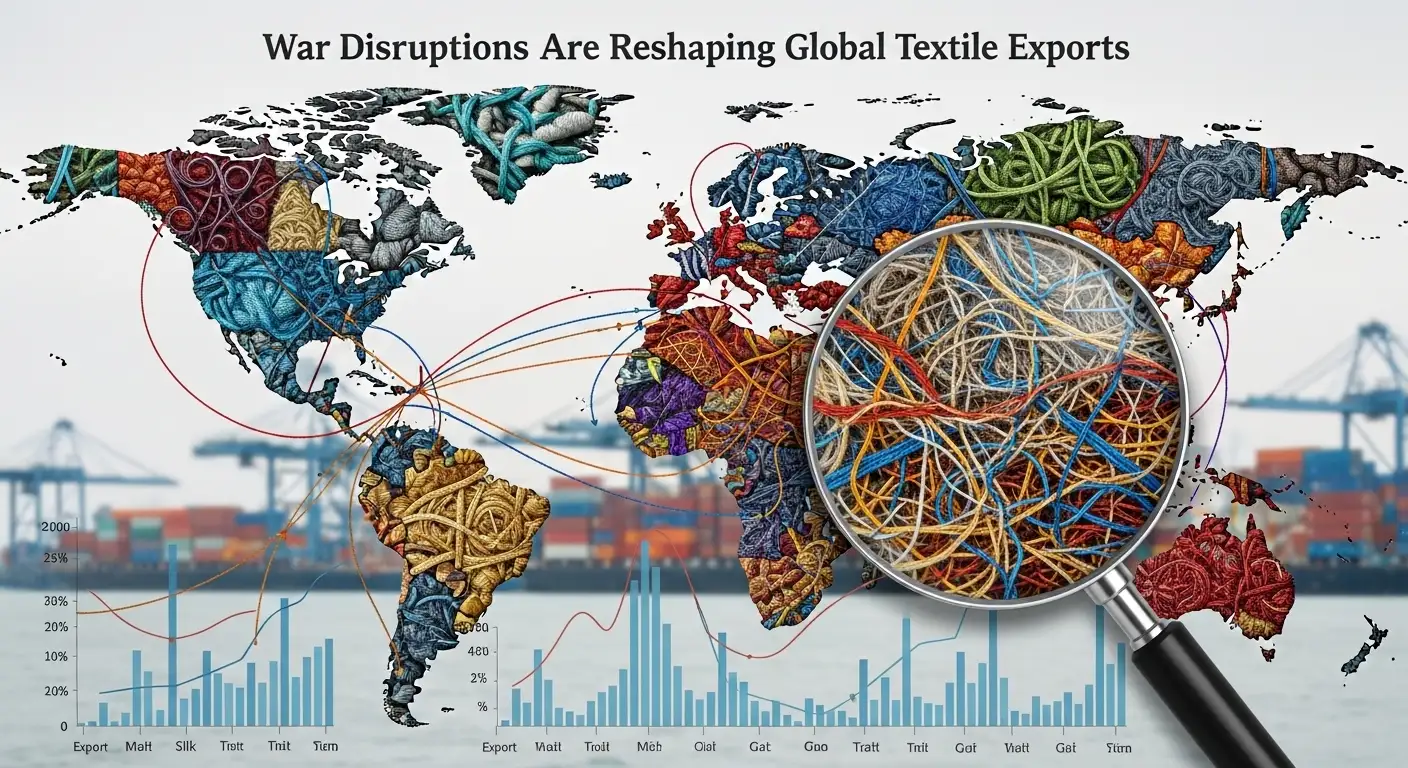
War disruptions are forcing a fundamental restructuring of global textile supply chains, pushing freight costs higher, cutting off raw material access, and accelerating the shift away from single-source manufacturing.
The effects are not limited to conflict zones. Textile exporters in Pakistan, Bangladesh, India, and China are all absorbing the pressure through rising production costs, delayed shipments, and changing buyer demands.
This article maps exactly what is happening, which regions are most exposed, and how manufacturers and buyers are responding. For sourcing intelligence specific to Pakistan, visit the Vigour Impex Market Watch.
Why Is the Global Textile Exports Industry So Vulnerable to Conflict?
The textile industry runs on long, cross-border supply chains that depend on stable trade routes, consistent raw material flows, and predictable energy costs. When any of these are disrupted, the entire chain absorbs the shock.
Cotton production is concentrated in a small number of countries. Polyester and synthetic fiber production is heavily tied to oil and gas prices. Nearly 80 percent of global textile trade moves by sea, through a handful of maritime chokepoints including the Suez Canal, the Strait of Hormuz, and the Red Sea corridor.
When conflict threatens any of these points, global textile market instability follows almost immediately. The 2024 Red Sea crisis alone pushed Asia-to-Europe freight rates up by over 200 percent within weeks, an example of how fast the damage spreads.
What Are the Major War-Driven Disruptions Hitting Textile Exports Right Now?
Five specific disruption types are currently reshaping how textile exporters operate and how buyers source. Each one compounds the others.
1. Shipping Route Instability
Conflict around the Red Sea and the Strait of Hormuz has rerouted significant volumes of Asia-Europe textile cargo around the Cape of Good Hope. This adds 10 to 14 days to transit times and significant fuel costs per voyage.
Port congestion at alternative routing hubs is creating secondary delays. Suppliers quoting standard lead times based on pre-conflict shipping schedules are routinely missing delivery windows.
2. Rising Freight and Insurance Costs
War risk insurance premiums for vessels transiting conflict-adjacent waters have increased sharply. These costs get passed through the supply chain and show up as freight cost increases that buyers did not budget for.
For textile exporters competing on thin margins, a freight cost increase of 15 to 25 percent can eliminate profitability on an entire order. This is one of the primary drivers behind the current squeeze on textile export margins.
3. Raw Material Shortages
Cotton price volatility is being driven by both climate disruption and conflict-related trade restrictions. Ukraine and Russia together supply a meaningful share of the world’s synthetic fiber inputs, including certain chemical precursors used in polyester production.
- Cotton price rise: driven by supply uncertainty in key growing regions.
- Yarn price increase: compounding downstream as raw fiber costs move up.
- Fabric cost inflation: flowing through to finished goods pricing at retail.
4. Energy Price Volatility
Textile manufacturing is energy-intensive. Dyeing, finishing, and yarn spinning all require significant electricity and thermal energy. When oil and gas prices spike due to geopolitical tensions, production cost increases follow directly.
Factories in countries dependent on imported energy, including Pakistan, are particularly exposed. Energy cost increases of 20 to 30 percent during conflict-driven oil price spikes translate directly into higher per-unit manufacturing costs.
5. Trade Sanctions and Export Restrictions
Sanctions imposed on conflict-adjacent countries can disrupt raw material sourcing and create compliance complexity for textile buyers. Some dye precursors, specialty fibers, and chemical inputs are sourced from regions now under trade restrictions, forcing manufacturers to find alternative suppliers at higher cost and longer lead times.
Rising input costs are hitting suppliers everywhere. See how Vigour Impex structures cost-stable sourcing for international buyers.
How Are Major Textile Exporting Regions Being Affected?
The impact varies significantly by region depending on geographic exposure, raw material dependency, and the strength of existing buyer relationships.
South Asia: Pakistan, India, Bangladesh
Pakistan’s textile exports, which represent over 60 percent of the country’s total export revenue, are absorbing pressure from multiple directions simultaneously. Higher energy costs, rerouted shipping adding lead time and freight costs, and rising cotton prices are all compressing margins.
At the same time, Pakistan is benefiting from the China+1 diversification trend as buyers actively reduce single-country dependency. Suppliers with strong compliance credentials and reliable delivery records are gaining new contracts.Vigour Impex home textiles and fabric sourcing are positioned to capture this demand shift.
Bangladesh faces similar freight and energy pressures, with the added complication of higher labor cost inflation reducing one of its traditional competitive advantages.
China and East Asia
China is simultaneously the world’s largest textile producer and the primary target of supply chain diversification efforts. Buyers are not exiting China entirely, but they are reducing concentration and building parallel sourcing relationships in South Asia and Southeast Asia.
The combination of trade war tariffs, geopolitical tensions, and pandemic-era supply chain lessons has permanently changed how much single-country exposure major retail buyers are willing to accept.
Turkey and Eastern Europe
Turkey is one of the clearest winners from the current disruption. Its geographic position allows rapid nearshoring for European buyers, with shorter lead times, lower freight costs, and no Red Sea routing risk. Turkish textile exporters are experiencing strong demand growth as EU buyers nearshore their sourcing.
Eastern European textile production capacity, particularly in countries like Poland and Romania, is also benefiting from the nearshoring trend despite higher labor costs compared to Asia.
How Is the Industry Shifting Toward Supply Chain Diversification?
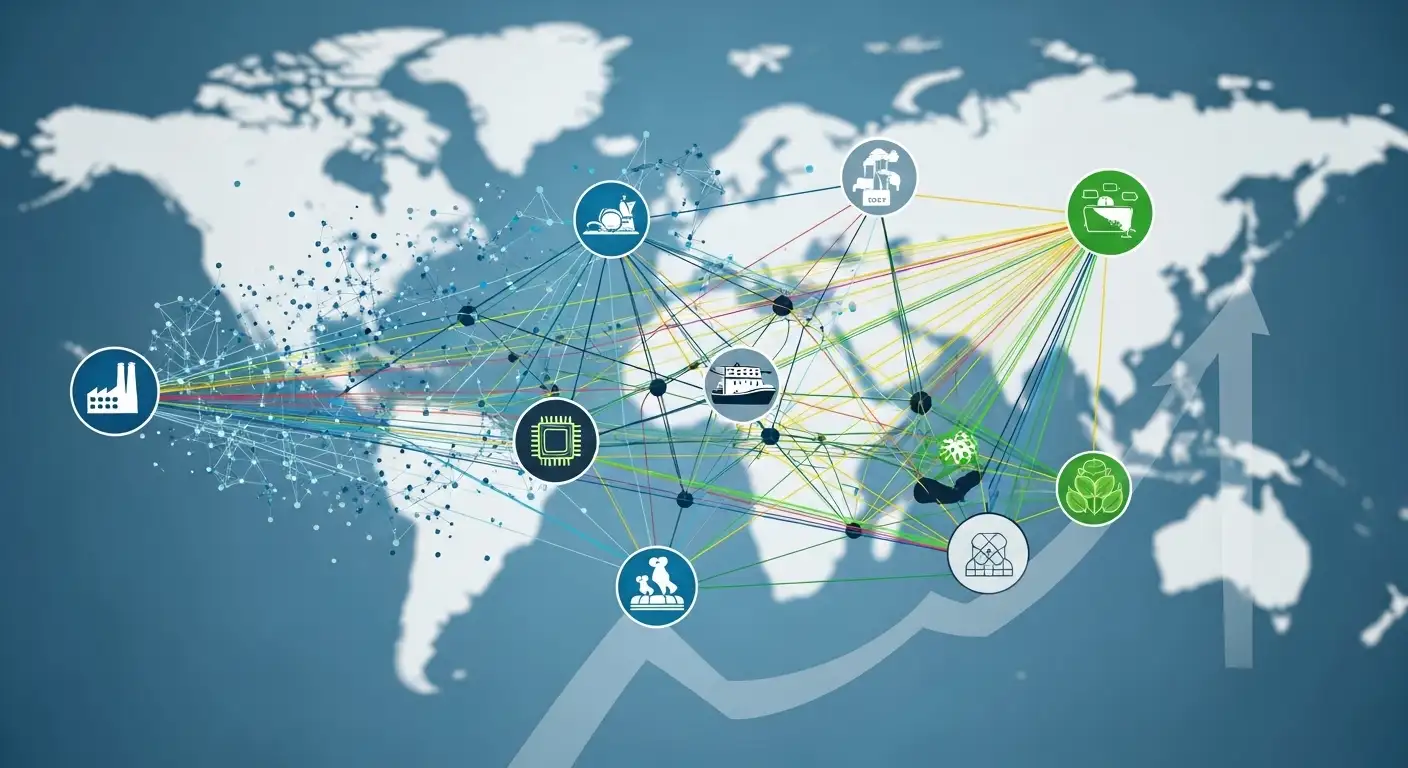
Supply chain diversification is the most significant structural response to war-driven instability. Buyers who relied on a single country or a single supplier for critical textile categories are actively building alternative sourcing relationships.
- China+1 strategy: Major retail brands are maintaining China relationships while qualifying one or more alternative suppliers in South Asia or Southeast Asia as a risk hedge.
- Nearshoring and friend-shoring: EU buyers are moving volume to Turkey, North Africa, and Eastern Europe. U.S. buyers are increasing sourcing from Mexico, Central America, and nearshore partners.
- Multi-country sourcing models: Rather than sourcing a single product from one country, buyers are splitting production across two or three countries to reduce exposure to any single point of failure.
Pakistan’s strength in yarns, fabric, and finished garments makes it a natural beneficiary of China+1 diversification for buyers targeting South Asian alternatives.
How Are U.S. and EU Retail Brands Responding to Global Textile Instability?
Retail buyers are not passive in this environment. They are actively restructuring their sourcing strategies to manage the new risk landscape.
- Smaller initial MOQs: Buyers are reducing commitment size on new supplier relationships to limit exposure while they assess reliability.
- Faster turnaround expectations: To offset longer lead times caused by shipping disruptions, buyers are pushing for earlier production start dates and tighter factory scheduling.
- Risk-adjusted sourcing contracts: Force majeure clauses, price adjustment triggers, and supply contingency requirements are becoming standard in sourcing agreements.
- Demand forecasting changes: Buyers are shortening forecast windows and ordering more frequently in smaller volumes to reduce inventory risk in an unstable market.
Vigour Impex’s end-to-end sourcing services are built around the flexibility these buyers now require, from trial orders to full production monitoring.
Is Digitalization Helping Textile Exporters Manage Supply Chain Risk?
Digital tools are becoming a practical necessity rather than a nice-to-have for textile exporters operating in a disrupted environment. Real-time visibility into production status, shipment tracking, and compliance documentation is now a buyer requirement at many major retail chains.
- Supply chain visibility platforms allow buyers to track order status from raw material procurement through to port loading without relying on manual updates from suppliers.
- Real-time shipment tracking reduces the information gap when routes are disrupted and gives buyers an earlier warning of potential delivery delays.
- Compliance and traceability documentation is increasingly required to prove fiber origin, chemical compliance, and ethical manufacturing standards across the full supply chain.
Vigour Impex provides buyers with production updates, inline inspection reports, and pre-shipment documentation throughout the order lifecycle. See our full service model.
Rising Costs vs. Competitive Advantage: Who Actually Wins?
Not every textile exporter loses in a disrupted market. The companies and countries that gain are those with stable energy access, diversified raw material sourcing, short shipping routes to key markets, and strong compliance credentials.
| Factor | Countries at Risk | Countries Gaining |
| Shipping cost | All export-dependent nations | Near-shore producers (Turkey, Mexico) |
| Raw material access | Cotton importers | Domestic cotton producers |
| Energy costs | Gas-dependent manufacturers | Renewables-powered factories |
| Buyer confidence | Conflict-adjacent regions | Stable, compliant suppliers |
| Lead time performance | Route-disrupted exporters | Multi-route capable suppliers |
Pakistan-based suppliers with verified compliance credentials, reliable delivery records, and flexible production capacity are positioned to absorb contracts displaced from higher-risk sourcing regions. Explore Vigour Impex’s sustainability credentials.
What Is the Long-Term Impact on Global Textile Trade?
The structural changes triggered by recent conflicts are not temporary. Global textile trade is being permanently reorganized around three principles: resilience over pure cost efficiency, diversification over concentration, and transparency over assumption.
Countries and suppliers that build toward these principles now will capture a disproportionate share of global textile contracts over the next decade. Those that do not adapt will find themselves progressively excluded from the preferred vendor lists of major retail buyers.
For Pakistan specifically, the opportunity is significant. The country has the production capacity, the compliance infrastructure, and the geographic position to serve as a primary alternative to China for buyers in both the U.S. and EU markets.
Looking for a stable, compliant sourcing partner as global trade shifts? Contact Vigour Impex to discuss your sourcing requirements.
FAQs
How do wars affect the global textile supply chain?
Wars disrupt textile supply chains by blocking or rerouting shipping lanes, pushing up freight and insurance costs, restricting access to raw materials, and creating trade sanctions that limit supplier options. The knock-on effect reaches manufacturers and buyers who are nowhere near the conflict zone.
Why are textile costs increasing in 2026?
Textile cost increases in 2026 are driven by a combination of higher freight rates from shipping route disruptions, rising cotton and yarn prices due to raw material supply uncertainty, energy cost increases from oil and gas price volatility, and higher compliance costs as buyers demand more documentation and certification.
Which textile-exporting countries are most affected by geopolitical tensions?
Countries with high export dependency and limited domestic raw material access face the most pressure. Pakistan, Bangladesh, and parts of Southeast Asia are absorbing significant freight and energy cost increases. Pakistan textile exports are navigating this through supplier reliability and compliance investment.
What is the China+1 strategy in textile sourcing?
China+1 is a sourcing strategy where buyers maintain their China-based supplier relationships but qualify at least one alternative supplier in another country, typically in South or Southeast Asia. The goal is to reduce single-country concentration risk without fully exiting China’s production capacity.
How are retail brands changing their sourcing due to supply chain disruption?
Retail brands are reducing initial MOQs, shortening forecast windows, adding risk adjustment clauses to sourcing contracts, and actively qualifying alternative suppliers. Vigour Impex sourcing services are structured to accommodate this new buying behavior.
Is Pakistan a good alternative to China for textile sourcing in 2026?
Yes. Pakistan is one of the most established textile manufacturing bases in the world, with strong capacity in yarns, fabric, home textiles, and garments. Its compliance infrastructure, ISO-certified suppliers, and competitive pricing make it a natural beneficiary of the China+1 diversification trend.