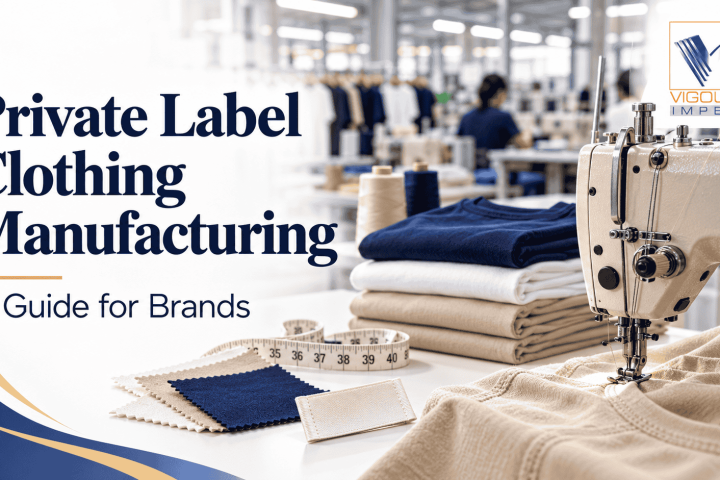

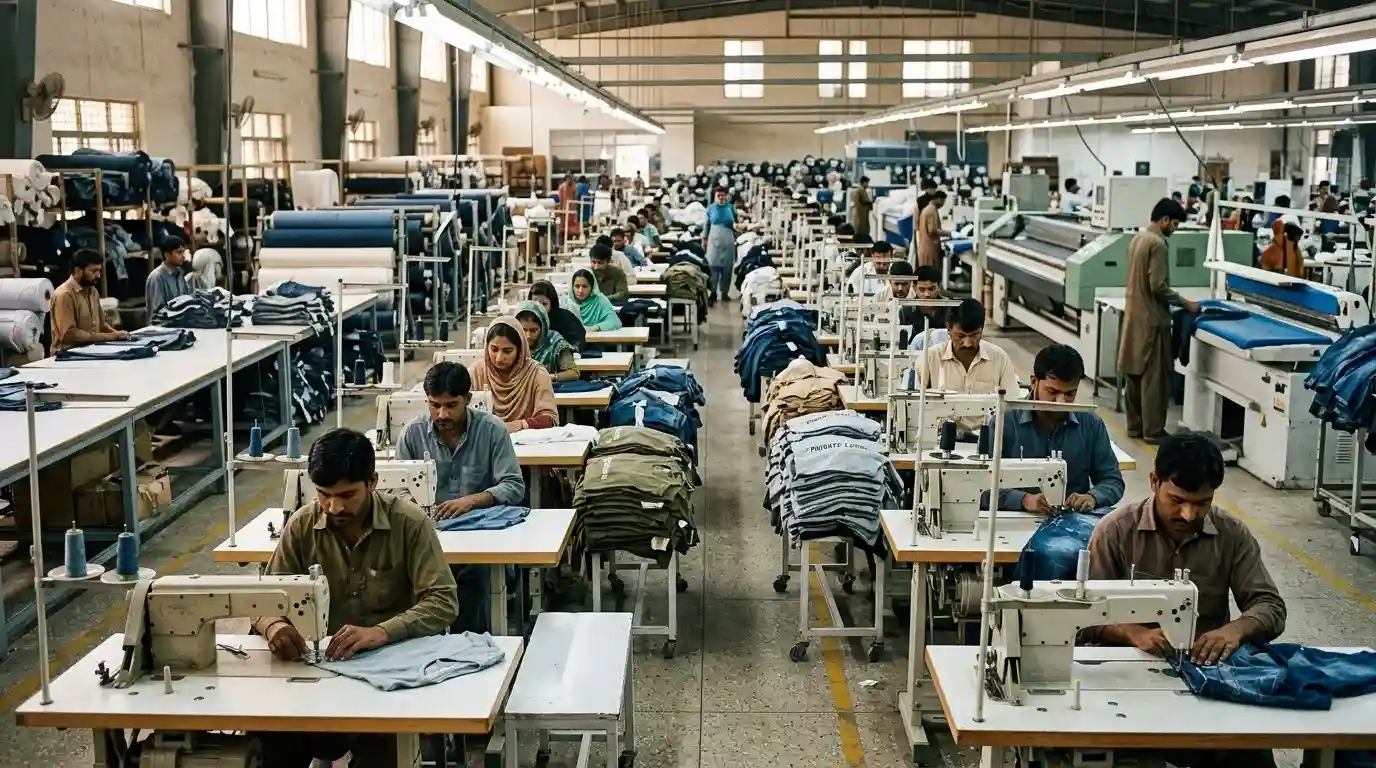
Pakistan offers OEM, private label, ODM and CMT garment manufacturing across woven, knit and denim categories. Trial MOQs start at 500 to 1,500 pieces per design. FOB Karachi pricing ranges from 2.10 USD per cotton T-shirt at scale up to 9.40 USD per denim jean. The full production cycle takes 45 to 70 days from signed PO to FOB Karachi for new buyers.
What Is OEM vs ODM vs Private Label Garment Manufacturing Pakistan?
OEM, private label, ODM and CMT describe four different production models that international apparel buyers use when sourcing from Pakistan. The right model depends on whether the brand has design capability in-house, owns the technical specifications, and wants to scale across multiple manufacturing partners. Choosing the wrong model at the brief stage forces every downstream decision into a compromise.
OEM (Original Equipment Manufacturing) means the brand provides the full technical pack and the factory produces to that exact specification. Private label means the brand applies its own label, tags and packaging to a factory’s existing product platform. ODM (Original Design Manufacturing) means the factory provides the design and the brand orders to specification. CMT (Cut, Make, Trim) means the brand supplies the fabric and trim, and the factory only stitches. Read our detailed analysis on the OEM vs ODM clothing guide for global buyers for the full decision framework.
| Model | Brand Provides | Factory Provides | Best For |
| OEM | Full tech pack, materials spec, design | Production capacity, QC, packaging | Established brands with strong design teams |
| Private Label | Brand labels, hangtags, packaging | Existing product, design, materials | Retailers and online brands without design capacity |
| ODM | Brand identity, distribution | Design, sampling, production | New brand launches, fashion startups |
| CMT | Fabric, trim, full tech pack | Cutting, sewing, finishing only | Brands controlling fabric sourcing separately |
Why Pakistan for OEM and Private Label in 2026?
Pakistan ranks among the top six global textile exporters and produces around 5 to 6 million bales of cotton annually. The combination of local raw material supply, mature export logistics and a growing base of certified manufacturers makes the country attractive for brands shifting away from China under the China-plus-one strategy. Faisalabad, Karachi, Lahore and Sialkot together support every common garment category from basics to denim to sportswear.
Buyers in 2026 benefit from three structural advantages. First, Pakistani cotton yarn pricing is among the most stable globally because raw material supply sits in-country. Second, the certified base of Pakistani manufacturers grew from roughly 280 in 2020 to over 470 in 2025, expanding shortlist options for buyers regulated by CSRD, ESPR and UFLPA. Third, the lead time from Karachi Port to major European and North American ports is competitive with regional alternatives. Read the broader context in our piece on how USA apparel brands are sourcing textiles from Pakistan in 2026.
Which Garment Categories Suit Pakistani OEM Production?
Pakistan covers seven primary garment categories at competitive scale. Each category concentrates in a specific cluster with its own production strengths.
Basic T-shirts and polos. Karachi knitwear mills dominate this category. Combed cotton 30s and 40s yarn produces premium fabric. MOQs from 1,000 pieces. FOB pricing from 2.10 USD per T-shirt at 5,000+ piece runs.
Woven shirts and blouses. Faisalabad woven mills lead this category. 100 percent cotton poplin, twill and chambray dominate. MOQs from 500 pieces. FOB from 4.20 USD per shirt at scale.
Denim jeans and jackets. Karachi denim mills handle 12 to 14 oz fabric. Sanforised and pre-washed options. MOQs from 1,000 pieces. FOB from 5.90 USD per jean.
Sportswear and activewear. Sialkot sportswear mills serve this category. Sublimated polyester and cotton blend builds. MOQs from 200 pieces for sublimation runs.
Children’s apparel. Faisalabad and Lahore mills cover this category. Tighter chemical compliance required. MOQs from 1,500 pieces.
Workwear and uniforms. Karachi and Faisalabad mills handle this category. Cotton twill and poly-cotton blends dominate. MOQs from 1,000 pieces.
Hospitality apparel and aprons. Faisalabad woven mills serve this niche. Cotton twill and canvas. MOQs from 500 pieces.
What Are the 7 Steps of Setting Up a Pakistani Private Label Run?
A private label or OEM run with a Pakistani manufacturer moves through seven defined stages. The cycle averaged 62 days from signed PO to FOB Karachi across our 2024 to 2025 production records for new-buyer engagements. Repeat buyers with standing fabric programmes compress the timeline to 38 to 50 days.
Step 1: Brief and supplier shortlist (Days 1 to 7). Brand submits the tech pack, target FOB, MOQ, certification requirements and target destination market. The buying house or in-house procurement team shortlists three to five mills against the brief.
Step 2: Quote and sample request (Days 8 to 14). Shortlisted mills return quotes inside 48 to 72 hours. Brand selects the strongest two mills and orders paid samples at 50 to 200 piece volumes.
Step 3: Sample evaluation and lab testing (Days 15 to 28). Samples tested for fabric weight, shrinkage, colour fastness and seam strength against AATCC and ISO standards. Brand selects one mill for the bulk PO.
Step 4: Pro Forma Invoice and advance payment (Days 29 to 33). PFI signed with full specification, payment terms and Incoterms. Standard 30 percent advance against PFI.
Step 5: Bulk production (Days 34 to 56). Yarn procurement, weaving or knitting, dyeing, cutting and sewing. Weekly progress photos shared with buyer.
Step 6: Quality check and pre-shipment inspection (Days 57 to 62). Internal AQL 2.5 inspection plus optional third-party pre-shipment inspection by Bureau Veritas, SGS or QIMA.
Step 7: Shipping and documentation (Days 63 to 70). Commercial invoice, packing list, certificate of origin, bill of lading. Sea freight from Karachi adds 28 to 40 days to destination port. Read our framework on textile risk management for international buyers to protect each stage.
What MOQs Should You Expect From Pakistani Manufacturers?
Minimum order quantities from Pakistani manufacturers depend on three factors: mill scale, product complexity and design count per order. Larger mills are more flexible on MOQ because they distribute setup cost across high daily output. Specialty fabrics and sublimation runs set higher per-design MOQs to justify setup. Buyers placing multi-design orders with shared fabric specifications can negotiate per-design MOQs below the mill floor by aggregating volume across the brief.
Standard MOQs in 2026 sit at 1,000 pieces per design for basic T-shirts, polos and denim. Woven shirts and aprons start at 500 pieces. Sportswear with sublimation starts at 200 pieces. Bulk price breaks unlock at 5,000 pieces and again at 15,000 pieces. Buyers below 500 pieces should use buying houses that aggregate orders across multiple brands into a single mill run. Read our piece on how to find the right garment supplier in Pakistan for the supplier matching approach.
How Much Does Private Label Production Cost at FOB Karachi?
FOB Karachi pricing for private label garment production in 2026 reflects four input variables: cotton harvest cost, energy tariffs at the mill, currency exchange rates against the US dollar, and finishing complexity. The reference prices below come from our active April 2026 price book across primary categories.
| Product | Specification | FOB Karachi (USD per piece) | Typical MOQ |
| Cotton T-shirt | 180 GSM, combed 30s, plain dyed | 2.10 to 3.40 | 1,000 pieces |
| Cotton polo | 220 GSM pique, combed 30s, embroidered | 3.40 to 5.20 | 500 pieces |
| Woven shirt | 100% cotton poplin, 110 GSM | 4.20 to 6.40 | 500 pieces |
| Denim jean | 12.5 oz right-hand twill, sanforised | 5.90 to 9.40 | 1,000 pieces |
| Sublimated sportswear T-shirt | Polyester interlock, full sublimation | 5.50 to 8.40 | 200 pieces |
| Cotton twill workwear shirt | 250 GSM, double-stitched | 4.80 to 7.20 | 1,000 pieces |
| Cotton canvas apron | 300 GSM, brass eyelet hardware | 3.20 to 5.40 | 500 pieces |
| GOTS organic cotton T-shirt | 180 GSM, certified organic | 3.10 to 4.60 | 1,000 pieces |
Smaller trial orders at the 200 to 1,000 piece MOQ band sit at the upper end of these ranges. Larger orders from 10,000 pieces and above can negotiate 6 to 11 percent below the FOB midpoint. Bulk orders above 50,000 pieces unlock vertically integrated pricing with the largest Karachi and Faisalabad mills. Air freight adds approximately 4 USD per kilogram. Sea freight adds roughly 0.30 to 0.80 USD per piece depending on destination port and CBM efficiency.
Which Certifications Should Your Manufacturing Partner Hold?

Compliance certifications drive shortlist eligibility for international apparel buyers in 2026. European buyers regulated by CSRD and ESPR cannot ship from undocumented suppliers. American buyers subject to UFLPA enforcement require cotton traceability documentation. The certification stack below covers the minimum expected at international procurement scale across woven, knit and denim categories.
WRAP for production audit. Worldwide Responsible Accredited Production standard covers labour standards, ethics, workplace safety and environmental compliance specifically for apparel manufacturing. Most US brand procurement teams require WRAP certification at Gold or Platinum level. Verify supplier certificates on the WRAP official site.
OEKO-TEX Standard 100. Confirms finished garments contain no harmful chemicals above published limits. Covers azo dyes, heavy metals, formaldehyde and chlorinated phenols.
BSCI and Sedex SMETA. Social audits covering working conditions, wages, hours, health and safety, and environmental management. Verify amfori BSCI certifications on the amfori official platform.
BCI Better Cotton Initiative. Tracks cotton fibre from farm to finished product. Required by European retailers committed to verified sourcing.
GOTS for organic cotton. Covers organic fibre content, chemical inputs and social criteria. Buyers selling certified organic ranges must source from GOTS certified mills.
How Long Does the Full Production Cycle Take?
The full cycle from PO signature to landed delivery typically runs 73 to 115 days for new buyers depending on destination port and product category. Repeat buyers with cleared sample approvals and standing fabric programmes compress to 55 to 85 days. Production averages 45 to 65 days. Sea freight adds 28 to 40 days. Air freight reduces transit to 5 to 7 days at significantly higher cost.
Buyers planning seasonal launches should book PO signature 100 to 130 days ahead of shelf delivery for sea freight orders and 60 to 75 days ahead for air freight orders. Holiday and end-of-quarter rushes can extend the production timeline by 7 to 14 days because Pakistani factories operate at capacity through peak ordering windows in March, June and October. Buyers placing orders during these windows should add buffer to the timeline rather than assuming standard lead times.
How Should You Vet a Pakistani OEM Manufacturer?
Vetting a Pakistani OEM manufacturer protects orders worth tens to hundreds of thousands of dollars and prevents the most common buyer disputes. The same six steps apply whether buyers approach mills directly or work through a buying house.
Step 1: Verify trade body membership. Confirm membership of the All Pakistan Textile Mills Association, the Pakistan Readymade Garments Manufacturers and Exporters Association, or the Pakistan Hosiery Manufacturers Association.
Step 2: Cross-check tax and trade registration. Every legitimate exporter holds a National Tax Number and Sales Tax Registration Number. Both verify on the Federal Board of Revenue portal.
Step 3: Request current compliance certificates. WRAP, OEKO-TEX Standard 100, BSCI or SMETA audit grade, BCI scope certificate. Verify each on the issuing body’s register.
Step 4: Audit production capacity. Request monthly production calendar and three current client references in your region. Mill capacity sets achievable lead times.
Step 5: Order paid pre-production sample. 100 to 300 piece sample shows real production quality. Test fabric weight, shrinkage, colour fastness and seam strength.
Step 6: Lock pre-shipment inspection. Every PO reserves buyer rights to a pre-shipment inspection at 300 to 450 USD per inspection day from Bureau Veritas, SGS or QIMA.
What Mistakes Should First-Time Buyers Avoid?
Most international buyers placing first or second OEM orders with Pakistani manufacturers make at least one of five mistakes. Each is avoidable with a 15-minute procurement audit.
Trusting WhatsApp quotes. Always confirm specifications in a signed Pro Forma Invoice with line-item detail on fabric, GSM, dimensions, trim, AQL grade and packaging.
Specifying GSM without yarn count and weave. A 180 GSM cotton T-shirt in carded blend yarn underperforms a 160 GSM combed cotton T-shirt. Always specify yarn quality alongside weight.
Skipping the paid sample. Free samples come from the best lot. Paid samples reflect production reality. The 350 USD sample fee protects a 40,000 USD bulk order.
Ignoring chemical compliance for destination markets. EU-bound shipments must satisfy REACH limits. US-bound shipments must clear UFLPA cotton origin documentation.
Skipping pre-shipment inspection. A 350 USD inspection fee on a 50,000 USD order is the cheapest insurance any buyer pays. The report protects both sides in any subsequent quality dispute.
The most expensive mistake on the list is the chemical compliance one. Buyers who skip REACH or UFLPA documentation face shipment seizure at the destination port, with re-export or destruction costs that exceed the original order value. Read our deeper guidance on building a transparent textile supply chain.
Why Buyers Work with Vigour Impex
Vigour Impex has operated as a Pakistan sourcing house for 30 years across yarn, fabric, home textiles and apparel categories. Our 94 staff team across offices in Pakistan, Europe and the UAE handles roughly 220 million USD in annual procurement volume. We managed OEM and private label production runs for 47 international apparel and home textile brands in 2025 with documented WRAP, OEKO-TEX and BCI compliance across every shipment.
Apparel buyers exploring Pakistan as a private label or OEM origin can review our complete service overview on the Vigour Impex services page and open a brief through the standard sourcing intake.
Frequently Asked Questions
What is the difference between OEM and private label garment manufacturing?
OEM means the brand provides the full technical pack and the factory produces to exact specification. Private label means the brand applies its own label, tags and packaging to a factory’s existing product platform. OEM offers more control over design and materials. Private label offers faster speed to market with lower upfront cost.
What is the minimum order quantity for private label apparel from Pakistan?
Trial MOQs for private label apparel from Pakistan range between 500 and 1,500 pieces per design. Basic T-shirts and polos start at 1,000 pieces. Woven shirts and aprons start at 500 pieces. Sportswear with sublimation starts at 200 pieces. Bulk savings unlock from 5,000 pieces upward.
How much does private label garment production cost at FOB Karachi?
FOB Karachi pricing in 2026 ranges from 2.10 USD per cotton T-shirt at scale to 9.40 USD per denim jean. Polos sit at 3.40 to 5.20 USD. Woven shirts at 4.20 to 6.40 USD. Sublimated sportswear T-shirts at 5.50 to 8.40 USD. GOTS organic ranges add 12 to 18 percent over conventional cotton.
How long does the full production cycle take from Pakistan?
The full cycle runs 73 to 115 days for new buyers depending on destination port. Repeat buyers compress to 55 to 85 days. Production averages 45 to 65 days. Sea freight adds 28 to 40 days. Air freight reduces transit to 5 to 7 days at higher cost.
What certifications should the manufacturer hold?
WRAP certification at Gold or Platinum level for production audit, OEKO-TEX Standard 100 for chemical safety, amfori BSCI or Sedex SMETA for social compliance, BCI for cotton sourcing, and GOTS for organic cotton ranges. US-bound shipments also require cotton origin documentation to meet UFLPA.
Do I need to provide a tech pack for OEM production?
Yes for OEM production. The tech pack must include fabric specification, GSM, yarn count, weave, dimensions per size, trim details, label placement, packaging and AQL grade. Private label production can proceed without a full tech pack because the factory provides the existing product platform.
How are payment terms structured?
Standard payment terms run 30 percent advance against Pro Forma Invoice and 70 percent on copy of bill of lading. Letters of Credit are accepted for orders above 25,000 USD. Trade Assurance and escrow services suit first orders below 25,000 USD. Avoid suppliers who require 100 percent in advance.
Final Thoughts
Pakistan offers one of the strongest OEM and private label garment manufacturing origins for international buyers in 2026. The country combines deep cotton supply, vertically integrated mills, mature export logistics and a growing certified manufacturer base. Choose the right production model for your brand maturity. Match the category to the right cluster. Demand documentation. Never skip the paid sample. Lock pre-shipment inspection into every PO. Buyers who follow this discipline build supply chains that last for years.
Ready to start a private label or OEM sourcing conversation? Explore the full Vigour Impex services overview for vetted mill shortlists, AQL audited shipments and documented compliance across every production run.